

Discover the Best High-Frequency Trading Workstations in Canada for 2026
The workstations sold as "high-frequency trading" machines are not the hardware that actually executes high-frequency trades. Real HFT execution lives on rack servers colocated in or beside the exchange's own data centre, where the round trip is measured in microseconds and the hardware is chosen accordingly: kernel-bypass network cards, FPGA boards that assemble order packets without ever touching the operating system, and PTP or GPS-disciplined clocks for timestamping. None of that comes in a desktop tower, and no tower specification closes a latency gap that is really a distance problem. What a trading desk in Canada does buy a workstation for is everything wrapped around execution — strategy research, backtesting across years of tick data, Monte Carlo and risk simulation, market-data capture, and multi-monitor order entry and monitoring. That is real work, it is genuinely hardware-bound, and it is the job the five machines below are ranked for. The things that matter for it are memory capacity and ECC integrity, core count for parallel backtests, single-thread clock for sequential strategy logic, PCIe lanes for capture cards and fast storage, and a machine that will run for weeks without a reboot. Several of the listings here are renewed enterprise workstations rather than new retail units, which is what makes this class of hardware reachable at a desk budget — and what makes warranty and support terms worth checking first.
Inception's AI took the time to understand this market in Canada · · How we pickWe may earn a commission on purchases. It never affects our rankings.
Top Picks Summary
HP Z8 G4 Workstation
The HP Z8 G4 Workstation is designed for professionals requiring extreme performance and reliability. With support for dual Intel Xeon processors and the ability to handle up to 3TB of RAM, it excels in resource-heavy applications. Its innovative thermal design ensures efficient performance even under heavy workloads. Moreover, a vast range of configuration options allows users to tailor it specifically to their needs, making it a top choice in the workstation category.

Estimated$4,000 – $6,000
Dell Precision 7920 Tower
The Dell Precision 7920 Tower is a dual-socket Intel Xeon Scalable workstation: two processors of up to 28 cores each, and 24 DIMM slots that accept up to 3TB of DDR4 ECC memory. The configuration linked here is a renewed unit built around 2x Xeon Gold 6130 with 192GB of RAM, two 1TB SSDs plus two 4TB hard drives, and a Quadro P1000 — generous memory and storage for market-data capture and parallel backtests, paired with a modest entry-level professional GPU. Per-core clock speeds on this platform sit below a modern single-socket desktop, so sequential strategy logic will not feel faster here; the case for the 7920 is capacity, expansion and ECC integrity for long unattended runs.

Estimated$3,500 – $5,500
Lenovo ThinkStation P920
The Lenovo ThinkStation P920 combines cutting-edge technology with exceptional build quality, making it a favorite among professionals in creative fields. With dual Intel Xeon processors and an optional NVIDIA RTX graphics card, it handles intense graphics rendering and simulation tasks seamlessly. Its thoughtful design includes tool-less access for easy upgrades and repairs, enhancing user experience. Additionally, its ISV certifications ensure compatibility with major software applications in the market.

Estimated$3,000 – $5,000
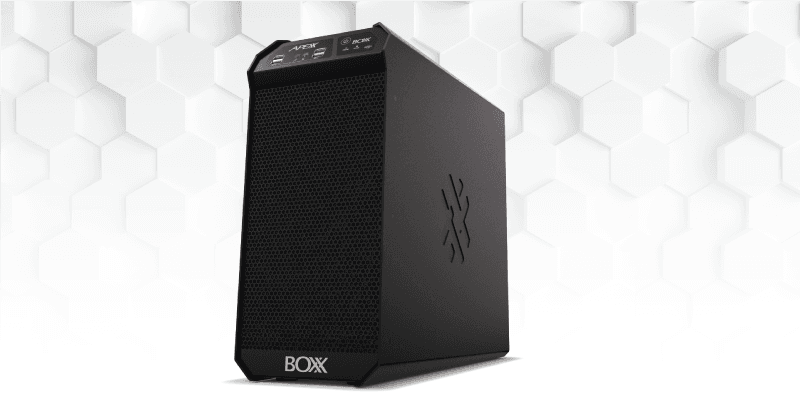
BOXX APEXX S3 Workstation
The BOXX APEXX S3 Workstation is tailored for those in the creative industries who demand uncompromised performance. Its unique design integrates powerful Intel processors with fast, efficient cooling. It stands out with its ultra-quiet operation, allowing users to focus on their work without distractions. Additionally, BOXX provides customized solutions to meet specific project needs, making it a top competitor in the high-performance workstation arena.
Origin PC Genesis
The Origin PC Genesis is a high-performance gaming and workstation solution that excels in both processing power and graphic capabilities. Customizable to the user's specific needs, it features high-quality components that cater to demanding tasks, from gaming to content creation. Its stunning aesthetics, combined with a solid build quality, make it not just a functional workstation but a visually appealing one as well. Origin PC also offers exceptional customer service and support for a complete package.

The top high-frequency trading workstations deliver incredible processing speed, outstanding graphics performance, and efficient memory management. Built for reliability, these systems are designed to support the fast-paced requirements of trading algorithms and data analysis, ensuring you stay ahead in the market.
Understanding High-Frequency Trading Workstations
Before comparing towers, it helps to separate the work a desktop can do from the work it structurally cannot:
Genuine high-frequency execution is colocated: firms rent rack space in the exchange's data centre because the advantage is measured in metres of fibre, which no desktop specification can overcome.
Latency-critical order paths use kernel-bypass networking or FPGA cards that build packets in hardware, bypassing the operating system entirely — server components, not desktop-tower parts.
Trading networks take their time from PTP (IEEE 1588) or GPS-disciplined clocks, because timestamp accuracy expectations are far tighter than a motherboard clock can hold.
What a desktop workstation is genuinely good for is the research half of the job: backtesting, Monte Carlo and risk simulation, market-data capture, and running large in-memory datasets.
Core count drives parallel backtests, but single-thread clock speed drives sequential strategy logic and spreadsheet-bound models — the two pull in opposite directions, so pick for the workload you actually run.
ECC memory and ISV-certified professional GPUs are what separate these machines from gaming towers: the goal is uninterrupted multi-week uptime and no silent memory errors in a risk model.
Much of this hardware reaches Canadian buyers renewed or refurbished through third-party sellers, so confirm the warranty term and who honours it before ordering.
Frequently Asked Questions
Which workstation should I buy for heavy HFT workloads?
Choose the HP Z8 G4 Workstation for resource-heavy HFT needs: it supports dual Intel Xeon processors, up to 3TB of RAM, and up to 3 NVIDIA GPUs, with an average rating of 4.8.
Does the HP Z8 G4 support 3TB RAM and triple GPUs?
Yes—the HP Z8 G4 Workstation supports up to 3TB of RAM and up to 3 NVIDIA GPUs, and it’s ISV-certified for professional applications; it has an average rating of 4.8.
What makes the Dell Precision 7920 Tower a strong HFT pick?
The Dell Precision 7920 Tower is a dual-socket Intel Xeon Scalable workstation—up to 28 cores per socket, so up to 56 cores and 112 threads—with 24 DIMM slots holding up to 3TB of DDR4 ECC memory, which is what lets it hold large tick-data sets in memory while running parallel backtests. The unit linked here is a renewed configuration with 2x Xeon Gold 6130; it has an average rating of 4.4.
What warranty comes with the Lenovo ThinkStation P920?
The listing for the Lenovo ThinkStation P920 on this page does not state a warranty term, and the unit is sold renewed rather than new, so confirm coverage and who honours it with the seller before ordering. What is listed: a $4,410 CAD price and an average rating of 4.5.
Conclusion
In summary, the five machines above — HP Z8 G4 Workstation, Dell Precision 7920 Tower, Lenovo ThinkStation P920, BOXX APEXX S3 Workstation and Origin PC Genesis — are strong research and risk-desk workstations, not execution hardware. The HP Z8 G4 leads on sheer headroom, with dual Xeon sockets, up to 3TB of ECC memory and room for three professional GPUs, which is what you want if your backtests are memory-bound. The BOXX APEXX S3 goes the other way, trading capacity for single-thread clock speed in a quiet, compact chassis. If your goal is genuinely low-latency execution rather than research, the money belongs in colocation and network hardware, not in a bigger tower. If you wish to refine or expand your search, feel free to use the search tool provided to explore additional products.