

Top 7 Warehouse Automated Guided Vehicles in Canada for 2026
Warehouse Automated Guided Vehicles (AGVs) are autonomous mobile robots engineered to automate material movement, inventory handling, and repetitive logistics tasks inside storage facilities. In Canada, AGVs are increasingly adopted across e-commerce hubs, distribution centers, and manufacturing supply chains to improve throughput, reduce labor dependency, and increase workplace safety. Canadian buyers value AGVs for reliable navigation in mixed-floor environments, compatibility with warehouse management systems (WMS), scalable fleet operation, and clear return-on-investment (ROI) metrics. Key benefits that drive preference include consistent cycle times, reduced picking and transport errors, optimized space utilization, and built-in safety systems that lower accident risk. For companies facing seasonal peaks, rising labor costs, or complex inventory flows, AGVs offer predictable performance and faster adaptation to changing demand patterns while helping meet sustainability and efficiency targets.
Inception's AI took the time to understand this market in Canada · · How we pickWe may earn a commission on purchases. It never affects our rankings.
Top Picks Summary
OTTO Motors OTTO 1500
The OTTO 1500 is a heavy-duty warehouse AMR prized for its industrial-grade towing and pallet transport capacity, delivering enterprise-class safety and fleet management for continuous, high-throughput operations. Compared with the other systems on this list, it stands out technically for payload and ruggedness and financially by lowering forklift dependence and reducing the number of vehicles required to meet throughput targets, which drives predictable lifecycle costs.

Estimated$150,000 – $250,000
MiR600 by Mobile Industrial Robots
The MiR600 by Mobile Industrial Robots is an innovative self-driving robot designed for the efficient transport of goods in complex environments. Its ability to navigate autonomously without the need for external infrastructure allows it to operate seamlessly alongside human workers. The MiR600’s enhanced load capacity and advanced safety features make it an exceptional choice for companies looking to improve workflow and productivity. With continuous updates and robust support, it stands out as a leader in the automated robotics sector.

Locus Robotics Origin
The Locus Origin is a picking-focused AMR engineered for dense, multi-robot deployments that significantly raise picks-per-hour while requiring minimal facility changes. Its cloud-native orchestration and fast ROI make it financially attractive against lift- and pallet-focused AMRs like Seegrid or OTTO, because it maximizes labor productivity and scales incrementally with demand.

Estimated$30,000 – $70,000
Seegrid Palion Lift AMR
The Seegrid Palion Lift AMR pairs vision-guided navigation with an integrated lift module to autonomously handle pallets and cases in mixed-traffic aisles, positioning it as a practical forklift alternative. Versus competitors, it offers strong industrial reliability and reduced operator training costs, enabling operators to replace manual lift trucks and realize operational savings in high-duty environments.
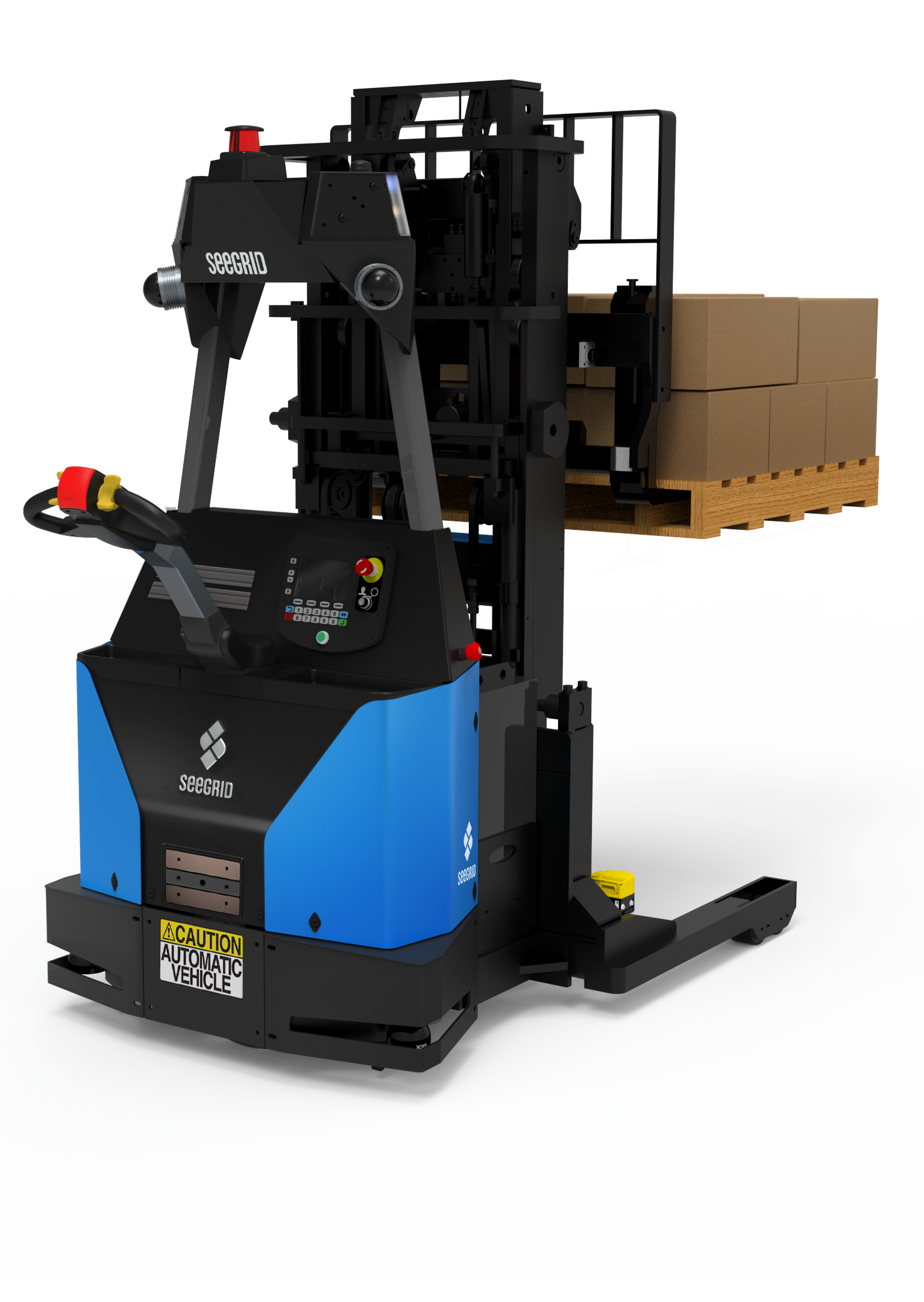
Estimated$120,000 – $220,000
6 River Systems Chuck
Chuck from 6 River Systems is a collaborative 'bring-to-person' mobile robot optimized for putaway and order-fulfillment workflows, emphasizing rapid deployment and simple operator interaction. Its lower implementation cost and tight software integration make it an economical choice for retailers and third-party logistics providers that want quick throughput improvements without the capital outlay of heavy-duty AMRs.

Estimated$25,000 – $45,000
Geek+ M1000R
The Geek+ M1000R is a high-capacity robotic forklift and pallet mover that combines fast travel with precise stacking for pallet-centric e-commerce and distribution operations. Financially competitive on a per-pallet basis, its modular design and speed-driven throughput offer a scalable, lower-footprint alternative to larger industrial platforms like OTTO for centers prioritizing pallet flow and density.

We may earn a commission on purchases. It never affects our rankings.
Estimated$70,000 – $140,000
AutoGuide Mobile Robots MAX-N10
The AutoGuide MAX-N10 is a compact, modular AMR designed for narrow-aisle tugging and medium-payload tasks, delivering dependable navigation and flexible payload mounts for mixed workflows. Positioned as a cost-effective alternative to larger fleets, its emphasis on low total cost of ownership and straightforward integration provides medium-sized warehouses a faster payback compared with higher-capacity leaders.

Estimated$80,000 – $160,000
Research and Evidence: Why AGVs Work
A mix of industry reports, academic research, and vendor case studies supports the performance and economic benefits of warehouse AGVs. Studies and deployments frequently highlight improvements in throughput, picking accuracy, safety, and lifecycle cost compared with fully manual operations. Research also examines human-robot collaboration, showing that guided automation paired with optimized workflows can increase productivity while preserving jobs that require human judgment. For beginners, the evidence indicates that AGVs are not a one-size-fits-all solution but provide measurable gains when selected and integrated to match facility layout, SKU mix, and operational peaks.
Throughput gains: Industry case studies commonly report throughput increases of 20 to 40 percent after AGV fleet deployment when workflows are rebalanced around automation.
Accuracy and errors: Automated transport and pick-assist systems reduce mispicks and inventory discrepancies by improving route consistency and integration with WMS software.
Safety improvements: Research on workplace automation links mobile robotics to lower rates of material-handling injuries by removing repetitive lifting and collision risk through sensors and safe navigation.
Return on investment: Lifecycle and total-cost-of-ownership analyses from vendors and third-party reports show payback periods typically ranging from 12 to 36 months, depending on labor rates, utilization, and scale.
Energy and space efficiency: Simulation and real-world studies indicate that AGVs can increase usable floor space and reduce energy per move through optimized routing and electric powertrains.
Frequently Asked Questions
Which AGV should I choose for high-throughput towing?
Choose OTTO Motors OTTO 1500 if you need high-payload towing and pallet transport across warehouse floors; it’s designed for industrial-grade towing/transport and has a 4.7 average rating.
Does MiR600 support navigation without external infrastructure?
Yes—MiR600 by Mobile Industrial Robots is designed to navigate autonomously without the need for external infrastructure, with flexible route planning and mapping, and it has a 4.9 average rating.
What does Locus Robotics Origin cost and include?
The provided data doesn’t include any price for Locus Robotics Origin, so I can’t compare value by cost; it does list a 4.6 average rating and cloud-based orchestration for pick-and-pack workflows.
Is Locus Origin a good fit for pick-and-pack operations?
Yes—Locus Robotics Origin is specifically built for pick-and-pack workflows to increase picker productivity, with autonomous navigation that dynamically pathes around workers and changing layouts, and it has a 4.6 average rating.
Conclusion
In Canada, Warehouse Automated Guided Vehicles are a practical, proven way to modernize logistics and inventory management. The top solutions featured here — OTTO Motors OTTO 1500, MiR600 by Mobile Industrial Robots, Locus Robotics Origin, Seegrid Palion Lift AMR, 6 River Systems Chuck, Geek+ M1000R, and AutoGuide Mobile Robots MAX-N10 — cover a wide range of payloads, navigation styles, and integration needs. For most Canadian warehouses looking for balanced performance, flexibility, and local support, the MiR600 by Mobile Industrial Robots stands out as the best overall choice on this list, while the OTTO Motors OTTO 1500 and Seegrid Palion Lift AMR are strong picks for heavy-duty and lift-capable workflows. We hope you found the comparison helpful. You can refine or expand your search by using the search box to filter by payload, navigation type, integration features, or vendor support in Canada.