

Top 5 Bluetooth Pulse Oximeters in Canada, 2026
A Bluetooth pulse oximeter clips to your finger (or wraps around it as a ring), reads blood oxygen saturation and pulse rate, and pushes the numbers to a phone app so you can see a trend instead of a single number. That trend is the whole point — an overnight recording of oxygen dips tells you far more than a five-second spot check. Two things matter before you spend anything. First, regulation: in Canada a pulse oximeter sold with health claims is a licensed medical device, and the licence class depends on what it does — spot-check devices sit in Class II, continuous-monitoring devices in Class III. Second, accuracy: consumer oximeters are typically specified at about ±2% (Arms) between 70% and 100% saturation, are unvalidated below 70%, and read less reliably on darker skin. The five below are grouped by what they're actually good at.
Inception's AI took the time to understand this market in Canada · We may earn a commission on purchases. It never affects our rankings.
Top Picks Summary
Wellue O2Ring Oxygen Monitor
The Wellue O2Ring Oxygen Monitor stands out for its innovative design and comfort, allowing users to monitor their oxygen saturation levels during sleep. With its lightweight and ergonomic features, this device can easily be worn throughout the night without discomfort. It provides real-time data and has a long battery life, making it reliable for prolonged use. Additionally, it's equipped with advanced algorithms to ensure accurate readings, making it a top choice among health-conscious individuals.

Where to buy Wellue O2Ring Oxygen Monitor in Canada: the trusted retailers we track in this market, with the best price we have observed at each. Prices are checked regularly and can change, and the retailer confirms the final price at checkout.
We may earn a commission on purchases. It never affects our rankings.
$152.90CAD
Innovo Deluxe iP900AP Fingertip Pulse Oximeter
A conventional fingertip spot-check oximeter that punches above its price on instrumentation: alongside SpO2 and pulse rate it displays a plethysmograph waveform and a perfusion index, which together let you judge whether the reading is well-perfused and stable rather than guessing. The dual-colour OLED rotates through six display modes with adjustable brightness, it runs about 30 hours on the two included AAA cells, and it shuts itself off after roughly ten seconds without a signal. Its listing does not advertise Bluetooth or app sync, so treat it as the value option for quick manual checks rather than a connected tracker.

Where to buy Innovo Deluxe iP900AP Fingertip Pulse Oximeter in Canada: the trusted retailers we track in this market, with the best price we have observed at each. Prices are checked regularly and can change, and the retailer confirms the final price at checkout.
We may earn a commission on purchases. It never affects our rankings.
$98.12CAD
Masimo MightySat
The MightySat brings Masimo's hospital signal-processing lineage into a fingertip form factor. Its Signal Extraction Technology is built to hold a reading through movement and poor perfusion, the two conditions that make budget oximeters drop out or return implausible numbers, and it reports respiration rate, perfusion index and PVi alongside SpO2 and pulse rate on a rotating colour touchscreen with Bluetooth LE sync. Accuracy is specified at ±2% between 70 and 100% saturation — the same band as far cheaper devices, since that is what the standard requires — so what you are paying for is reliability of the reading in difficult conditions, not a tighter number. Confirm the licensing status of the specific variant before purchase, as some MightySat models are sold as prescription devices.
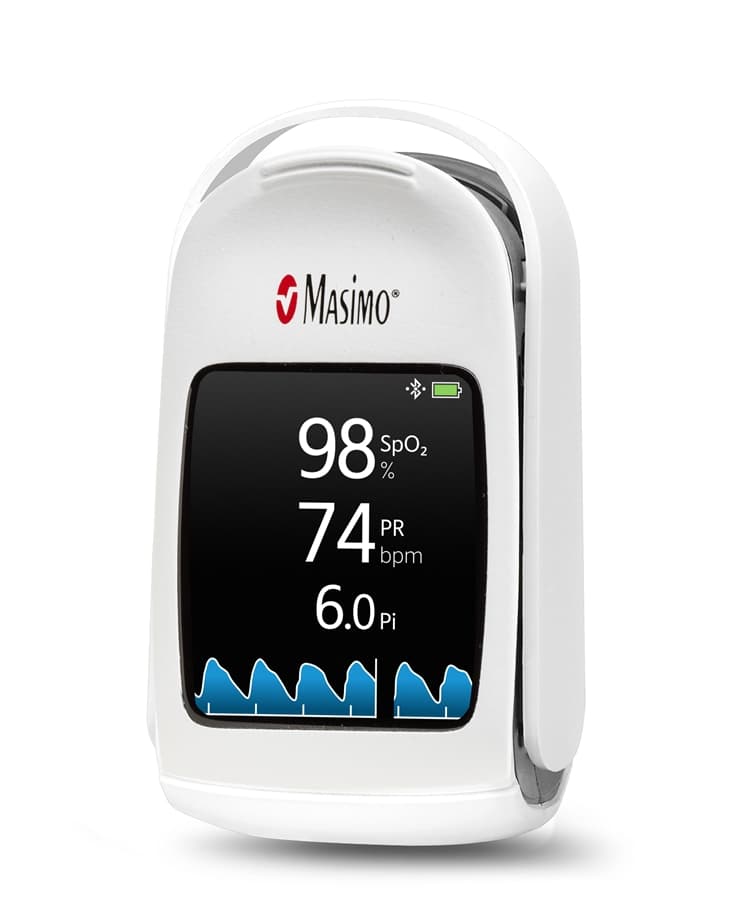
Where to buy Masimo MightySat in Canada: the trusted retailers we track in this market, with the best price we have observed at each. Prices are checked regularly and can change, and the retailer confirms the final price at checkout.
We may earn a commission on purchases. It never affects our rankings.
Estimated price$300 – $350
Santamedical Generation 2 OLED Fingertip Pulse Oximeter
A conventional fingertip spot-check oximeter with a bright OLED readout, sized for home use and travel. It measures SpO2 across a 70–99% range at a stated ±2% accuracy and pulse rate from 30 to 250 bpm, runs on two AAA cells, and shuts off automatically when you remove your finger. It is a spot-check device — you read the number off the screen — so it suits quick manual checks rather than the overnight trend tracking the connected models on this page are built for.

Beurer PO 60 Bluetooth Pulse Oximeter
The Beurer PO 60 Bluetooth Pulse Oximeter is distinguished by its ergonomic design and modern Bluetooth technology, allowing for effortless connection to your smartphone. This device not only measures blood oxygen levels accurately but also tracks pulse rates, providing a comprehensive insight into your health. Users appreciate its large, easy-to-read display and user-friendly app, which facilitates seamless data management and sharing. It caters to those who prioritize technology and simplicity in their health monitoring.
App sync is what separates these from a drugstore clip — it turns isolated readings into an overnight trend you can actually act on.
Understanding Bluetooth Pulse Oximeters
A Bluetooth oximeter shines red and infrared light through your fingertip and infers oxygen saturation from how much of each colour the blood absorbs. It is an estimate, not a blood test — which is why the caveats below matter as much as the feature list.
Licensing in Canada: a pulse oximeter marketed with health claims needs a Health Canada medical device licence — Class II for single spot measurements, Class III for continuous monitoring — and the importer or distributor needs a medical device establishment licence. Devices sold purely as sports, aviation or wellness gear are sold without one and are explicitly not for medical use. Look for the licence, not the phrase 'medical-grade'.
Skin pigmentation is the biggest known accuracy problem: oximeters tend to overestimate oxygen saturation on darker skin, which can hide genuinely low oxygen — occult hypoxaemia. A 2020 New England Journal of Medicine analysis by Sjoding and colleagues found roughly three times the rate of missed hypoxaemia in Black patients compared with White patients, and the FDA followed with a safety communication and, in January 2025, draft guidance asking manufacturers to validate across a range of skin tones. A 2024–25 bench comparison of 11 popular fingertip units found nine performed worse in the darkest pigmentation group.
What corrupts a reading: nail polish and artificial nails, cold hands or poor perfusion, movement during the measurement, and bright ambient light. Carbon monoxide poisoning is the dangerous one — carboxyhaemoglobin reads as oxygenated, so the device shows a falsely high, reassuring number.
Read the accuracy spec properly: most consumer units state ±2% Arms over 70–100% SpO2. That is a root-mean-square error across a test population, not a guarantee for your individual reading, and nothing below 70% is validated at all. Treat any '±1%' claim as unsupported.
Bluetooth earns its keep overnight: a spot check catches nothing while you sleep. Ring-style and wrist-tethered continuous recorders log hours of data and flag desaturation events, which is the one use case where app sync genuinely changes what you learn.
Portability and battery: spot-check fingertip units run on two AAA cells for roughly 30 hours of use; continuous recorders are rechargeable and need a nightly top-up.
None of these devices diagnose anything. A consumer oximeter cannot confirm or rule out sleep apnoea, COVID-19 or respiratory failure — if your readings worry you, that is a reason to call a clinician, not to self-diagnose from an app chart.
Frequently Asked Questions
Which Bluetooth pulse oximeter is best for sleep tracking?
The Wellue O2Ring Oxygen Monitor, rated 4.4 here. It is a ring rather than a fingertip clip, so it stays on comfortably all night and records oxygen saturation continuously instead of taking a single reading. Note that continuous-monitoring oximeters fall into Health Canada's Class III device category rather than Class II, so check the licence if you plan to use the data for health purposes.
Does Masimo MightySat handle motion better during readings?
Yes. The MightySat uses Masimo's Signal Extraction Technology (SET), designed to hold a reading through motion and low perfusion — the two conditions that most often make a cheap oximeter drop out or show nonsense. It is rated 4.7 here and specified at ±2% between 70 and 100% SpO2, the same accuracy band as the rest of the field.
Are pulse oximeters less accurate on darker skin?
Yes, and it is the single most important thing to know about this category. Pulse oximeters tend to overestimate oxygen saturation on darker skin, so a genuinely low oxygen level can be missed — occult hypoxaemia. Sjoding and colleagues reported in the New England Journal of Medicine in 2020 that Black patients had roughly three times the rate of undetected hypoxaemia that White patients did, and the FDA has since issued a safety communication and January 2025 draft guidance asking manufacturers to validate their devices across a range of skin tones. If you have darker skin, treat a reassuringly normal reading with extra scepticism and judge by symptoms and trend, not by one number.
Can I pair the Wellue O2Ring with an app via Bluetooth?
Yes — the O2Ring syncs over Bluetooth to its companion app, which is how you get the overnight oxygen trend and desaturation events rather than a single live number. It is rated 4.4 here. Warranty length varies by seller, so confirm it on the listing before you buy.
Conclusion
Pick on use case: a ring-style continuous recorder if you want overnight data, a fingertip spot-check unit if you want a quick number, and check for a Health Canada licence if you intend to use the readings for anything health-related. And treat any single reading — especially a reassuring one — with the caveats above in mind. If you're comparing something more specific, our search bar will narrow it down.