

Top 5 Glass Polishing Compounds in Canada for 2026
Glass polishing compounds are abrasive and fine polishing formulas designed to remove scratches, water spots, and mineral etching from automotive glass using rotary or dual action polishers. In Canada, where road salt, hard water, seasonal temperature swings, and winter grit accelerate windshield wear and pitting, these compounds are essential for restoring optical clarity, improving driver visibility, and preparing glass for coatings or tint application. Consumers in Canadian markets favor products that balance strong cutting power with low dust, predictable heat control, and compatibility with modern coatings. Practical concerns such as provincial availability, safety data, ease of use with common polishers, and environmentally responsible formulations also shape buyer choices across the country.
Inception's AI took the time to understand this market in Canada · · How we pickWe may earn a commission on purchases. It never affects our rankings.
Top Picks Summary
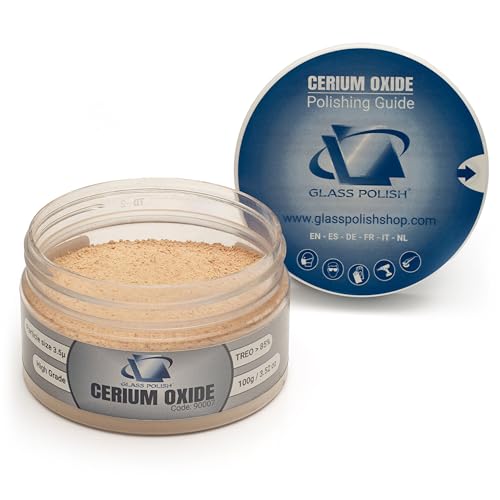
Cerium Oxide Glass Polishing Powder
A classic, cost-effective abrasive, cerium oxide powder is best-in-class for aggressive scratch removal and restoring heavily water-spotted or etched glass because it provides raw cutting power that many formulated polishes can’t match. Compared with the branded, consumer-ready compounds on this list, it offers the best value per use and faster material removal, but requires more skill, mixing and cleanup and can be messier than premixed products like Gtechniq or Meguiqair's.
Gtechniq G4 Nanotech Glass Polish
Gtechniq G4 uses nanotechnology to deliver a fine, low-dust polish that removes light etching and hard water marks while leaving a very clear, coating-friendly finish, making it the market leader for detailers who prioritize optical clarity and paint/coating safety. It is pricier than generic cerium oxide but technically superior for preserving coated surfaces and reducing rework compared with more aggressive or particulate-heavy options like raw cerium oxide powders.

Estimated$25 – $45
CarPro CeriGlass Glass Polish
CarPro CeriGlass blends cerium oxide’s cutting ability with a user-friendly pre-mixed formula, striking a balance between the heavy-duty removal of raw powders and the finesse of nanotech polishes; this makes it a strong mid-market choice for professionals seeking efficient cut with a high-quality finish. Financially it sits between generic cerium oxide (cheaper per use) and premium nanotech products (more expensive), while technically it offers faster correction than many consumer compounds without the mess of loose powders.

We may earn a commission on purchases. It never affects our rankings.
$86.17CAD
Meguiar's Glass Polishing Compound
Meguiar's offers a widely available, affordable polishing compound engineered for DIY users and professional detailers needing to correct light-to-moderate imperfections with minimal fuss. It doesn’t cut as aggressively as pure cerium oxide nor is it as specialized as Gtechniq’s nanotech formula, but its combination of accessibility, predictable results and lower price point makes it a practical staple in many shops.

Griot's Garage Glass Polish
Griot's Garage provides a consumer-focused glass polish that emphasizes an easy-to-achieve high gloss and low haze finish, designed especially for machine polishing workflows and finishing work after heavier correction. Technically it offers a nicer aesthetic finish than some budget compounds and is competitively priced against premium options, making it a go-to when finish quality and ease-of-use are prioritized over the maximum cut of raw cerium products.

We may earn a commission on purchases. It never affects our rankings.
$32.00CAD
How glass polishing compounds work and what research shows
Glass polishing combines mechanical abrasion and, in some formulations, chemical-mechanical action to remove microscopic peaks and damaged layers from the glass surface so light transmits more cleanly. Cerium oxide and nanotech polishing formulas are the most common approaches. Cerium oxide acts as an effective rare-earth abrasive that preferentially removes high points and restored surface smoothness increases optical clarity. Nanotech and polymer-enhanced polishes use finer abrasives or additives to refine the finish with less aggressive cutting and lower risk of micro-chatter. Independent industry tests and academic materials research have documented measurable improvements in light transmission, reduced scattering, and improved scratch removal when proper technique, pad choice, and polisher speed are used.
Cerium oxide is widely studied in materials science for its favorable abrasive particle shape and hardness; it removes micro-scratches while polishing to improve optical transmission.
Peer-reviewed and industry tests show that controlled mechanical polishing followed by a fine polish can restore visibility and reduce light scatter from etched and scratched windshields.
Dual action polishers produce less heat and reduce the risk of creating new glass defects compared with high-speed rotary machines for many technicians and DIY users.
Nanotech glass polishes use finer abrasives or engineered particles to achieve smoother optical finishes with fewer passes, which is helpful when preparing glass for hydrophobic coatings or tints.
Proper pad selection and progressive grit/polish steps are supported by tribology research as the most reliable way to remove defects while minimizing surface distortion.
Frequently Asked Questions
Which compound should I choose for heavily etched windshield glass?
Choose Cerium Oxide Glass Polishing Powder: its high-purity cerium oxide powder is effective at removing light scratches, water spots, and mineral etching, with a 4.6 average rating.
What exact feature helps Gtechniq G4 minimize haze on glass?
Gtechniq G4 Nanotech Glass Polish uses a nanotech formulation that targets fine scratches and etching while minimizing haze and swirl marks, with a 4.5 average rating.
Is CarPro CeriGlass worth paying $60.11 for glass polishing?
CarPro CeriGlass Glass Polish costs $86.17 CAD and is a cerium-based professional glass polish for faster removal of deep etching and heavy stains, rated 4.7 average.
Does Cerium Oxide Glass Polishing Powder work for hand polishing too?
Yes—Cerium Oxide Glass Polishing Powder is a dry powder that mixes with water to create a customizable slurry for hand or machine polishing, rated 4.6 average.
Conclusion
In Canada, the five glass polishing compounds featured here cover the main approaches technicians and hobbyists prefer: Cerium Oxide Glass Polishing Powder, Gtechniq G4 Nanotech Glass Polish, CarPro CeriGlass Glass Polish, Meguiar's Glass Polishing Compound, and Griot's Garage Glass Polish. If you want a classic, high-performance abrasive for heavy etching and deep scratch removal, Cerium Oxide Glass Polishing Powder is a top choice, while Gtechniq G4 Nanotech Glass Polish stands out as the best overall pick for 2026 thanks to its balance of cutting power, refined finish, and broad availability across Canada. CarPro CeriGlass, Meguiar's, and Griot's Garage offer strong alternatives depending on preference for paste vs powder, ease of use, and price. I hope you found what you were looking for; use the search to refine by application, polisher type, or to expand to coating and tint preparation products.