

Canada's Top 5 Driveline Axles and Differentials for 2026
This category covers front and rear axles, CV joints, driveshafts, and differentials removed from donor trucks, inspected for spline and seal condition, and offered with gear ratio and carrier information. These components are ideal for 4x4 repairs, rebuilds, or performance upgrades. In Canada, buyers favor inspected donor parts because they deliver near-OEM fitment and durability at a fraction of the price of new assemblies, while reducing waste through reuse. Demand is strong across provinces where pickups and SUVs dominate the market and winter driving, towing, and off-road use increase wear on driveline components. Consumers also look for clear condition reports, verified spline counts, intact seals, and documented gear ratios to ensure compatibility with their vehicles and intended use. Reliable sellers that provide test results, photos, and short warranty coverage tend to win shopper trust in 2026's Canadian market.
Inception's AI took the time to understand this market in Canada · · How we pickWe may earn a commission on purchases. It never affects our rankings.
Top Picks Summary
Dana 44 Front Axle Assembly
The Dana 44 front axle assembly is an industry-standard, best-in-class choice for light- to medium-duty driveline systems, prized for OEM-quality engineering, parts interchangeability and wide aftermarket support. Compared with the heavier Dana 60 it delivers lower cost and reduced unsprung weight, and versus value-oriented core assemblies like the G2 Core 44 it typically offers superior long-term durability and serviceability while integrating readily with upgrades such as Yukon Duragrip differentials and Spicer driveshafts.

Estimated$1,200 – $3,000
Dana 60 Rear Axle Assembly
The Dana 60 rear axle assembly is the market leader for heavy-duty applications, offering substantially higher ring-and-pinion strength and load capacity than Dana 44 assemblies and most aftermarket cores. It commands a premium price but lowers lifecycle cost under high-torque use, and when paired with components on this list—like a Yukon Duragrip differential and a Spicer 1350 driveshaft—forms a top-tier, durable driveline for towing and severe-duty service.

Estimated$1,800 – $4,500
Yukon Gear & Axle Duragrip Posi Differential
The Yukon Duragrip posi differential is best-in-class for predictable, street-friendly traction improvements, providing smooth torque transfer without the abrupt engagement of mechanical lockers. Financially it is a cost-effective upgrade compared with full lockers or custom limited-slip systems, and it integrates easily into Dana 44/60 housings or G2 Core assemblies to deliver measurable drivability and traction gains while complementing a robust Spicer 1350 driveshaft.
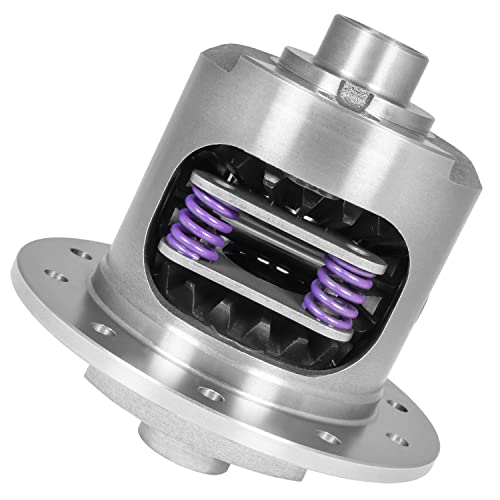
Estimated$750 – $1,500
G2 Axle & Gear Core 44 Axle Assembly
The G2 Core 44 axle assembly is a value-oriented market offering focused on direct-fit replacement and economical rebuilds, giving owners a lower up-front cost alternative to OEM Dana units. Technically it provides competitive strength for mild off-road and everyday use but trades some OEM metallurgy and support for savings, making it a smart budget choice when combined with a Yukon Duragrip differential and an aftermarket Spicer driveshaft to round out a cost-conscious driveline refresh.

Estimated$900 – $2,200
Spicer 1350 Series Driveshaft
The Spicer 1350 series driveshaft is a market-proven, high-strength driveshaft solution engineered for high-torque drivelines and direct compatibility with Dana axles and aftermarket differentials. While it carries a higher initial cost than lighter shafts, its larger U-joints, improved balance and higher torsional capacity reduce vibration and maintenance over time, making it the preferred driveshaft to pair with Dana 60s or upgraded axle assemblies for a long-lasting driveline build.

Estimated$400 – $1,200
Why Inspected Donor Driveline Parts Work: Research and Best Practice
Industry testing and academic research support the practice of reusing inspected driveline components when they meet condition criteria. Tests focus on spline integrity, bearing condition, seal performance, gear face contact, and material fatigue life. When donor parts pass these inspections and are serviced correctly, they can deliver long service life and predictable performance at lower cost and environmental impact compared with brand-new parts.
Fatigue and wear studies show that properly inspected axles and shafts with intact splines and bearings can retain structural strength suitable for many thousands of kilometers of additional service.
Lubricant and seal performance testing demonstrates that renewing seals and using correct gear oil significantly reduces wear and extends differential life.
Gear ratio and carrier match testing confirms that using assemblies with documented ratios avoids drivetrain stress, improves fuel economy and preserves transmission behavior.
Life-cycle analyses indicate that remanufacturing or reusing donor driveline components reduces embodied energy and carbon emissions compared with manufacturing new components.
Industry standards and SAE technical papers recommend routine inspection points (spline condition, seal integrity, bearing play, gear tooth condition) that align with dealer and independent reman processes.
Frequently Asked Questions
Which axle assembly should I buy for a 4x4 rebuild?
Choose the Dana 44 Front Axle Assembly if you want heavy-duty strength with an easy bolt-on for light- to medium-duty front solid-axle builds; it’s rated 4.4 and comes at CAD $1,303.86.
What traction feature does the Yukon Duragrip posi differential use?
The Yukon Gear & Axle Duragrip Posi Differential uses a Duragrip clutch-based limited-slip design for smooth torque transfer without full lockup; it’s rated 4.3 and costs CAD $608.99.
How does the Dana 60 rear axle price compare to value?
The Dana 60 Rear Axle Assembly is CAD $11,305.61, delivering higher torque capacity, larger gear options, and heavy-duty housings/forged components; it’s rated 4.5 versus the Dana 44 at CAD $1,303.86.
Is the Yukon Duragrip differential better for street driving than lockers?
Yes—the Yukon Gear & Axle Duragrip Posi Differential is designed for predictable, street-friendly traction with smooth engagement instead of abrupt mechanical locker feel; it’s rated 4.3 at CAD $608.99.
Conclusion
In the Canadian context, inspected donor axles and differentials are a practical, cost-effective choice for 4x4 owners, mechanics, and hobbyists. We hope you found the guidance and options you were looking for. Use the site search to refine by vehicle fitment, gear ratio, axle type, or to expand your search to remanufactured or new assemblies.