

Top 5 Through Bore and Hollow Shaft Encoders for Industrial Motors and Drives in Canada: 2026
Through-bore and hollow shaft encoders enable direct shaft mounting for compact, backlash-free feedback and simplified coupling in servo and motor assemblies. In Canada, demand for these encoders is driven by increasing factory automation, retrofitting of legacy motors, space-constrained robotics, and renewable energy and oil and gas applications that require rugged, reliable feedback devices. Buyers favor products that combine high resolution, robust IP and environmental ratings, easy installation, and strong local support or distribution. Designs range from low-profile magnetic types for cost-effective retrofits to high-resolution optical encoders for precision motion control, making this category attractive across a wide range of industrial motor and drive projects throughout Canada.
Inception's AI took the time to understand this market in Canada · · How we pickWe may earn a commission on purchases. It never affects our rankings.
Top Picks Summary
Dynapar HS35R Hollow Shaft Encoder
The HS35R hollow shaft encoder from Dynapar is a rugged, cost-effective solution optimized for through-bore mounting in industrial motors and drives, offering a broad range of shaft sizes and resolutions for retrofit and OEM applications. It holds its position by balancing durable mechanical design and competitive pricing against higher-end offerings — delivering many of the practical performance features of premium encoders at a lower acquisition cost, though without the ultra-high precision of Heidenhain products. For users who prioritize straightforward installation and value for money over absolute accuracy or extensive diagnostic features, the HS35R is an economical choice.

Estimated$500 – $1,200
Heidenhain ERN 1387 Hollow Shaft Encoder
The ERN 1387 is a high-precision hollow shaft encoder engineered for demanding servo and position-critical industrial drives, providing very low jitter, excellent repeatability, and high-resolution feedback. It commands a premium price but justifies it with class-leading metrology and long-term stability that outperforms the other encoders on high-accuracy axes; this makes it the preferred option where motion control performance directly impacts process quality or yields. Compared to more budget-friendly or diagnostics-focused units, Heidenhain targets applications where technical performance outweighs upfront cost.

Sick DFS60B Pro Hollow Shaft Encoder
The DFS60B Pro hollow shaft encoder from SICK emphasizes industrial robustness and modern connectivity, combining through-bore mounting with rich diagnostic features, configurable interfaces, and fieldbus/IO-Link readiness for predictive maintenance. It stands out when networked control and condition monitoring are required, offering more onboard diagnostics and communication flexibility than many simpler encoders, though it is typically less focused on ultimate metrological precision than Heidenhain. For installations where uptime and integration into automation systems matter financially, the DFS60B Pro can reduce lifecycle costs through improved maintainability.
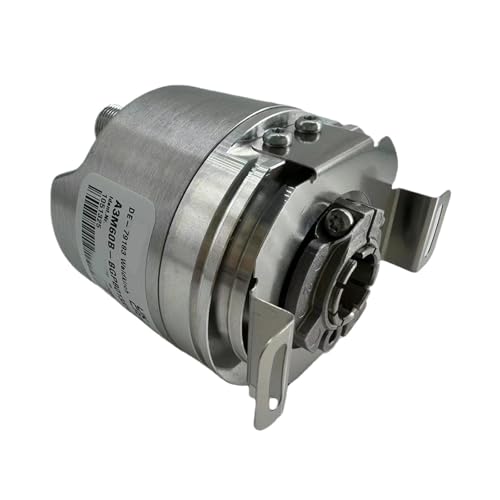
Estimated$800 – $2,200
Encoder Products Model 30T Thru-Bore Encoder
The Model 30T thru-bore encoder from Encoder Products Company (EPC) is an economical, versatile option built for simple installation on hollow shafts and motor drives, offering a wide range of resolutions and interface options for retrofit and spare-parts programs. Its strength is modularity and affordability—providing a straightforward mechanical fit and competitive unit cost relative to premium metrology encoders—though it lacks some of the advanced diagnostics and absolute-accuracy characteristics of higher-end vendors. For maintenance teams and OEMs seeking low total cost of ownership and fast field swaps, the 30T is a practical, budget-conscious selection.
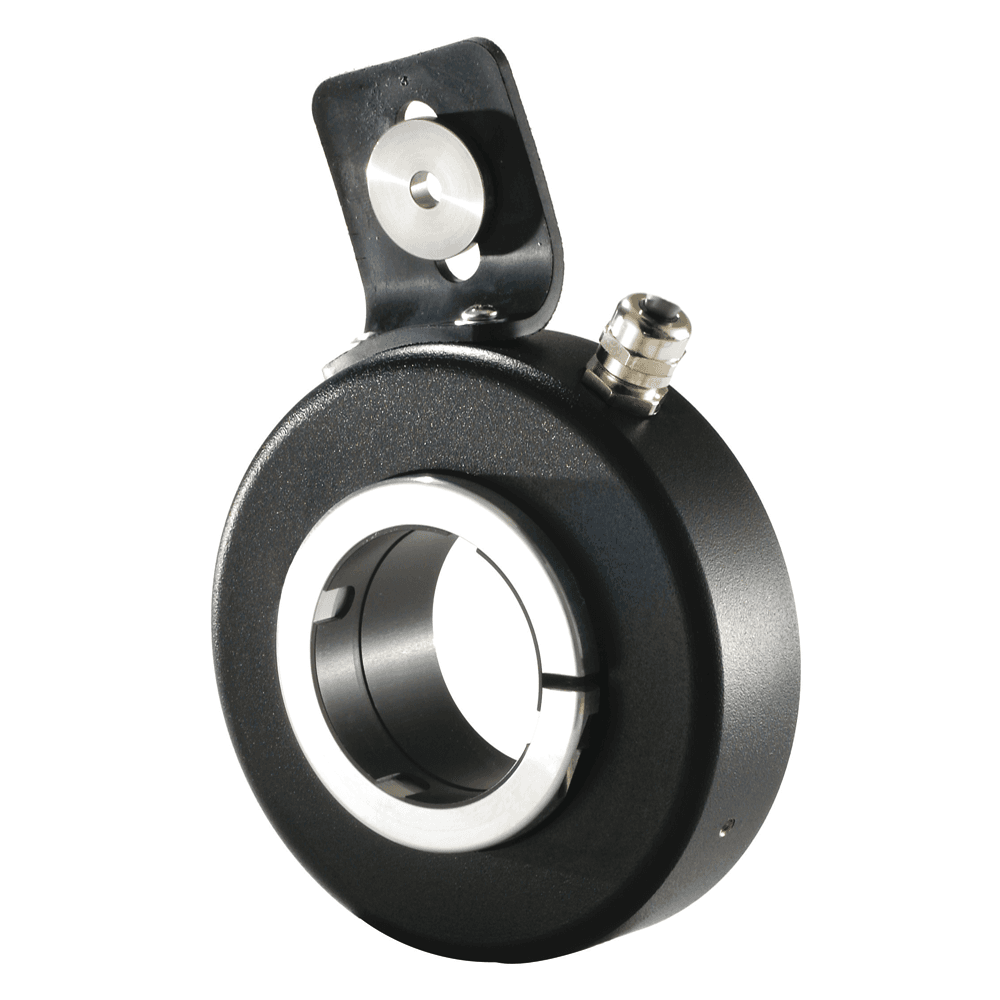
Estimated$400 – $1,000
What Research and Industry Practice Say About Through-Bore and Hollow Shaft Encoders
Scientific studies and industry testing consistently show that direct-shaft encoders reduce mechanical coupling errors and maintenance compared with externally coupled solutions. When properly selected and installed, through-bore and hollow shaft encoders can improve closed-loop control stability, reduce position error, and simplify integration in constrained layouts. Research also highlights trade-offs between magnetic and optical technologies: magnetic encoders offer higher tolerance to contaminants and shock, while optical encoders typically deliver higher resolution and lower jitter for demanding precision tasks.
Direct shaft mounting reduces backlash and cumulative mechanical error compared with belt, gear, or flexible-coupling feedback arrangements.
Higher encoder resolution and lower signal jitter improve servo loop performance and can reduce settling time and overshoot in motion systems.
Magnetic encoder designs show superior resilience in dirty, humid, or high-shock environments, supporting longer mean time between failures in heavy industry.
Optical encoders provide the highest incremental and absolute accuracy for precision positioning, making them preferred in metrology and high-performance servo applications.
Field studies emphasize the importance of correct shaft fit, axial play control, and bearing load limits to preserve encoder life and accuracy.
Choosing encoders with appropriate IP, temperature ranges, and connector standards simplifies installation and reduces downtime in Canadian climates and industrial environments.
Frequently Asked Questions
Which encoder should I buy for heavy-duty automation?
For heavy-duty automation, choose the SICK DFS60B Pro Hollow Shaft Encoder; it’s rated 4.7 and features robust sealing IP67/IP69K plus high shock/vibration tolerance for industrial drives.
Does the Dynapar HS35R support through-bore mounting?
Yes—the Dynapar HS35R Hollow Shaft Encoder is optimized for through-bore mounting, using a hollow-shaft design for direct coupling, with an average rating of 4.6.
Is the SICK DFS60B Pro worth $1908.69 CAD?
At $1908.69 CAD, the SICK DFS60B Pro Hollow Shaft Encoder (4.7 rating) gives IP67/IP69K sealing and multiple interface options like TTL/HTL, differential, and Sin/Cos.
What interface options are available on DFS60B Pro?
The SICK DFS60B Pro Hollow Shaft Encoder offers multiple interface options, including TTL/HTL, differential, and Sin/Cos; it has an average rating of 4.7.
Conclusion
This shortlist highlights five leading through-bore and hollow shaft encoders suited to industrial motors and drives in Canada: Dynapar HS35R Hollow Shaft Encoder, Heidenhain ERN 1387 Hollow Shaft Encoder, Sick DFS60B Pro Hollow Shaft Encoder, Baumer ITD 21 Hollow Shaft Encoder, and Encoder Products Model 30T Thru-Bore Encoder. For high-precision, long-term reliability in demanding servo applications the Heidenhain ERN 1387 Hollow Shaft Encoder stands out as the best choice among these options. We hope you found what you were looking for; you can refine or expand your search using the search to match specific shaft sizes, resolutions, or environmental ratings.