

Top 5 Couplings and Shaft Connectors in Canada — 2026 Guide
Published on Saturday, January 24, 2026
Mechanical couplings, flexible connectors, and shaft adapters join rotating components while accommodating misalignment, absorbing shock, and protecting drivetrains from torque spikes. In Canada in 2026, demand for couplings focuses on maintenance-free elastomeric elements, torque overload protection, and quick-install modular systems tailored to industrial automation, packaging, and OEM machinery. Buyers favor parts that reduce downtime, resist corrosion in variable climates, deliver consistent torque transmission, and provide low backlash for servo and precision applications. This category includes elastomeric jaw couplings, torsionally flexible couplings, bellows couplings for precision alignment, and torque-limiting designs that match the needs of manufacturing, food and beverage, and energy sectors across Canada.
Top Picks Summary
Lovejoy L-Type Jaw Coupling
The Lovejoy L-Type Jaw Coupling is a long-standing best-in-class choice for general-purpose shaft connection because it combines simple design, an elastomeric spider for vibration dampening, and very low initial cost. Compared with the more precision-oriented Ruland bellows and the heavy-duty Dodge Para-Flex, the L-Type trades ultimate torsional stiffness for ease of service and lower replacement expense, making it the most cost-effective option for many standard power-transmission and shaft-connector applications. Its wide availability and modular parts reduce downtime and spare-parts inventory relative to specialty couplings on this list.

Martin Sprocket Quadra-Flex Coupling
The Martin Quadra-Flex coupling earns its position by delivering high misalignment capacity and robust shock absorption through multiple elastomeric elements designed for heavy-duty conveyors and industrial drives. Technically it sits between simple jaw couplings and precision bellows—offering greater torque capacity and service life than basic elastomer designs like Lovejoy and TB Wood's while costing less than precision, zero-backlash solutions such as Ruland. For applications where uptime and durability drive lifecycle cost, Quadra-Flex provides a strong total-cost-of-ownership advantage.

Ruland Bellows Coupling
Ruland bellows couplings are the market leader for precision motion control and servo applications due to their near-zero backlash, high torsional stiffness, and excellent concentricity. While pricier than elastomeric couplings like Lovejoy, TB Wood's, or Martin's Quadra-Flex, Ruland's technical advantages reduce tuning time, improve positional accuracy, and lower scrap or rework costs in high-precision systems, making the higher upfront investment justified in automated and servo-driven shafts. Compared to heavy-duty names like Dodge Para-Flex, Ruland prioritizes precision over shock tolerance, so it outperforms others when tight control is the primary requirement.

TB Wood's Sure-Flex Plus Coupling Pulleys
TB Wood's Sure-Flex Plus coupling is a refined elastomeric connector that emphasizes extended life, interchangeability, and reduced maintenance for pumps, fans, and general rotating equipment. It offers a middle ground financially and technically: lower cost and easier service than precision bellows from Ruland, but improved durability and torque handling versus basic jaw couplings such as the Lovejoy L-Type. For plant operators seeking predictable lifespan and straightforward spares management across common shaft-connector applications, Sure-Flex Plus often lowers total operating expense.
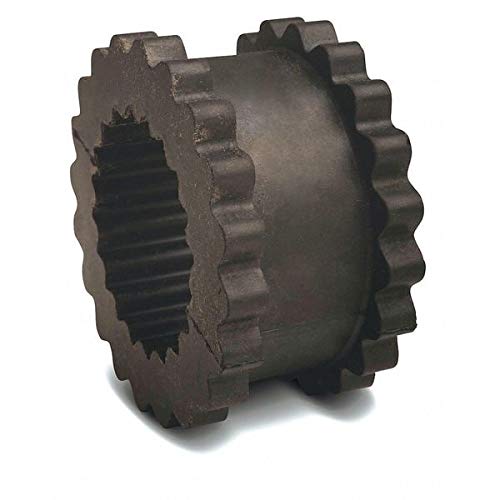
Dodge Para-Flex Coupling
The Dodge Para-Flex coupling is a market-leading industrial solution known for its heavy-duty torque capacity, replaceable elastomeric inserts, and spacer options that simplify maintenance on long shaft separations. Technically it is built for rugged service and offers a lifecycle-cost advantage in high-torque or hard-start environments compared with precision-focused Ruland units and lower-capacity jaw couplings like Lovejoy; its replaceable elements also make it more economical over time than fully machined or one-piece designs. In the domain of couplings and shaft connectors, Para-Flex is frequently chosen where reliability and in-situ serviceability outweigh the premium for motion-control precision.
Where to buy Dodge Para-Flex Coupling in Canada: the trusted retailers we track in this market, with the best price we have observed at each. Prices are checked regularly and can change, and the retailer confirms the final price at checkout.
We may earn a commission on purchases. It never affects our rankings.
$200 – $900
Research and Evidence: Why Couplings Improve Performance
Laboratory tests and industry standards (including ISO and AGMA guidance) show that well-designed couplings reduce vibration, accommodate shaft misalignment, and limit peak loads that cause premature equipment failure. Studies and manufacturer test data demonstrate that elastomeric elements dampen torsional vibration and reduce transmitted shock, while precision bellows and zero-backlash designs maintain accurate positional control for servo-driven systems. Torque-limiting couplings and modular quick-install systems also reduce maintenance time and improve safety by preventing overload-related damage.
Elastomeric inserts reduce transmitted vibration and noise, improving bearing and gearbox life.
Flexible and torsionally-damped couplings accommodate angular, parallel, and axial misalignment, lowering unintended loads on bearings and seals.
Bellows and zero-backlash couplings preserve positional accuracy, which is critical for automation and motion control.
Torque overload protection prevents catastrophic failures and simplifies maintenance by isolating faults before major damage.
Modular and quick-install coupling designs reduce downtime and labor costs during assembly and service.
Frequently Asked Questions
Which coupling should I choose for general shafting?
For general-purpose shaft connection, choose the Lovejoy L-Type Jaw Coupling, rated 4.6, because its elastomeric spider absorbs shock and dampens vibration and it uses a simple two-hub design with easy spider replacement.
Does the Ruland bellows coupling have zero backlash?
Yes—the Ruland Bellows Coupling is a zero-backlash design for accurate angular and torsional positioning, rated 4.8, using a flexible stainless-steel bellows that handles axial, angular, and parallel misalignment.
Is the Ruland bellows worth the higher price?
Ruland Bellows Coupling costs $409.22 CADand provides near-zero backlash plus high torsional stiffness and compact size for servo and encoder shafts; Lovejoy L-Type Jaw Coupling is $16.39 CADwith a shock-damping elastomeric spider.
Which coupling supports heavy misalignment installation?
The Martin Sprocket Quadra-Flex Coupling is designed for large torque capacity and excellent misalignment tolerance, rated 4.6, and its split-in-half design allows fast installation without moving equipment.
Conclusion
This selection reflects the leading coupling types available in Canada for 2026. The Lovejoy L-Type Jaw Coupling, Martin Sprocket Quadra-Flex Coupling, Ruland Bellows Coupling, TB Wood's Sure-Flex Plus Coupling, and Dodge Para-Flex Coupling each address common needs from shock absorption to precision alignment. For most general industrial automation and maintenance-free elastomeric performance, the Lovejoy L-Type Jaw Coupling is the best overall choice on this list. We hope you found what you were looking for — you can refine or expand your search using the search function to compare sizes, materials, and torque ratings.