

Best High Current Power Relays in Canada 2026: Top 5 Picks
High current power relays are engineered to switch heavy loads and deliver sustained continuous current for motors, power distribution, and industrial drives. In Canada, demand for rugged relays is rising as EV charging infrastructure, renewable energy inverters, and heavy equipment electrification accelerate. Buyers prefer relays with low contact resistance, high inrush current capacity, effective thermal management, and certifications for Canadian and international standards. Key selection drivers include proven contact materials and plating, robust arc suppression, integrated temperature sensing or forced cooling options, and local availability with strong warranty and support. For cold climates and remote installations common in Canada, weatherproof housings, hermetic sealing, and reliable control interfaces are also highly valued.
Inception's AI took the time to understand this market in Canada · · How we pickWe may earn a commission on purchases. It never affects our rankings.
Top Picks Summary
Omron G9EC-1 High Current Relay
Omron's G9EC-1 is a compact, high-current power relay valued for its reliability and PCB-friendly footprint, making it a strong market leader for space-constrained industrial and automotive designs. Compared with larger contactors like the TE EV200 or Sensata Gigavac GX16, the G9EC-1 delivers lower acquisition cost and easier integration while trading off some extreme-voltage and continuous-duty capability those heavier contactors provide.
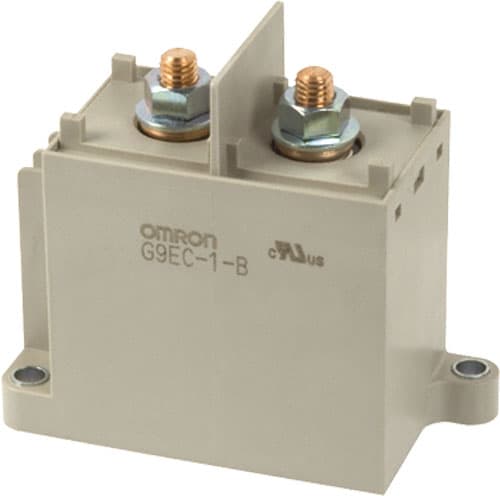
Estimated$40 – $80
TE Connectivity EV200 Contactor
TE Connectivity's EV200 contactor is positioned as a market-leading solution for electric vehicle and heavy-duty DC switching, offering robust continuous current handling, automotive-grade certifications and proven thermal management. It typically carries a premium over commodity relays such as Hongfa, but its higher upfront cost is justified by longer service life, stricter safety compliance and lower total cost of ownership in demanding transportation applications.

Estimated$400 – $900
Panasonic HE-V Relay
Panasonic's HE-V series provides high-current relay performance in a low-profile, energy-efficient package with long mechanical life, making it attractive where PCB integration and coil-power savings are important. Versus rugged contactors like the Sensata Gigavac GX16, the HE-V trades off extreme environmental sealing and ultra-high-voltage ratings for lower cost and simpler installation, serving well as a middle ground between economy relays and heavy-duty contactors.

Estimated$50 – $120
Sensata Gigavac GX16 Contactor
Sensata's Gigavac GX16 is a best-in-class hermetically sealed contactor engineered for very high-voltage, high-current DC switching and harsh environments, offering exceptional insulation, low leakage and minimal maintenance requirements. While it is more expensive than general-purpose relays from Hongfa or Omron, the GX16's sealed construction and high-voltage capability make it the preferred choice where safety, environmental resistance and long-term reliability are paramount for high current power relays.

We may earn a commission on purchases. It never affects our rankings.
Estimated$500 – $1,200
Hongfa HFE18V High Power Relay
Hongfa's HFE18V is a cost-competitive high-power relay that delivers practical current ratings and wide distributor availability, making it a go-to option for budget-conscious OEMs working with high current power relays. It does not match the certification breadth or specialized high-voltage sealing of TE or Gigavac, but its lower upfront cost and broad supply make it attractive for applications with moderate regulatory requirements and tight cost targets.

Estimated$20 – $70
Research and Standards Behind High Current Relays
Scientific research, industry testing, and international standards inform relay design and selection. Studies from electrical engineering labs and industry groups emphasize contact material science, heat transfer, and life cycle testing. Standards and test protocols from organizations such as CSA, UL, and IEC set performance and safety baselines used by manufacturers and specifiers in Canada. Understanding these findings helps buyers choose relays that balance reliability, efficiency, and lifecycle cost.
Contact materials and surface treatments matter: silver and silver-alloy contacts lower contact resistance and reduce material transfer and welding under heavy current and frequent switching.
Thermal management prevents premature failure: thermal modeling and temperature rise testing identify the need for larger contact gaps, heat sinks, or forced-air cooling for continuous high-current applications.
Arcing and suppression techniques extend life: arc shields, magnetic blowouts, and snubber circuits reduce contact erosion in high inrush or inductive loads such as motors and chargers.
Lifecycle and accelerated aging tests predict field reliability: manufacturers use cycle testing, vibration and thermal cycling to estimate mean cycles to failure and to validate designs for harsh Canadian climates.
Standards compliance ensures safety and interoperability: CSA C22.2, UL 508, and relevant IEC standards guide electrical ratings, insulation levels, and environmental protection required for commercial and industrial use.
Frequently Asked Questions
Which relay should I buy for space-constrained panels?
Choose the Omron G9EC-1 High Current Relay: it’s compact, has a PCB-friendly footprint, and fits space-constrained industrial and automotive designs, with an average rating of 4.6.
Does the Panasonic HE-V relay have long electrical life?
Yes—the Panasonic HE-V Relay lists high breaking capacity plus long electrical/mechanical life for frequent power switching, with an average rating of 4.4.
Is the Panasonic HE-V relay better value than TE EV200?
The Panasonic HE-V Relay is CAD $97.65 versus the TE Connectivity EV200 Contactor at CAD $521.89, and the HE-V is rated 4.5 while the EV200 is rated 4.5.
Who should pick TE Connectivity EV200 instead of HE-V?
Pick the TE Connectivity EV200 Contactor for electric vehicle battery and traction systems, with a sealed automotive-grade design for harsh environments; it’s rated 4.5 and is listed at CAD $521.89.
Conclusion
Whether you are equipping EV charging stations, retrofitting industrial drives, or specifying components for renewable inverters, the right high current power relay improves reliability and reduces maintenance. We hope this guide to high current relays in Canada for 2026 helped you narrow your choices. Use the site search to refine by current rating, form factor, certification, or supplier to find products that match your exact application.