

Best Multi Process Welders in Canada - Top 5 Picks for 2026
Multi process welders combine MIG, TIG, and Stick welding in a single machine, and often add plasma cutting or advanced feeder options. Inverter-based multi process units deliver compact size, digital controls, smoother arcs, and flexible duty cycles that suit mixed-work environments from small fabrication shops to mobile service rigs. In Canada, buyers favor these machines for their versatility across industries such as automotive repair, farm and agricultural maintenance, light manufacturing, and construction. Key Canadian preferences include portability for remote jobs, energy efficiency for lower operating costs, straightforward digital interfaces for quicker setup and training, and reliable local service and warranty support. As shops take on a broader range of materials and thicknesses, multi process welders offer a practical way to reduce shop floor clutter and capital expense while keeping the capability to switch processes quickly as jobs demand.
Inception's AI took the time to understand this market in Canada · · How we pickWe may earn a commission on purchases. It never affects our rankings.
Top Picks Summary
Lincoln Electric Power MIG 210 MP
The Power MIG 210 MP earns its best-in-class spot for multi process welders by balancing broad process capability with an accessible price and simple controls, making it ideal for shop and small-fab environments. Compared with the premium Miller and industrial Fronius units it delivers similar MIG and flux-cored performance at a lower acquisition cost, while offering more professional features and power headroom than consumer-focused alternatives like the Hobart.

Miller Multimatic 220 AC/DC
The Multimatic 220 AC/DC is positioned as the market leader for users who need high-quality AC/DC performance and refined arc control across TIG, MIG and stick, giving superior aluminum and thin-material results. It commands a higher price than most on this list but justifies that cost with advanced waveform control, consistent arc stability and features aimed at weld-quality-sensitive applications that outclass budget-focused models such as the Hobart and many portable ESAB units.

Estimated$3,000 – $4,500
ESAB Rebel EMP 215ic
The Rebel EMP 215ic stands out for portability and field-ready design, offering a strong mix of MIG, stick and DC TIG capabilities in a compact package that suits contractors and mobile technicians. While it may not match Miller's AC performance or Fronius' industrial durability, ESAB's unit provides a financially attractive middle ground—better performance and duty cycle than entry-level hobby machines but with easier transport and lower cost than full-production systems.

Fronius TransSteel 2200
The TransSteel 2200 represents the industrial end of the multi process welder market, delivering exceptional thermal management, long duty cycles and process stability designed for production environments where uptime and consistency matter most. It carries a premium price compared with workshop-focused machines like Lincoln or Hobart, but that investment reduces downtime and lifecycle cost for high-volume shops that require welding performance and reliability above entry-level savings.

Estimated$4,500 – $7,500
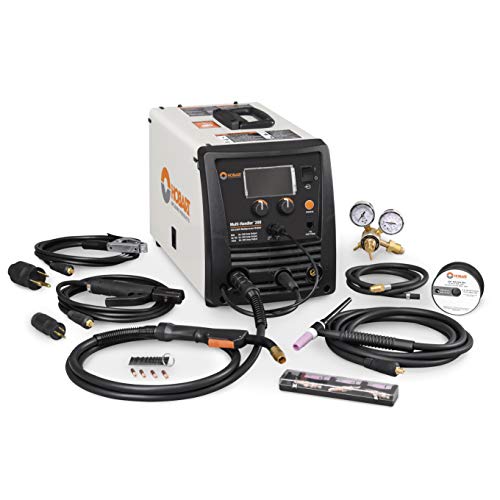
Hobart Multi-Handler 200
The Multi-Handler 200 is the value-focused choice for users who need reliable multi-process capability without a large capital outlay, making it a practical option for hobbyists, small shops and light contractors. It cannot match the Miller's arc finesse or Fronius' industrial robustness, but its lower purchase price and straightforward serviceability deliver the best short-term financial ROI for lower-duty multi-process applications.
Estimated$1,100 – $1,800
How Multi Process Inverter Welders Deliver Better Performance: Research Highlights
Independent industry research and technical reviews show that inverter-based multi process welders improve energy efficiency, arc stability, and control compared with older transformer-based machines. These benefits translate into cleaner welds, less rework, and reduced heat input on thin materials. Studies from welding associations, academic metallurgy programs, and industry testing labs also document the advantages of digital control systems for repeatable settings and reduced operator variability. For new or transitioning welders, the science supports choosing machines that offer process-specific controls, appropriate duty cycles for expected workloads, and user-friendly interfaces to shorten learning curves.
Energy efficiency: inverter designs typically reduce power loss and can cut energy usage compared with legacy transformer units, often resulting in lower operating costs over the machine lifetime.
Arc stability and weld quality: modern inverter control and waveform technology provide more stable arcs across MIG, TIG, and Stick processes, producing less spatter and better bead appearance.
Heat input management: improved control over welding parameters reduces distortion and burn-through on thin materials, which is important for automotive and sheet metal work.
Repeatability: digital presets and memory functions reduce operator variability and speed up job changeovers, which helps small shops maintain consistent quality.
Portability and duty cycle tradeoffs: while inverter units are lighter and more portable, buyers should match duty cycle ratings to anticipated workloads to avoid overheating during continuous industrial use.
Frequently Asked Questions
Which multi process welder should I buy for shop work?
For shop and small-fab work, choose the Lincoln Electric Power MIG 210 MP, which supports MIG, flux‑cored, stick and DC TIG (TIG torch sold separately), has a 4.5 rating, and offers simple digital controls with 120/240V dual‑voltage operation.
What exact processes does the Miller Multimatic 220 AC/DC support?
The Miller Multimatic 220 AC/DC provides full AC/DC TIG plus MIG, flux‑cored and stick capabilities, with an Auto‑set feature and Smooth‑Start, and it’s rated 4.7.
Is the Lincoln Power MIG 210 MP good value at $1699?
At $1699 CAD, the Lincoln Electric Power MIG 210 MP includes MIG, flux‑cored, stick and DC TIG (TIG torch sold separately), plus 120/240V dual‑voltage operation, and it has an average rating of 4.5.
Does the ESAB Rebel EMP 215ic work for aluminum welding?
Yes—ESAB Rebel EMP 215ic is spool‑gun ready and is described as capable of welding thinner aluminum and steel; it’s a MIG, FCAW, stick and DC TIG inverter multi‑process unit with a 4.4 rating.
Conclusion
In Canada, multi process welders are a practical choice for shops that need one machine to handle MIG, TIG, and Stick work without buying separate units. The Lincoln Electric Power MIG 210 MP and the ESAB Rebel EMP 215ic bring strong performance and flexibility, while the Fronius TransSteel 2200 targets heavier production use. The Hobart Multi-Handler 200 offers solid value for cost-conscious buyers. For most Canadian users seeking the best balance of process range, ease of use, and dealer support, the Miller Multimatic 220 AC/DC stands out as the top overall choice on this list. We hope you found the information you were looking for. You can refine or expand your search using the site search to compare specifications, duty cycles, and local Canadian dealer availability.