

Canada 2026: Top 5 Force Gauge and Load Cell Calibration Frames and Reference Standards
Published on Saturday, January 24, 2026
Modular calibration frames, jigs, and alignment fixtures for force gauge and load cell calibration are essential reference standards for laboratories, calibration service providers, and production test benches across Canada. These systems are designed for controlled loading, repeatable alignment, automated data capture, and seamless integration with modern sensor electronics to minimize measurement uncertainty. Canadian buyers favor solutions that deliver traceable accuracy, ISO/IEC 17025 compatibility, rugged construction for shop-floor use, and responsive local support. In 2026 the market shows growing demand for modular rigs that combine precise mechanical alignment, automated force control, and built-in software logging so teams can reduce human error, shorten calibration cycles, and demonstrate traceability to national standards.
Top Picks Summary
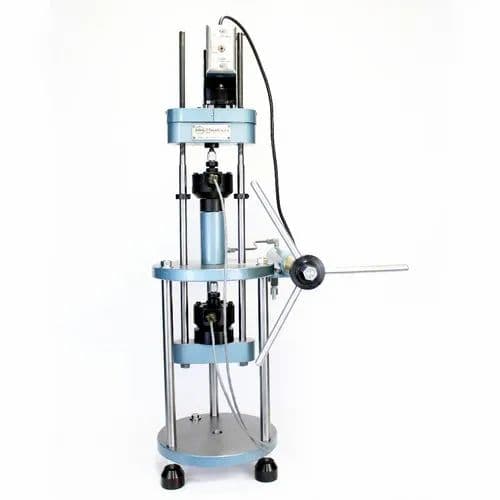
Morehouse Universal Calibrating Machine
The Morehouse Universal Calibrating Machine is positioned as a reference-class frame widely used for force gauge and load cell calibration because of its long metrological pedigree and very high accuracy and stability. Compared with the other products on this list it typically serves as the laboratory primary/transfer standard—trading higher capital cost and larger footprint for best-in-class uncertainty and long-term traceability that other bench or production stands use as their reference. For labs requiring top-tier reference standards for accreditation and inter-laboratory comparisons, Morehouse remains the technical gold standard.
$50,000 – $150,000
AMETEK Jofra Force Calibration System
AMETEK Jofra's Force Calibration System brings modularity and automation to force gauge and load cell calibration, delivering excellent software integration, automated procedures and strong traceability at a competitive price point. It compares favorably to heavier laboratory frames by offering flexible configurations and faster throughput for accredited labs that want near-reference accuracy without the capital and space requirements of a primary standard. Financially it often provides a lower total cost of ownership for mid- to high-volume calibration operations through automation and extensible reporting features.

$30,000 – $90,000
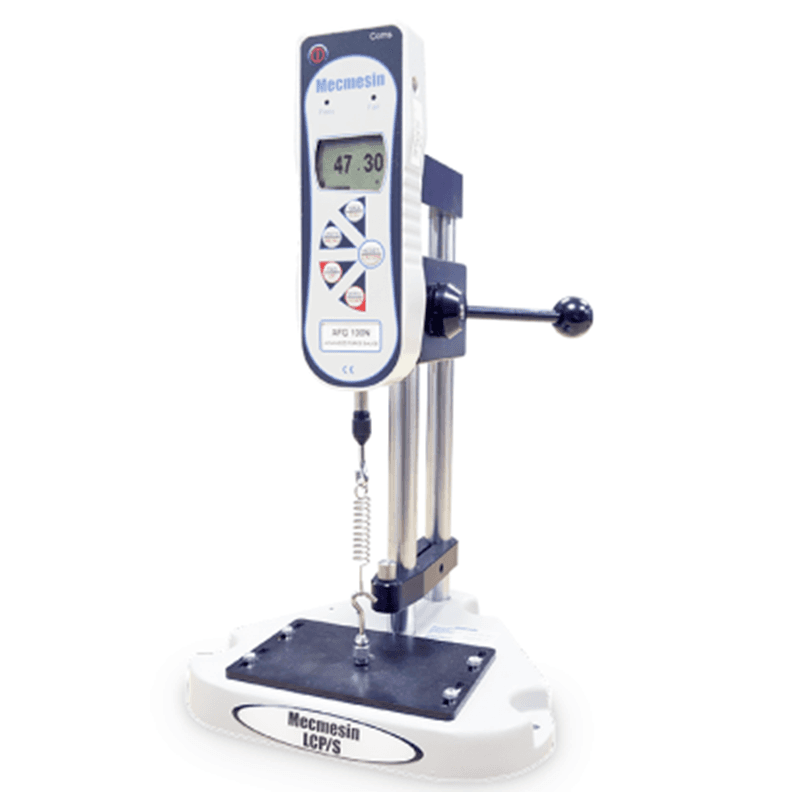
Mecmesin Calibration Test Stand
Mecmesin's calibration test stands are compact, economical benchtop frames optimized for routine force gauge and low-capacity load cell calibration where space and budget are constrained. While they do not match the uncertainty of a laboratory primary machine like Morehouse or the deep automation of AMETEK Jofra, Mecmesin offers the best practical cost-per-test for production labs and service centers that prioritize throughput and footprint. Their affordability and ease of use make them a strong market choice for companies building traceable, repeatable calibration capability without large capital expenditure.
$3,000 – $12,000
Mark-10 ES Series Test Stands
The Mark-10 ES Series delivers motorized, high-repeatability test stands geared to force gauge and load cell calibration with fine motion control and a modular accessory ecosystem, providing a middle ground between benchtop economy and full lab systems. Compared with Mecmesin, the ES Series generally offers greater payload options and advanced control features; compared with AMETEK and Morehouse it is more affordable and easier to deploy for routine calibration and QA while not intended as a primary reference standard. The ES stands are popular where labs require robust automation and precise displacement control without the premium cost of primary laboratory frames.

Starrett Digital Force Tester
Starrett's Digital Force Tester line pairs rugged test frames with integrated digital readouts to provide a turnkey solution for force gauge and load cell calibration that emphasizes durability and straightforward electronic measurement. Though less configurable than some modular systems (e.g., AMETEK Jofra or Mark-10), Starrett is financially attractive for organizations seeking an off-the-shelf calibrated tester with broad service support and simple digital reporting. It is a practical choice for calibration shops and production environments that need reliable results and reduced setup complexity rather than the lowest possible uncertainty.
$3,500 – $12,000
How calibration frames reduce uncertainty: research-backed reasons
Scientific standards and industry studies emphasize that mechanical alignment, controlled loading profiles, and automated data capture lower random and systematic errors in force and load cell calibration. International metrology frameworks such as OIML R60 for load cells, ISO/IEC 17025 for laboratory competence, and guidance from national institutes like NIST outline the best practices that calibration frames help implement. Practical studies and industry reports repeatedly show measurable gains in repeatability and lower measurement uncertainty when using rigid fixtures, proper alignment, and electronic data logging versus manual, ad hoc methods.
Mechanical alignment reduces off-axis loading and bending moments, which lowers systematic error and improves consistency across tests.
Controlled loading profiles and motorized actuation minimize operator variability and yield tighter repeatability and reproducibility statistics.
Automated data capture with time-stamped records improves traceability, simplifies uncertainty budgets, and supports ISO/IEC 17025-compliant reporting.
Modular frames allow matched fixturing and calibrated reference transducers, enabling labs to maintain lower uncertainty across a wide range of forces without multiple dedicated machines.
Use of nationally recognized reference standards and adherence to OIML R60 or equivalent guidance provides confidence for regulatory and procurement stakeholders.
Frequently Asked Questions
Which calibration frame should a standards lab choose?
Choose the Morehouse Universal Calibrating Machine for primary force calibration tasks, since it’s a reference-class frame designed for traceable calibration workflows and long-term stability, with an average rating of 4.6.
What feature helps repeatable calibration on AMETEK Jofra?
The AMETEK Jofra Force Calibration System includes programmable sequences for automated force calibration procedures, improving throughput and repeatability, and it has an integrated software stack for data capture, reporting, and certificate generation (rating 4.7).
How does Mecmesin Calibration Test Stand value compare?
Mecmesin Calibration Test Stand is positioned as a compact, economical benchtop frame for routine force gauge and low-capacity load cell calibration, and it’s rated 4.5 for shop-level reference checks when space and budget are tight.
Is Mecmesin better for low-capacity load cells only?
Yes—Mecmesin Calibration Test Stand is optimized for routine force gauge and low-capacity load cell calibration, using quick-change fixtures, and it has an average rating of 4.5.
Conclusion
In Canada the category of force gauge and load cell calibration frames is centered on accuracy, traceability, and practical integration with modern test systems. The top five options for 2026 reviewed here are Morehouse Universal Calibrating Machine, AMETEK Jofra Force Calibration System, Mecmesin Calibration Test Stand, Mark-10 ES Series Test Stands, and Starrett Digital Force Tester. Each product covers distinct needs: the Morehouse Universal Calibrating Machine for heavy industrial reference use, Mecmesin and Mark-10 for flexible bench-top calibration and production testing, and the Starrett Digital Force Tester for compact, portable precision. For most Canadian calibration labs and service providers seeking modern automation and strong support, the AMETEK Jofra Force Calibration System stands out as the best overall choice. We hope you found what you were looking for; if you want to refine or expand your search, use the site search to filter by force range, automation level, or ISO compliance.