Top 5 Axial Fatigue Test Systems in Canada for 2026
Published on Saturday, January 24, 2026
Axial fatigue test systems are specialized platforms designed to apply controlled axial tension and compression cycles to materials and components for fatigue characterization. In Canada, these systems are widely used across automotive, aerospace, composites, and industrial supply chains to produce strain-controlled data, generate S-N curves, and validate welds and joints. Canadian buyers prioritize accuracy, repeatability, and local support: labs and manufacturers look for machines that meet ASTM and ISO testing protocols, handle both low- and high-cycle regimes, and integrate with digital data acquisition and remote monitoring. Growing trends in Canada such as electrified vehicles, increased use of advanced composites, and stricter durability requirements have pushed demand for flexible test systems that combine robust hydraulics or electrodynamic actuation with modern software and environmental control options.
Top Picks Summary
Instron ElectroPuls E10000
The Instron ElectroPuls E10000 is a best-in-class electrodynamic axial fatigue system prized for its ability to deliver high-frequency, low-to-mid load cyclic tests with very low maintenance and compact footprint. It is chosen where fast duty cycles and precise waveform control matter, offering lower operating and facility costs compared with heavy servohydraulic rigs like the MTS Landmark while trading off peak load capacity for higher usable frequency ranges.

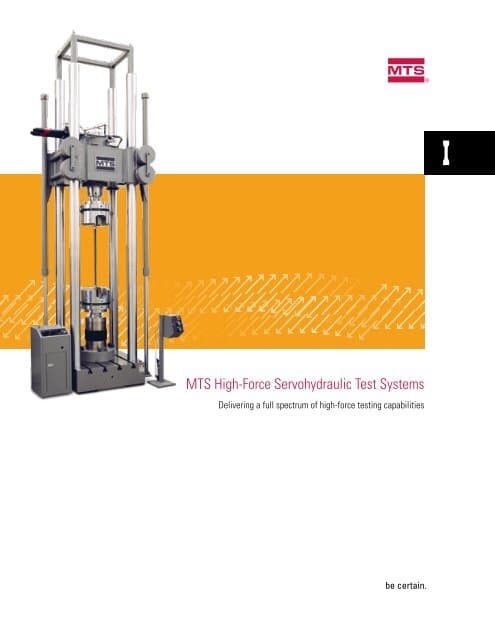
MTS Landmark Servohydraulic Test System
The MTS Landmark Servohydraulic Test System is a market leader for axial fatigue when high peak forces, full standards compliance and broad instrumentation options are required, making it the go-to for structural and component-level endurance testing. It outperforms electrodynamic platforms on maximum load capacity and system integration for complex fatigue protocols, although it typically carries higher capital, installation and service costs than smaller electromechanical competitors.
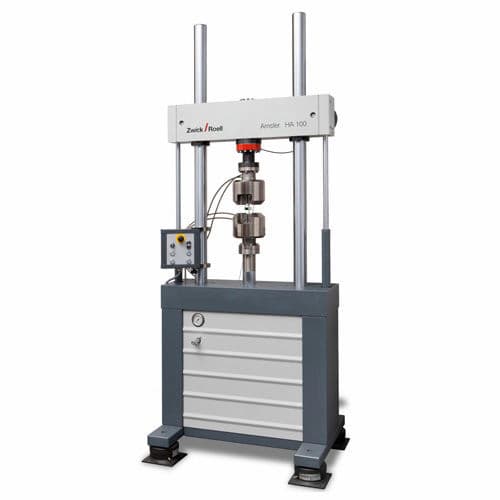
ZwickRoell HA Series Fatigue Testing Machine
The ZwickRoell HA Series offers a balanced, high-precision axial fatigue solution that combines robust hydraulic performance with intuitive testXpert software for standards-driven R&D and QA labs. It delivers competitive price-to-performance and repeatability that sit between the high-capacity MTS systems and the high-frequency electrodynamic Instron units, making it a versatile choice for labs needing strong data quality without the highest facility investments.
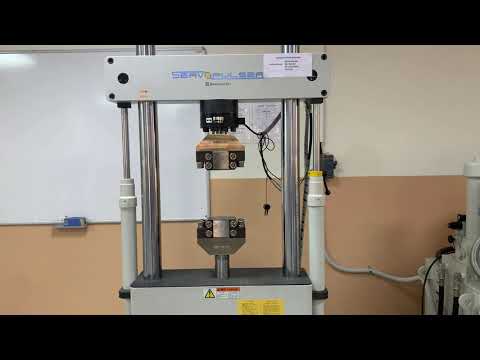
Shimadzu Servopulser Series
The Shimadzu Servopulser Series provides compact, cost-effective servo-driven axial fatigue testers with advanced control electronics for accurate waveform reproduction and low system noise. It is often favored by materials and academic labs for its flexible frequency and waveform control and lower lifecycle costs compared with larger servohydraulic machines, while typically offering lower absolute peak force than top-tier hydraulic leaders like MTS.
$90,000 – $350,000
Walter+Bai LFV Series Fatigue Testing System
The Walter+Bai LFV Series is tailored to high-throughput axial fatigue and endurance testing with an emphasis on durability, automation and fixture flexibility for production environments. Its strength is a favourable total cost of ownership and robust long-term operation for service and manufacturing test cells, making it a practical alternative to R&D-focused platforms even if its software ecosystem is less feature-rich than some laboratory-oriented competitors.

What Research and Standards Say
Scientific studies and international standards back the benefits and best practices of axial fatigue testing. Peer-reviewed research has shown that controlled axial and strain-controlled fatigue tests reliably predict crack initiation and early-life fatigue behavior for metals and many composite systems when tests follow recognized protocols. Standards and round robin studies help ensure data comparability across labs, and research comparing servo-hydraulic and electrodynamic systems clarifies which technologies suit particular frequency ranges and sample types.
Standards such as ASTM E466 (force controlled axial fatigue) and ASTM E606 (strain-controlled fatigue) provide widely accepted methods that improve repeatability and comparability between labs.
Peer-reviewed studies show strain-controlled testing is especially informative for predicting fatigue crack initiation and for components with complex local strain distributions.
Comparative research indicates electrodynamic systems excel at high-frequency, low-force testing, while servo-hydraulic systems offer wider load ranges and better performance for large specimens and structural components.
Environmental and thermal conditioning during tests has been demonstrated to significantly affect fatigue life, so integrated chambers and thermal control increase real-world relevance.
Interlaboratory round robin studies highlight the value of calibrated instrumentation, consistent fixtures, and standardized data reduction when generating S-N curves for design use.
Frequently Asked Questions
Which axial fatigue system should I choose for fast cycling?
Choose the Instron ElectroPuls E10000 if you need fast duty cycles and precise waveform control, since it uses a high-frequency electrodynamic actuator and scores 4.6 average rating.
What does the MTS Landmark servohydraulic system enable?
The MTS Landmark Servohydraulic Test System is built for high-force axial fatigue and long-duration tests, with advanced controls for real-time servo-valve tuning and safety interlocks; rating is 4.7.
How does ZwickRoell HA Series compare by value?
ZwickRoell HA Series Fatigue Testing Machine is described as competitive price-to-performance while delivering high-cycle axial fatigue with reliable hydraulic drive systems; it also has an average rating of 4.5.
Is the Instron ElectroPuls E10000 suitable for standards-driven labs?
Yes for waveform complexity and data acquisition: the Instron ElectroPuls E10000 supports complex load waveforms and high-repeatability data acquisition with integrated control electronics; warranty duration isn’t provided.
Conclusion
This shortlist highlights five leading axial fatigue systems available to Canadian labs and manufacturers in 2026: Instron ElectroPuls E10000, MTS Landmark Servohydraulic Test System, ZwickRoell HA Series Fatigue Testing Machine, Shimadzu Servopulser Series, and Walter+Bai LFV Series Fatigue Testing System. Each model brings strengths: the ElectroPuls is compact and ideal for dynamic, high-frequency work; ZwickRoell and Shimadzu offer excellent materials testing ecosystems; Walter+Bai focuses on high-precision fatigue solutions; and the MTS Landmark Servohydraulic Test System stands out for most Canadian testing programs because of its broad load range, modularity, and strong local support network. I hope this helps you find the right axial fatigue test system. If you want narrower recommendations by sample type, frequency, or budget, refine or expand your search using the search field.