

Top 5 Environmental Fatigue Test Systems in Canada for 2026
Published on Saturday, January 24, 2026
Environmental fatigue test systems combine mechanical fatigue rigs with controlled environmental chambers to manage temperature, humidity, and corrosive atmospheres during cyclic loading. These systems are used to evaluate the combined effects of mechanical fatigue and environmental degradation on materials, coatings, and seals, producing realistic service-life data for aerospace, automotive, energy, and infrastructure sectors. In Canada, buyers prioritize reliability, test repeatability, and local technical support; they also value modularity for multi-purpose labs, energy-efficient chambers that lower operating costs, and data systems that integrate with modern analysis and predictive models. Growing sectors such as electric vehicles, renewable energy, and advanced composites make environmental fatigue testing especially appealing, because combined stress testing shortens development cycles, reduces field failure risk, and helps meet regulatory and customer-driven durability targets.
Top Picks Summary
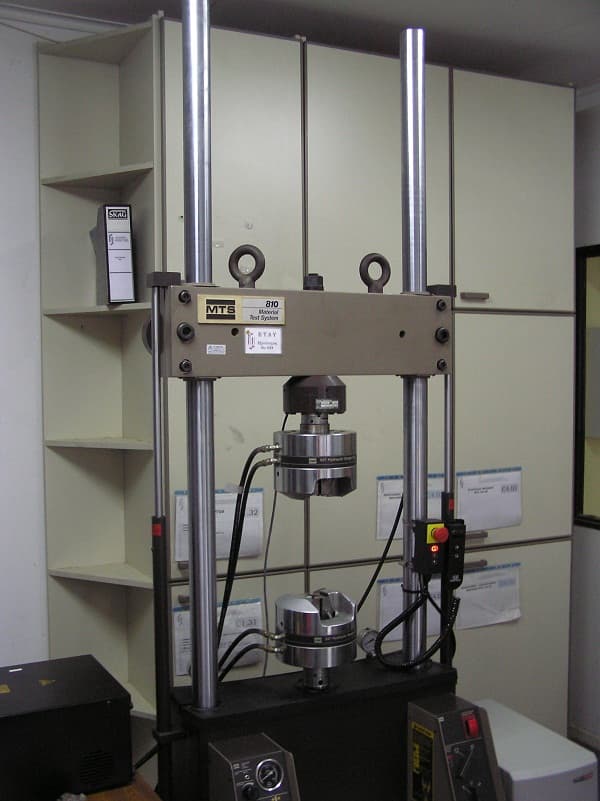
MTS 810 Environmental Test System
The MTS 810 Environmental Test System is positioned as a best-in-class heavy-duty solution for environmental fatigue testing thanks to its high-capacity servo-hydraulic actuation and integrated environmental controls that handle large specimens and structural components. Compared with the other systems on this list it trades higher upfront cost for superior load capacity, long-term durability and advanced controller integration, making it technically and financially attractive for labs that require wide force ranges and lower lifetime maintenance compared with high-frequency electrodynamic alternatives.
Instron ElectroPuls E10000 with Environmental Chamber
The Instron ElectroPuls E10000 with Environmental Chamber is a market-leading electrodynamic fatigue tester optimized for high-frequency, high-cycle environmental fatigue testing and precise displacement control. Relative to hydraulic frames like the MTS 810 it offers a smaller footprint, lower recurring hydraulic maintenance and often lower per-test operating costs for high-cycle regimes, while benefiting from Instron's global service network and software ecosystem that make it a cost-effective choice for labs focused on high-throughput fatigue characterization.

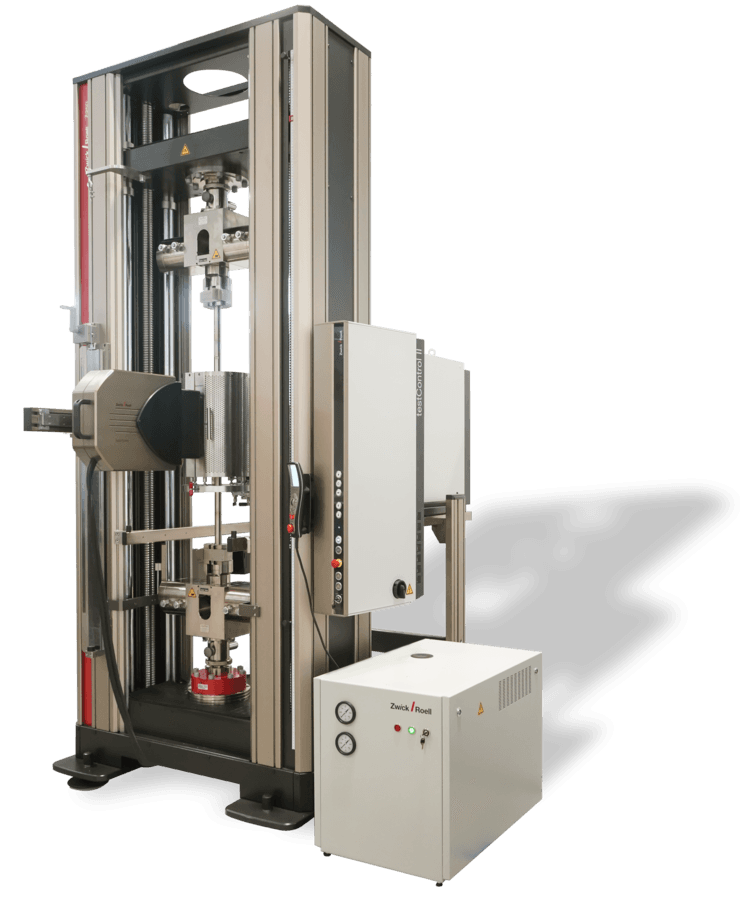
ZwickRoell AllroundLine with Temperature Chamber
The ZwickRoell AllroundLine with Temperature Chamber is a versatile electromechanical tester well-suited to environmental fatigue workflows that prioritize precision, reproducibility and temperature uniformity for material-level testing. Compared with the heavier-capacity MTS 810 and the high-frequency ElectroPuls, ZwickRoell typically offers a more budget-friendly, low-maintenance option for mid-range loads and static-to-fatigue transitions, making it attractive for university and industrial labs that need traceable measurements without the premium spend of specialized fatigue-only systems.
Shimadzu Servopulser with Environmental Chamber
The Shimadzu Servopulser with Environmental Chamber delivers pulse-focused fatigue testing with compact servo-driven actuation and precise control suited to medium-duty environmental fatigue applications. It competes technically with Instron's electrodynamic approach by offering low-vibration, predictable pulse shaping and typically lower acquisition costs in some markets, providing a practical alternative for labs seeking reliable fatigue test performance with a favorable balance of price and service reach in Asia-Pacific and globally.

TestResources 800L Series Fatigue Test System
The TestResources 800L Series Fatigue Test System is a purpose-built fatigue platform favored for high-cycle, axial fatigue testing and turnkey integration with environmental chambers and specimen fixtures. Compared to universal systems from Zwick or Instron it is more specialized—often providing higher throughput, longer duty cycles and optimized fixture options for fatigue laboratories—making it financially efficient for organizations that run large volumes of fatigue tests and want a dedicated, low-downtime workhorse.

Scientific evidence behind combined environmental and mechanical fatigue testing
Peer-reviewed research and industry studies consistently show that combined environmental and mechanical stresses accelerate damage mechanisms compared with isolated tests. Controlled environmental fatigue testing produces reproducible, accelerated failure modes that improve predictive life models and help qualify materials and coatings under realistic conditions. Standards development organizations and university research in Canada and internationally have demonstrated measurable benefits when temperature, humidity, and corrosive agents are included in fatigue protocols.
Combined testing accelerates crack initiation and propagation compared with purely mechanical fatigue, giving earlier, reliable insight into service life.
Humidity and salt-containing atmospheres can significantly reduce cycles to failure for metals and coated systems, a finding supported by corrosion-fatigue studies.
Thermomechanical cycles induce differential expansion and contraction that reveal adhesive or interface weaknesses in composites and coatings.
Reproducible chamber control enables consistent test conditions for better comparison across materials, labs, and design iterations.
Data from environmental fatigue tests feed predictive models (fatigue life estimation and corrosion-fatigue coupling) used by industry to reduce overdesign and support certification.
Frequently Asked Questions
Which system should I pick for heavy structural fatigue testing?
Choose the MTS 810 Environmental Test System if you need a servo-hydraulic load frame for high axial loads and long-duration structural fatigue testing, with integrated environmental chamber options and an average rating of 4.7.
What’s the highest cyclic loading for Instron ElectroPuls E10000?
The Instron ElectroPuls E10000 with Environmental Chamber uses an electrodynamic actuator delivering precise high-frequency cyclic loading up to 10 kN, supported by environmental chamber compatibility for temperature and humidity control, rated 4.6.
How do prices compare for these environmental fatigue test systems?
Price isn’t provided for the MTS 810 Environmental Test System, Instron ElectroPuls E10000 with Environmental Chamber, or ZwickRoell AllroundLine with Temperature Chamber in the available details, so I can’t compare value by cost.
Do the MTS 810 and Instron E10000 support environmental temperature cycling?
Yes—both support temperature and environmental cycling: the MTS 810 has integrated environmental chamber options for temperature and humidity control, while the Instron E10000’s environmental chamber enables temperature and humidity control under dynamic loading (ratings 4.7 and 4.6).
Conclusion
In summary, environmental fatigue test systems are essential for Canadian labs and manufacturers that need to evaluate how materials and assemblies perform under combined mechanical and environmental stress. The five leading options on this page—MTS 810 Environmental Test System, Instron ElectroPuls E10000 with Environmental Chamber, ZwickRoell AllroundLine with Temperature Chamber, Shimadzu Servopulser with Environmental Chamber, and TestResources 800L Series Fatigue Test System—cover a range of capacities and features for different budgets and applications. For most buyers who want a proven, versatile platform with strong performance and available Canadian support, the MTS 810 Environmental Test System is the best overall choice. We hope you found what you were looking for; you can refine or expand your search using the site search to compare specifications, request local demos, or view case studies.