

Top 5 Infrared Thermography Nondestructive Inspection Cameras in Canada for 2026
Published on Saturday, January 24, 2026
Infrared thermography nondestructive inspection cameras and active thermography systems are specialized imaging tools for detecting subsurface defects, delaminations, voids, and thermal anomalies in components and assemblies without contact or destructive testing. Modern systems combine high-sensitivity sensors, cooled and uncooled detector options, pulsed and lock-in excitation techniques, high frame rates, and AI-driven analysis to deliver faster, more reliable inspections across aerospace, composites, automotive, power generation, oil and gas, and advanced manufacturing. In Canada, demand is driven by manufacturers and service providers seeking reduced downtime, predictable maintenance, and improved quality control. Users prefer compact instruments that balance sensitivity and portability for field work, high-resolution cooled cameras for deep or research-grade inspections, and turnkey systems that integrate excitation sources, software, and cloud analytics for automated reporting. Canadian buyers also value local support, rental and service networks, and compatibility with drones and robotic inspection platforms to reach large or hazardous structures safely.
Top Picks Summary
FLIR T865
The FLIR T865 is positioned as a best-in-class handheld thermography camera for nondestructive inspections, offering rugged ergonomics, field-centric reporting and quick lens interchangeability that speeds routine surveys. It outshines lab instruments on site usability and total-cost-of-ownership for field technicians, while accepting that cooled laboratory cameras in this list deliver superior sensitivity for specialized research applications.

FLIR X8500sc
The FLIR X8500sc is a market-leading cooled, scientific infrared camera tailored for high-speed and high-sensitivity NDT tasks where transient thermal events matter most. It commands a premium price compared with handheld or uncooled systems on this list but justifies that cost for advanced research and diagnostics with superior detector performance and frame-rate flexibility versus uncooled industrial heads.

InfraTec ImageIR 9400
The InfraTec ImageIR 9400 is a high-performance cooled camera that balances very high spatial resolution and long-term radiometric stability for demanding industrial and research thermography. Compared with FLIR's cooled science models it competes on image fidelity and comprehensive analysis software, often delivering competitive total value for labs that prioritize repeatability and advanced measurement workflows.
.png%3Fh%3D6eb229a4%26itok%3Dcd8TD-Te&w=3840&q=75)
Optris PI 640i
The Optris PI 640i is a compact, cost-conscious uncooled camera designed for quick deployment and system integration in routine NDT inspections and process monitoring. Its financial and integration advantages make it an attractive choice when project budgets or installation constraints rule out larger cooled systems or very high-resolution heads, even though it cannot match the sensitivity of cooled detectors.

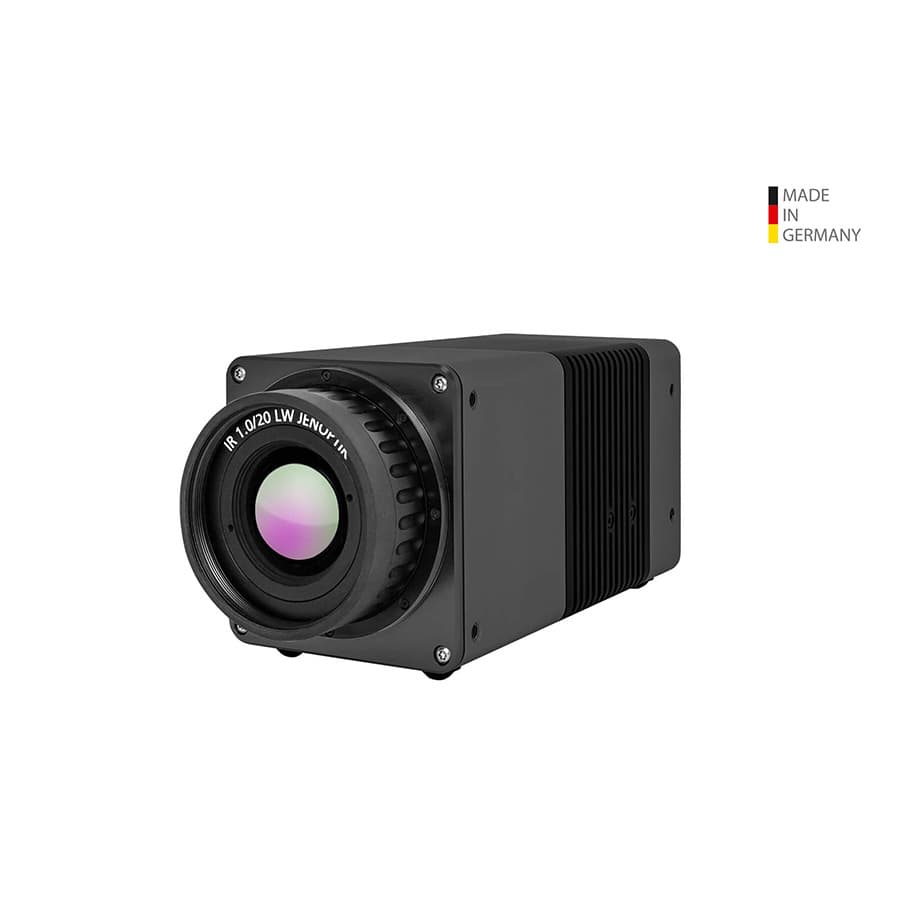
Infratec VarioCAM HD head 900
The InfraTec VarioCAM HD head 900 is a high-definition uncooled camera head that delivers exceptional pixel count and modular flexibility for industrial nondestructive testing and laboratory installations. It occupies a middle ground financially and technically—offering much higher spatial resolution than compact uncooled models like the Optris PI series while remaining far less expensive and operationally simpler than the cooled scientific cameras on this list.
What the Research Says About Infrared Thermography for Nondestructive Inspection
Scientific and industry research over the past two decades shows that active infrared thermography is an effective, noncontact method for locating near-surface and subsurface defects in metals, composites, plastics, and bonded assemblies. Studies demonstrate that pulsed thermography is efficient for rapid scanning of large areas, while lock-in and phase-based methods improve depth resolution and signal-to-noise when looking for deeper defects. Advances in sensor sensitivity, faster detectors, and machine learning image analysis have measurably increased detection rates and reduced false positives, enabling automated defect classification and repeatable reporting.
Pulsed thermography provides rapid thermal contrast across large surfaces, making it suitable for production-line spot checks and maintenance inspections.
Lock-in and phase thermography improve defect depth characterization by analyzing steady-state or frequency-domain thermal responses.
Cooled midwave and longwave sensors typically achieve higher thermal sensitivity (lower mK noise) and superior spatial resolution for detecting subtle anomalies under the surface.
Uncooled microbolometer cameras offer lower cost, portability, and acceptable performance for many field inspections where extreme sensitivity is not required.
AI and machine learning applied to thermal datasets increase repeatability and reduce operator dependence by automating anomaly detection and prioritization.
Peer-reviewed studies and industry trials confirm strong performance on composite delamination, adhesive bond quality assessment, and early detection of thermal faults in electrical systems.
Frequently Asked Questions
Which camera should I pick for field inspections?
Choose the FLIR T865 if you need a rugged handheld thermography camera for professional field inspections, with integrated laser-assisted autofocus and a large intuitive touchscreen for rapid data capture; it has an average rating of 4.7.
What exact feature helps with fast focusing on FLIR T865?
The FLIR T865 includes laser-assisted autofocus plus a large intuitive touchscreen to speed thermal data capture; it’s rated 4.7 and is built with rugged ergonomic handling for inspection work.
How does FLIR T865 price compare to InfraTec ImageIR 9400?
The FLIR T865 lists at $963.20 CADwhile the InfraTec ImageIR 9400 has no listed price in the provided data; the FLIR T865 is rated 4.7 versus InfraTec ImageIR 9400 at 4.6.
Is the FLIR X8500sc better for transient events work?
Yes—FLIR X8500sc is designed for high-speed, high-sensitivity NDT where transient thermal events matter most, using a cooled detector with external triggering; it has an average rating of 4.7.
Conclusion
For Canadian buyers seeking reliable noncontact inspection tools in 2026, these top options cover a range of workflows and budgets. The FLIR T865 delivers rugged, high-end handheld performance for field diagnostics; the FLIR X8500sc is optimized for high-speed, research and development active thermography; the InfraTec ImageIR 9400 provides exceptional sensitivity and resolution for the deepest, most demanding industrial inspections and is our top overall choice for industrial NDT; the Optris PI 640i balances portability with precise temperature measurement for production and field use; and the Infratec VarioCAM HD head 900 offers a high-resolution head unit for integration into automated inspection cells. We hope you found the information you were looking for. If you want to refine or expand your search by application, sensitivity, sensor type, or price range, use the site search to narrow results or compare specifications.