

Top 5 Local Exhaust Arms and Capture Systems in Canada — 2026
Flexible local exhaust arms, capture hoods, and modular fume capture systems engineered for source capture of hazardous emissions in automotive and industrial labs are essential tools for protecting worker health and maintaining regulatory compliance. In Canada these systems appeal to purchasers because they combine precise source capture, chemical-resistant materials, and easy installation with modular options that suit shop floors, research labs, and service bays. Buyers prioritize adjustable articulating arms, low-noise operation, straightforward mounting and serviceability, and suppliers with Canadian distribution and after-sales support. Growing attention to indoor air quality, stricter occupational exposure expectations, and incentives for energy efficient ventilation make robust local exhaust arms a practical, cost effective investment across manufacturing, automotive repair, electronics assembly, and educational laboratories.
Inception's AI took the time to understand this market in Canada · · How we pickWe may earn a commission on purchases. It never affects our rankings.
Top Picks Summary
Nederman FX2 Extraction Arm
The Nederman FX2 is positioned as a best-in-class extraction arm for Local Exhaust Arms and Capture Systems thanks to its robust industrial construction, excellent airflow performance, and wide range of nozzle and mounting options that suit heavy-duty welding and fabrication environments. Compared with the other products listed, the FX2 emphasizes durability and higher capture efficiency for continuous use, trading off a higher upfront price for lower long-term service and replacement costs in demanding applications.

We may earn a commission on purchases. It never affects our rankings.
Estimated$1,500 – $3,500
Plymovent UltraFlex-4
Plymovent UltraFlex-4 stands out for its lightweight, highly flexible design and smooth balance that makes frequent repositioning effortless in garages and small workshops, offering a strong value proposition where operator ergonomics matter. Compared to heavier industrial arms like the Nederman FX2 or Fumex FA2, the UltraFlex-4 provides a lower-cost, lower-weight alternative with quick deployment and attractive total cost of ownership for light- to medium-duty capture tasks.

Nordfab Quick-Fit Extraction Arm
Nordfab Quick-Fit earns its market-leader status primarily because of its modular Quick-Fit coupling system that dramatically reduces installation time and labor costs for ducting and capture arm networks. In comparison to fixed-connection systems from other brands, Nordfab’s product delivers technical and financial advantages during system build-outs and reconfigurations, making it especially attractive for facilities that prioritize rapid installation and frequent layout changes.
Estimated$700 – $2,200
Diversitech Flex-O-Duct Fume Arm
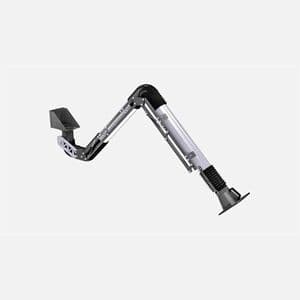
The Diversitech Flex-O-Duct fume arm is a cost-conscious, flexible capture solution that emphasizes portability and simple attachment, making it a practical choice for occasional or temporary extraction needs and service technicians. Compared with heavier, permanently mounted arms like the Nederman FX2 or modular Nordfab systems, the Flex-O-Duct offers the lowest entry price and easiest deployment, though with trade-offs in long-term durability and maximum capture performance for intense industrial use.
Estimated$300 – $1,200
Research and Evidence: Why Source Capture Works
Scientific research and industry guidance consistently show that capturing contaminants at the source is one of the most effective ways to reduce airborne exposures. Local exhaust systems stop hazardous emissions before they disperse into the workspace, lowering worker exposure, reducing general ventilation load, and improving overall indoor air quality. Relevant guidance from organizations such as the Canadian Centre for Occupational Health and Safety, NIOSH, and ASHRAE supports the use of source capture, appropriate hood design, and correct capture velocities to control fumes, dusts, and aerosols.
Source capture reduces contaminant concentrations near breathing zones faster than general dilution ventilation, improving immediate worker protection.
Design guidance recommends selecting hood geometry and capture velocities based on contaminant type; typical target capture velocities often range from approximately 0.5 to 2.5 meters per second depending on particulate or fume characteristics.
Studies and industrial case reports show captured-emission control often enables lower total building ventilation rates, which can reduce energy use while maintaining safety.
Materials compatibility and chemical resistance are important: hoses, arms, and seals must match the chemicals handled to avoid degradation and maintain capture performance.
Regular maintenance, filter checks, and proper mounting significantly influence long-term performance and consistent compliance with occupational health recommendations.
Frequently Asked Questions
Which arm is best for heavy-duty welding labs?
Nederman FX2 Extraction Arm is the best pick for heavy-duty welding and fabrication since it uses robust aluminum construction with a corrosion-resistant finish and a balanced spring-arm design for precise positioning and stable capture (rating 4.7).
What’s special about Nederman FX2 flexible positioning?
The Nederman FX2 Extraction Arm features balanced spring-arm geometry with smooth swivel joints for precise positioning and stable capture, plus multiple hood sizes and mounting options (wall/ceiling/bench) for standard ducting and filtration integration (rating 4.7).
Is Plymovent UltraFlex-4 better value than heavier arms?
Plymovent UltraFlex-4 is positioned as lightweight and easy to reposition thanks to low-resistance joints and a counterbalance system for single-hand positioning, rated 4.6; however no Canada price is provided in the data.
Who should choose Fumex FA2 flexible arm instead?
Choose the Fumex FA2 Flexible Extraction Arm for lab and light manufacturing where noise and comfort matter, since it has a slim-profile flexible arm for confined workstations and durable, chemically resistant materials for quick-adjust repositioning (rating 4.5); no warranty duration is provided.
Conclusion
In Canada the market for local exhaust arms and capture systems is practical and performance driven. The five leading options highlighted here are Nederman FX2 Extraction Arm, Plymovent UltraFlex-4, Fumex FA2 Flexible Extraction Arm, Nordfab Quick-Fit Extraction Arm, and Diversitech Flex-O-Duct Fume Arm. Each model offers a balance of flexibility, chemical resistance, and ease of installation for automotive and industrial lab environments. For most Canadian buyers seeking proven performance, broad support and the best mix of durability and serviceability, the Nederman FX2 Extraction Arm stands out as the top choice among these options. We hope you found what you were looking for—use the search to refine by application, material compatibility, mounting type, or to expand your search to ventilation units and filtration accessories.