

Top 5 Precision Metallographic Cutoff Saws in Canada for 2026
Precision metallographic cutoff saws are high-accuracy machines for preparing metallographic samples in automotive, aerospace, battery, and industrial labs. Designed to minimize heat and mechanical deformation, these saws use controlled feed, diamond or abrasive wheels, and often wet cutting to protect microstructure and deliver repeatable sectioning. In Canada, buyers favor units with strong local service and parts support, low total cost of ownership, automation options for high throughput, and compliance with metallography standards. The result is improved microstructure fidelity, faster lab workflows, and fewer re-preparations for demanding R&D and quality control applications.
Inception's AI took the time to understand this market in Canada · · How we pickWe may earn a commission on purchases. It never affects our rankings.
Top Picks Summary
Struers Secotom-60
The Struers Secotom-60 is positioned as a best-in-class precision metallographic cutoff saw for laboratories that need consistent, easy-to-use sample cutting with minimal setup. It stands out for its compact, serviceable design and strong global support network, offering a lower lifecycle cost and faster time-to-result than larger, higher-throughput systems while delivering tighter tolerances than many entry-level units. Compared with the IsoMet 5000 and LECO MSX255, the Secotom-60 trades raw throughput for bench-top convenience and predictable per-sample operating cost, making it a practical choice for research and quality labs focused on repeatable precision without oversized capital expenditure.

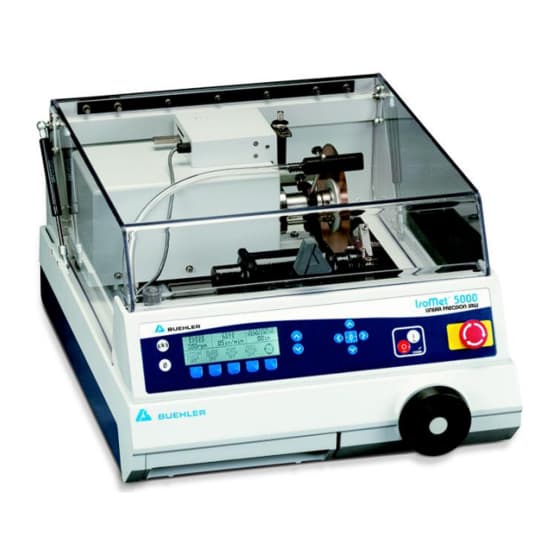
Buehler IsoMet 5000
The Buehler IsoMet 5000 is marketed as a market-leading precision cutoff saw for delicate and hard-to-machine materials where minimizing deformation is critical. Its advanced control of cut parameters and gentle cutting philosophy justify a higher upfront price by protecting microstructure integrity and reducing downstream rework, distinguishing it from more throughput-oriented machines like the LECO MSX255. For laboratories prioritizing specimen integrity over volume — such as failure analysis and high-end R&D — the IsoMet 5000 offers technical advantages that often outweigh its premium cost.
Estimated$25,000 – $45,000
LECO MSX255
The LECO MSX255 is a market leader for high-throughput precision metallographic cutoff operations, designed to process large sample batches with automated workflows and robust build quality. Its strength is operational efficiency and integration potential for production or central analytical facilities, delivering faster throughput and lower per-sample labor costs than compact bench saws like the Secotom-60 or Presi Mecatome T330. While typically a larger capital investment than simpler saws, the MSX255 provides strong return-on-investment in environments where volume, traceable process control, and uptime drive overall cost-effectiveness.

ATM Brillant 265
The ATM Brillant 265 occupies a middle ground as a precision cutoff saw that balances German-engineered durability with straightforward operation for routine metallographic work. It offers a pragmatic combination of precise cutting, good coolant and wheel management, and competitive pricing that makes it attractive for labs that need higher reliability than entry-level machines but cannot justify the premium of specialized systems. Compared with the IsoMet 5000 and LECO MSX255, the Brillant 265 is technically versatile and often more cost-competitive for medium-volume labs seeking dependable, low-maintenance performance.

Estimated$10,000 – $18,000
Presi Mecatome T330
The Presi Mecatome T330 is presented as a cost-conscious precision cutoff saw that delivers fine microstructural preservation and modular accessory options for research and small-scale production. Its principal advantage is a lower purchase price and flexible configuration, making precision cutting accessible to academic and boutique laboratories that find high-end units like the IsoMet 5000 or LECO MSX255 prohibitively expensive. While it may not match the throughput of LECO or the ultra-gentle cutting of Buehler, the Mecatome T330 offers excellent value where accuracy and budget sensitivity are both priorities.

We may earn a commission on purchases. It never affects our rankings.
Estimated$18,000 – $35,000
Research-backed benefits of precision cutoff cutting
Multiple laboratory studies and industry guides show that cutting technique, control of heat, and the use of coolant materially affect metallographic sample quality. Following standardized specimen preparation procedures and using precision cutoff saws reduces artifacts such as smearing, thermal alteration, and mechanical deformation, making downstream grinding, polishing, and analysis more reliable.
Minimizing heat generation during cutting preserves the native microstructure; slower cutting speeds combined with adequate coolant are consistently recommended.
Wet cutting reduces recast layers and airborne particulates, improving surface finish and laboratory safety compared with dry cutting.
Automated and programmable feed systems improve repeatability and reduce operator-to-operator variation, which is critical for quality control and comparative studies.
Diamond and CBN abrasive wheels produce cleaner sectioning on hard or brittle materials and lower the risk of chipping compared with standard abrasives.
Proper fixturing and clamping minimize mechanical deformation during sectioning; rigid setup is as important as cutting parameters.
Following standards such as ASTM E3 and recognized laboratory protocols ensures results are comparable across labs and testing campaigns.
Frequently Asked Questions
Which cutoff saw should my lab buy Struers Secotom-60?
Choose the Struers Secotom-60 if you want repeatable, easy-to-use metallographic cuts with an adjustable feed, integrated coolant routing, and safety interlocks; it’s rated 4.7 and suited to routine lab workflows.
What does Buehler IsoMet 5000 control during cutting?
The Buehler IsoMet 5000 uses advanced programmable cycles and force control for automated, repeatable sample preparation, and it has a high-torque motor with a wide speed range; it’s rated 4.8.
How does LECO MSX255 price compare for throughput value?
The provided info doesn’t include any LECO MSX255 price, so I can’t compare value by cost; what is available is its microprocessor-controlled customizable cutting programs and efficient coolant management, rated 4.5.
Is LECO MSX255 better for production batch work?
Yes—the LECO MSX255 is designed for high-throughput metallographic cutoff operations with automated workflows and customizable cutting programs, rated 4.5; the provided details don’t list a warranty duration.
Conclusion
In the Canadian lab market, the Struers Secotom-60, Buehler IsoMet 5000, LECO MSX255, ATM Brillant 265, and Presi Mecatome T330 represent the leading precision cutoff saws for 2026, each balancing accuracy, serviceability, and workflow features. For many high-precision automotive and industrial labs the Buehler IsoMet 5000 stands out as the best overall choice because of its advanced automation options and established support network in Canada, while the Struers Secotom-60, LECO MSX255, ATM Brillant 265, and Presi Mecatome T330 each provide strong alternatives depending on budget and specific application needs. We hope you found the information you were looking for — you can refine or expand your search using the site search to compare specifications, consumables, and local service options.