

Top 5 Laboratory Presses in Canada 2026: Hydraulic, Pneumatic and Heated Pellet Presses
Published on Saturday, January 24, 2026
Laboratory presses are essential tools for sample preparation across Canadian research, quality control, environmental testing and industrial labs. These machines compress powders and materials into pellets or shaped specimens for chemical analysis, spectroscopy, XRF, XRD, mechanical testing and more. Modern units — including hydraulic, pneumatic and heated presses — offer programmable force and temperature profiles that deliver repeatable conditioning, tighter tolerances and better data quality. In Canada, buyers favor compact benchtop designs, energy efficient systems, clear digital controls and service networks that can support calibration and compliance with ISO and ASTM testing practices. Labs also prioritize safety features, traceable load and temperature logs, and flexible tooling to handle small research batches as well as routine quality control runs.
Top Picks Summary
Carver 4386 Heated Press
The Carver 4386 Heated Press is a heavy-duty laboratory press prized for its wide heated platen and precise temperature control, making it a go-to for polymer molding and high-temperature sample preparation in research and production labs. Compared with the manual or pellet-focused presses in this list, it commands a higher upfront cost but delivers superior thermal uniformity and throughput that reduce per-sample processing time and long‑term operating costs for labs that need repeatable heated pressing.
Where to buy Carver 4386 Heated Press in Canada: the trusted retailers we track in this market, with the best price we have observed at each. Prices are checked regularly and can change, and the retailer confirms the final price at checkout.
We may earn a commission on purchases. It never affects our rankings.
$8,000 – $13,000
Specac Atlas Manual Hydraulic Press
The Specac Atlas Manual Hydraulic Press is a compact, manually operated unit that offers an economical, low-maintenance solution for routine pellet and small-sample pressing in constrained budgets or space-limited labs. It lacks the automation and high-pressure digital control of the market-leading automated models, but its lower purchase price and simple serviceability make it attractive for teaching labs and occasional use where capital expenditure and complexity must be minimized.
Where to buy Specac Atlas Manual Hydraulic Press in Canada: the trusted retailers we track in this market, with the best price we have observed at each. Prices are checked regularly and can change, and the retailer confirms the final price at checkout.
We may earn a commission on purchases. It never affects our rankings.
$3,000 – $7,000
PIKE Technologies Crush Pellet Press
The PIKE Technologies Crush Pellet Press is purpose-built for FTIR pellet production and is valued for its straightforward operation, quick cycle times, and low per-pellet cost, making it a practical choice for spectroscopy labs focused on routine KBr or Nujol pellet workflows. While it does not match the automated precision or high pressures of the Retsch or Spex systems, its specialized, cost-efficient design provides excellent value when pellet quality and throughput needs are moderate rather than industrial-scale.

Retsch PP 40 Pellet Press
The Retsch PP 40 Pellet Press is a German-engineered laboratory press known for high reproducibility and robust hydraulic control, delivering consistent pellet density and pressure for analytical applications that demand tight tolerance. It typically carries a premium price compared with simpler pellet presses, but its technical advantages—digital pressure control, repeatability and build quality—translate into lower analytical variability and reduced rework costs for labs prioritizing precision.
Where to buy Retsch PP 40 Pellet Press in Canada: the trusted retailers we track in this market, with the best price we have observed at each. Prices are checked regularly and can change, and the retailer confirms the final price at checkout.
We may earn a commission on purchases. It never affects our rankings.
$10,000 – $18,000
Spex SamplePrep 3624B X-Press
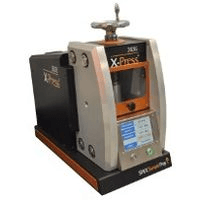
The Spex SamplePrep 3624B X-Press is a motorized, programmable press favored by labs that require automated, repeatable sample compaction and high-throughput workflows; its modular tooling and advanced controls position it as a market leader for demanding QC and R&D environments. Although its capital cost is higher than manual or basic pellet presses, the savings in labor, improved reproducibility versus purely manual systems, and compatibility with a wide range of sample types justify the investment in medium-to-large laboratory operations.
Why controlled pressure and temperature matter
Controlled pressing and heating improve sample homogeneity and reproducibility, which directly affects the accuracy and precision of downstream tests. Research and technical reports from instrument manufacturers and academic labs consistently show that consistent force, dwell time and temperature reduce variability between pellets or specimens and lower the risk of matrix effects in spectroscopic methods. For beginners, the practical takeaway is simple: a press that records and repeats the same profile makes results easier to trust and compare across runs and labs.
Consistent pressure improves density uniformity, reducing within-sample variability and improving measurement precision.
Temperature control limits loss of volatiles and prevents thermal decomposition, which is important for organic and mixed-matrix samples.
Programmable profiles with repeatable ramps and dwells increase reproducibility across operators and over time.
Pelletizing and compaction reduce particle size effects and surface irregularities, producing more representative samples for XRF and XRD analysis.
Data logging and traceability support QA workflows and make it easier to meet audit and certification requirements.
Frequently Asked Questions
Which press should I buy for polymer molding labs?
Choose the Carver 4386 Heated Press for polymer molding and high-temperature sample preparation, since it has an integrated heated platen for controlled cure cycles and a robust hydraulic system for stable pressure; it has an average rating of 4.6.
What exact heated press spec does Carver 4386 offer?
The Carver 4386 Heated Press includes an integrated heated platen that delivers reproducible thermal pressing and controlled cure cycles; it’s rated 4.6 on average.
How does PIKE Crush Pellet Press price compare value-wise?
The provided data doesn’t list a price or currency for the PIKE Technologies Crush Pellet Press, but it notes fast pelletizing and purpose-built FTIR pellet production with an average rating of 4.3.
Is the Specac Atlas Manual Hydraulic Press good for small labs?
Yes—the Specac Atlas Manual Hydraulic Press is a compact, manually operated benchtop unit for routine pellet and small-sample pressing in space-limited labs, with a calibrated pressure gauge and average rating of 4.4.
Conclusion
If you are shopping in Canada for a reliable laboratory press, these top choices cover a wide range of needs. The Carver 4386 Heated Press stands out for temperature control and programmability, the Specac Atlas Manual Hydraulic Press is a solid manual workhorse, the PIKE Technologies Crush Pellet Press is built for straightforward pellet production, the Retsch PP 40 Pellet Press offers robust engineering for routine lab use, and the Spex SamplePrep 3624B X-Press provides compact automated convenience. For most labs seeking the best combination of heated control and repeatability, the Carver 4386 Heated Press is the recommended choice. We hope you found what you were looking for; you can refine or expand your search by model, capacity, or feature set using the search options.