

Top 5 Automated Guided Vehicle Fleets in Canada for 2026
Automated Guided Vehicle (AGV) fleets are wire-, magnetic-, or laser-guided vehicles deployed for repetitive intra-facility transport of materials, pallets, and racks. In Canada, AGV adoption is driven by growth in e-commerce, manufacturing modernization, cold chain demands, and the need for resilient, cost-effective material handling. Current market trends emphasize fleet coordination, advanced battery management, safety-rated navigation, and seamless integration with facility control systems and warehouse management software. Canadian buyers tend to prioritize reliability, local support and service, predictable total cost of ownership, rapid return on investment, and scalable solutions that can adapt to seasonal demand and cross-border supply chains.
Inception's AI took the time to understand this market in Canada · · How we pickWe may earn a commission on purchases. It never affects our rankings.
Top Picks Summary
Linde C-MATIC
Linde C-MATIC secures a best-in-class position for AGV fleets by turning proven Linde trucks into automated lift vehicles with robust safety systems and industry-grade durability; its strength is seamless integration with existing Linde forklifts which lowers capital expense for mixed fleets. Compared with the other offerings here, C-MATIC is particularly cost-effective for operators who want to automate selectively and keep a common fleet footprint, reducing training and spare-parts complexity versus deploying wholly new robot platforms.

Estimated$60,000 – $120,000
Toyota Autopilot LAE
Toyota Autopilot LAE is a market leader due to Toyota's deep expertise in materials-handling hardware and global service network, delivering highly reliable autonomous operation and strong total cost of ownership performance for fleet deployments. Against the other products on this list, Toyota stands out for its end-to-end ecosystem and lifecycle support—often commanding a higher upfront investment but offering predictable maintenance costs and rapid worldwide support for large, multi-site AGV fleets.

Estimated$70,000 – $140,000
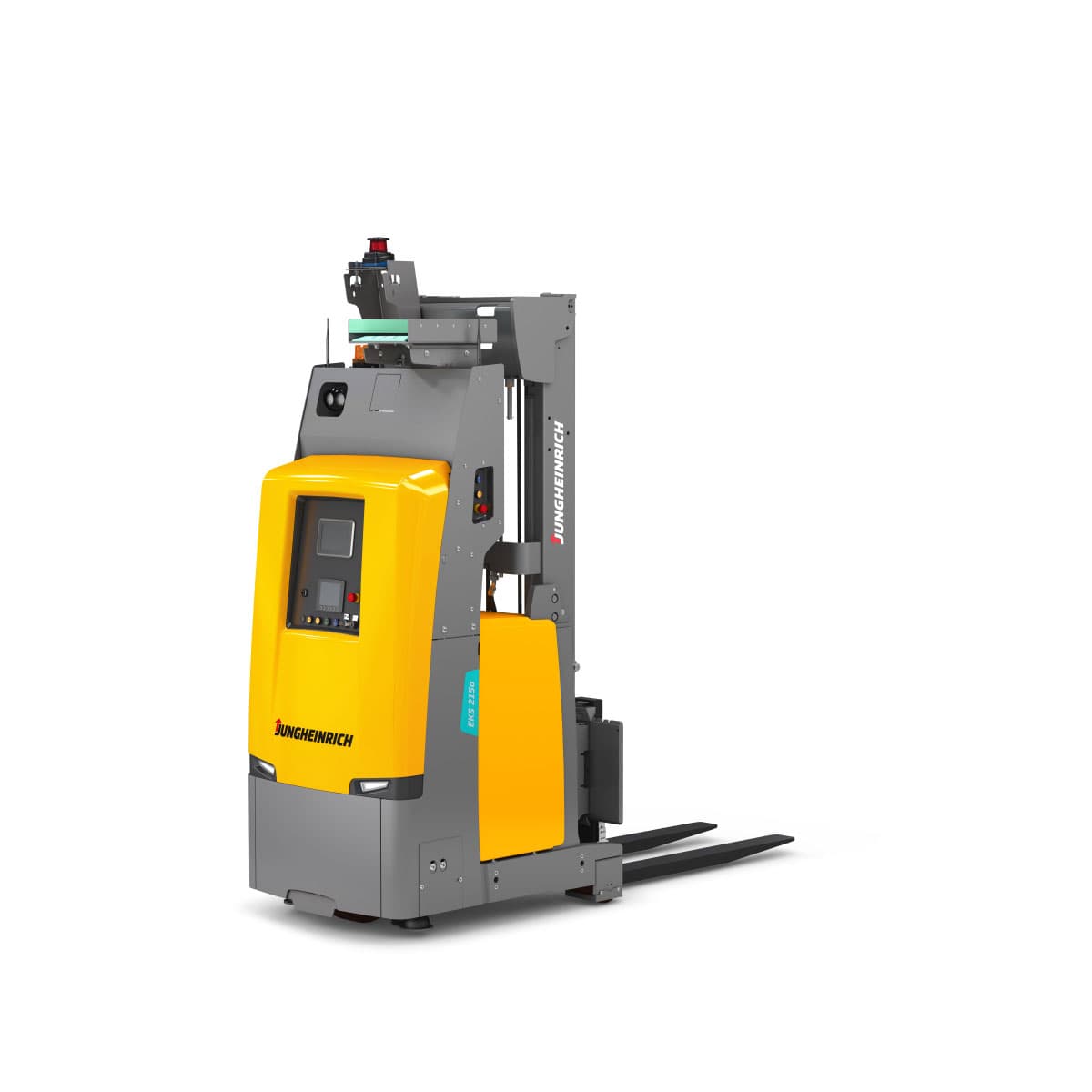
Jungheinrich EKS 215a
The Jungheinrich EKS 215a is recognized for narrow-aisle and high-density warehouse automation, offering compact automated reach-truck capability that maximizes throughput per square meter and reduces storage footprint. In comparison to larger tow or truck-style AGVs, the EKS 215a delivers a technically efficient option for operations prioritizing aisle utilization and energy efficiency, making it an attractive financial choice where space is the limiting resource.
Estimated$50,000 – $95,000
Dematic AGV
Dematic AGV systems are positioned as market leaders for fleet-scale automation because they combine proven vehicle hardware with powerful fleet management and WMS/ERP integration, enabling rapid orchestration of hundreds of robots and measurable labor savings. Versus the other products listed, Dematic emphasizes turnkey software and systems integration which can raise initial project scope but yields larger operational savings and faster ROI for enterprise-class AGV fleets.

Estimated$80,000 – $250,000
OTTO 1500
OTTO 1500 by OTTO Motors is a leader for heavy-duty autonomous material movement, offering high payload capacity and modular towing/pallet solutions that deploy quickly and scale flexibly across production and distribution sites. Compared with forklift-based or narrow-aisle options, the OTTO 1500 provides technical versatility and fast redirection of workflows—often at a higher unit price but with lower integration time and strong savings in labor and downtime for dynamic, mixed-workload AGV fleets.

Estimated$75,000 – $160,000
What research and studies say about AGV benefits
Multiple industry studies and technical assessments show that AGV fleets deliver measurable improvements in throughput, consistency, safety, and operating cost when implemented with proper planning and integration. Research from automation and supply chain analysts, together with vendor case studies and standards bodies, highlights benefits such as reduced manual handling injuries, lower product damage rates, and predictable cycle times. Studies also underline the importance of battery technology, fleet orchestration software, and safety-rated navigation for achieving those gains.
Productivity and throughput: Industry analyses and vendor case studies report consistent productivity gains. When AGVs replace repetitive manual transport tasks, facilities typically see more consistent cycle times and higher hourly throughput.
Safety improvements: Research and safety assessments indicate fewer workplace injuries from material handling when AGVs remove repetitive towing and pallet-moving tasks from workers, especially when combined with safety-rated navigation and sensors.
Energy and battery management: Technical studies on lithium-ion and advanced battery systems show improved run times and faster charging cycles, reducing downtime and increasing effective utilization for 24/7 operations.
Return on investment: Supply chain reports and cost models demonstrate that many AGV projects meet payback targets in a few years, depending on labor costs, utilization rates, and the degree of process change.
Integration and digitalization: Research into Industry 4.0 and smart warehouses emphasizes that the largest benefits occur when AGVs are integrated with warehouse management systems, fleet supervisors, and facility control systems for task allocation and real-time routing.
Frequently Asked Questions
Which AGV fleet product fits Linde forklift sites best?
Linde C-MATIC is the best fit for sites already using Linde forklifts because it “turns proven Linde trucks into automated lift vehicles” with seamless integration, automated counterbalance precision positioning, built-in safety sensors, and integration with fleet management systems; rating 4.7.
What safety and positioning features does Linde C-MATIC have?
Linde C-MATIC uses built-in safety sensors plus speed control and obstacle detection for mixed-traffic environments, and it provides automated counterbalance truck platform precision positioning for pallet handling; average rating 4.7.
How does Toyota Autopilot LAE pricing compare here?
No price information is provided for Toyota Autopilot LAE, but it is described as delivering strong total cost of ownership performance through integration with Toyota telematics and WMS for centralized fleet orchestration; rating 4.5.
Is Jungheinrich EKS 215a meant for narrow aisles?
Yes—Jungheinrich EKS 215a is a compact automated pallet stacker designed for narrow aisles and dense racking layouts, with precise lift and positioning control and compatibility with Jungheinrich fleet control systems; rating 4.4.
Conclusion
In the Canadian context, AGV fleets are a practical solution for modern warehouses and factories that need reliable, scalable material transport. The five leading options presented here each suit different priorities: Linde C-MATIC for forklift automation and heavy pallet flows, Toyota Autopilot LAE for proven OEM integration and dealer support, Jungheinrich EKS 215a for compact electric pallet handling, Dematic AGV for large-scale system integrator projects, and OTTO 1500 for flexible, safety-focused mobile load handling. For most Canadian sites seeking a balance of safety, fleet coordination, and integration capability, the OTTO 1500 stands out as the best overall choice among these options. I hope you found what you were looking for; you can refine or expand your search using the site search to compare features, case studies, or local support for each model.