

Canada's Top 5 Steering Dampers and Stabilizers for 2026
Steering dampers and stabilizers reduce wobble and improve high speed stability across motorcycles, ATVs, UTVs, trucks, trailers, and light vehicles. In Canada the category is driven by diverse road conditions, from gravel and winter-salt roads to high-speed highways, and by growing interest in electronic compatibility for modern vehicles and EVs. Shoppers prefer systems that offer tunable damping (adjustable or progressive), durable aftermarket mounts, proven reliability in cold weather, and, increasingly, active electronic control that can integrate with CAN bus systems. This category covers mechanical viscous and friction dampers, progressive-valve designs, and adaptive active systems that use sensors and controllers to adjust damping in real time.
Inception's AI took the time to understand this market in Canada · · How we pickWe may earn a commission on purchases. It never affects our rankings.
Top Picks Summary
The Öhlins SD 090 is positioned as the premium choice for rotary steering dampers thanks to its precision engineering, highly tunable damping and robust materials that deliver consistent control at extreme speeds. It justifies a higher price point with rebuildable internals and race-proven performance, outclassing the cheaper and simpler units on this list while offering more refined feedback and longevity than Scotts, HyperPro, GPR and Toby alternatives. For riders who prioritize ultimate stability and serviceability in demanding road or track use, the SD 090 represents best-in-class technical refinement.
Show More Rotary Steering Dampers
Estimated$750 – $1,000
The GPR V1 is positioned as a best-in-class linear steering stabilizer cylinder because it balances high-quality damping hardware with competitive pricing, delivering precise linear control and durable construction suited to aggressive street and light race use. Compared with the ultra-premium Öhlins unit it offers many of the same build and serviceability features at a lower cost, and it provides a more refined feel than entry-level options like WRP while sitting close to Scotts in adjustability and fitment coverage.
Show More Linear Steering Stabilizer Cylinders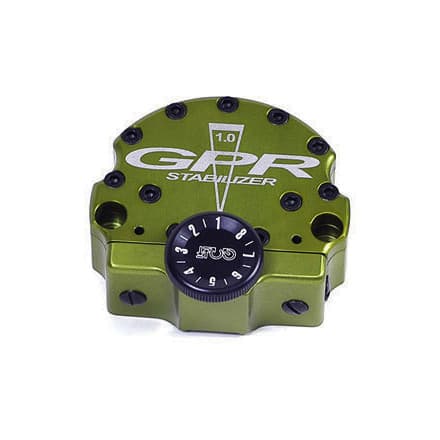
Estimated$450 – $650
Hyperpro's Steering Damper RSC earns its place for a compact, sport-focused approach to progressive friction steering control, with rider-friendly adjustability geared toward performance motorcycles. It sits between Scotts and Öhlins on cost and capability—more sophisticated and better tuned than entry-level kits, yet more affordable and lighter than some premium Öhlins options—making it a strong choice for riders wanting spirited handling without the highest premium. The RSC's balance of progressive damping, packaging and mid-range pricing makes it especially attractive for sportbike applications.
Show More Progressive Friction Steering Stabilizers
Estimated$700 – $1,000
Toby Dampers Electronic Steering Damper
Toby Dampers' electronic steering damper emphasizes lightweight electronics, fast-response control and straightforward retrofitability, making it an attractive, cost-effective active option for riders who want modern functionality without premium brand fees. It typically undercuts Öhlins and HyperPro on price while offering more active control than many GPR or basic Scotts units, though it may have a smaller service footprint and less extensive dealer support.
Show More Electromechanical Active Steering Stabilizers
YSS SD-001 is the budget-friendly option that delivers competent damping improvements for everyday riders and commuters, significantly undercutting the rest of the lineup on cost while offering acceptable reliability. It lacks the ultra-fine valving and premium materials of Öhlins or the race bias of HyperPro and Scotts, but its low price and easy availability make it the practical choice for cost-conscious buyers.
Show More Universal Aftermarket Steering Dampers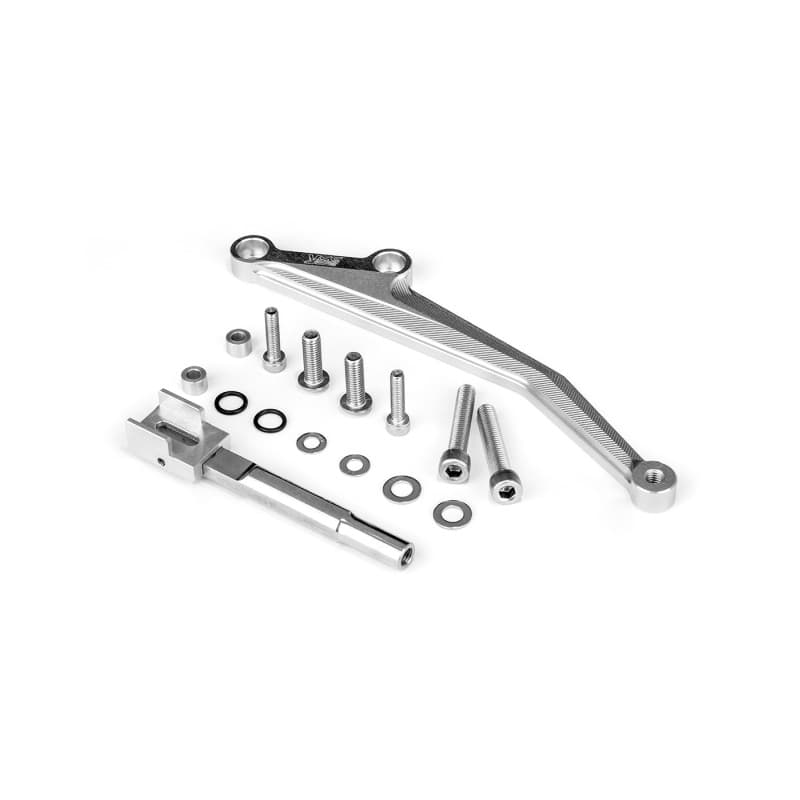
Estimated$240 – $380
How Steering Dampers Work and What Research Shows
Steering dampers reduce repetitive or sudden steering oscillations by adding a controlled resistive torque to the steering system. Mechanical dampers use viscous fluid, friction elements, or spring-progressive mechanisms to absorb energy from oscillations, while active electronic systems use sensors, fast actuators, and control logic to vary damping based on speed, yaw, and road inputs. Vehicle dynamics research, industry technical papers, and controlled test rigs consistently show that properly matched dampers lower oscillation amplitude, reduce the frequency of headshake events, and improve tracking stability at speed. Active systems further enhance performance by adapting damping to driving conditions, which can improve both stability and ride comfort.
Basic physics: dampers convert steering oscillation energy into heat or controlled resistance, reducing amplitude and growth of wobble.
Mechanical studies and SAE technical papers demonstrate measurable reductions in steering oscillation and improved handling when damping is tuned to the vehicle.
Active electronic dampers use sensors (steering angle, yaw rate, wheel speed) and actuators to change damping in milliseconds for optimized stability across conditions.
Different damping strategies work for different vehicles: motorcycles often benefit from progressive and hydraulic dampers to control headshake; off-road trucks and UTVs require heavy-duty stabilizers to manage impact-induced oscillations.
Cold climate performance matters: low-temperature viscous characteristics and seals must be specified for reliable Canadian winter use.
Frequently Asked Questions
Which Öhlins steering damper fits serious racers best?
Choose the Öhlins SD 090 Steering Damper for serious racers who want highly tunable damping and consistent control at extreme speeds; it has a 4.8 rating and a CNC-machined corrosion-resistant body with tool-free adjust.
What adjustability does the Öhlins SD 090 include?
The Öhlins SD 090 Steering Damper includes precisely adjustable damping with multiple click settings for track and street tuning, plus a tool-free adjust feature.
Is the Öhlins SD 090 worth $917.73 for damping?
The Öhlins SD 090 Steering Damper costs $917.73 CAD and gives a gas-pressurized rotary design for consistent damping, multiple click settings, and a corrosion-resistant CNC-machined body; it’s rated 4.8.
Does the Öhlins SD 090 have corrosion-resistant materials?
Yes—Öhlins SD 090 Steering Damper lists a corrosion-resistant finish and high-grade CNC-machined body built for long-term reliability; it’s rated 4.8 (warranty duration not provided).
Conclusion
Whether you need a premium motorcycle damper, a heavy-duty stabilizer for off-road trucks, or an electronically adaptive system that integrates with modern controls, Canada offers solutions that balance stability, durability, and compatibility. We hope this guide helped you find a direction for 2026. If you want to refine results by vehicle make, application, or budget, use the search filters or expand the query to find mounts, kits, and installation options.