

Top 5 Boost and Vacuum Pressure Sensors in Canada for 2026
Published on Saturday, January 24, 2026
Boost and vacuum pressure sensors, including MAP, absolute and relative pressure transducers, are essential for turbocharged, supercharged, and naturally aspirated engines. These sensors deliver high accuracy across wide pressure ranges to support precise air fuel ratio control, boost management, and safe engine tuning. Modern variants for 2026 commonly offer digital outputs, temperature compensation, and rugged housings designed for motorsport and harsh Canadian climates. Canadian buyers favor sensors that balance accuracy, pressure range (for example 3.5 bar, 4 bar, and 7 bar options), ECU compatibility, durable construction, and local availability or support. Trends in Canada emphasize reliable cold-weather performance, plug-and-play compatibility with popular ECUs, and clear calibration data, while advanced users increasingly look for CAN, SPI, or digital frequency outputs for low-noise, repeatable measurements.
Top Picks Summary
AEM Electronics 30-2130-50 3.5 BAR MAP Sensor
AEM's 30-2130-50 3.5 BAR MAP sensor is a value-focused aftermarket choice that balances accuracy and affordability for mild to moderate boost applications. It stands out versus higher-range units on this list by offering competitive pricing and reliable linearity for everyday tuning needs, making it a practical option when 4–7 bar capability is unnecessary. For users who need OEM-like performance without the cost premium of heavy-duty or branded OEM sensors, the AEM is an economical, performance-oriented pick.

Bosch 0261230013 MAP Sensor
The Bosch 0261230013 MAP sensor leverages Bosch's OEM heritage to deliver proven long-term reliability and consistent output, making it a go-to for stock and lightly modified engines. Compared with the aftermarket 4–7 bar units listed here, Bosch typically offers excellent availability and cost-efficiency for lower-boost systems while prioritizing robust manufacturing and wide compatibility over extreme range. Its technical advantage is mature sensor calibration and supply-chain strength, which often yields lower life-cycle costs for fleet or replacement applications.

Hondata 4 Bar MAP Sensor
Hondata's 4 Bar MAP sensor is purpose-built for performance tuning and integrates tightly with Hondata ECUs and software, offering a broader measurement range than 3.5 bar sensors for more aggressive turbo setups. Its financial trade-off is a modest premium for better headroom and tuning convenience compared with cheaper 3.5 bar options, but the technical benefit is direct ECU compatibility and calibration tailored to high-boost tuning workflows. For tuners running higher boost on Honda and similar platforms, Hondata provides a balanced mix of range, accuracy and plug-and-play integration.

Where to buy Hondata 4 Bar MAP Sensor in Canada: the trusted retailers we track in this market, with the best price we have observed at each. Prices are checked regularly and can change, and the retailer confirms the final price at checkout.
We may earn a commission on purchases. It never affects our rankings.
$110 – $150
Link ECU 4 Bar MAP Sensor
Link's 4 Bar MAP sensor targets motorsport users needing fast transient response and compatibility with standalone ECUs; it matches Hondata on range but emphasizes high-frequency response and ruggedness for track environments. Compared to the AEM and Bosch units, Link offers greater performance headroom and telemetry-friendly characteristics at a price that reflects its race-oriented design. This makes it a strong choice when precise boost control and rapid signal fidelity matter more than the lowest purchase price.
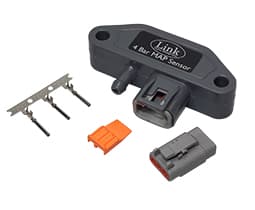
Where to buy Link ECU 4 Bar MAP Sensor in Canada: the trusted retailers we track in this market, with the best price we have observed at each. Prices are checked regularly and can change, and the retailer confirms the final price at checkout.
We may earn a commission on purchases. It never affects our rankings.
$140 – $220
Haltech 7 Bar MAP Sensor
Haltech's 7 Bar MAP sensor is the market leader for extreme-boost applications, providing the widest measurement range and the safety margin required for high-boost forced-induction or supercharged builds. While it carries a higher cost than 3.5–4 bar sensors, its technical advantage is undeniable for tuners who need accurate, stable readings at very high pressures where other sensors saturate. For high-end builds where maximum range, overpressure tolerance and advanced ECU integration are required, Haltech offers the most future-proof solution among these options.

Research and Evidence: Why Accurate Pressure Sensors Matter
Engineering studies and industry standards show that precise pressure measurement directly affects engine control, efficiency, and reliability. Accurate MAP and pressure transducers enable tighter closed loop fueling, faster boost control response, and reduced knock risk. Temperature compensated and digitally calibrated sensors reduce drift and improve repeatability in changing conditions. For tuners and motorsport teams, traceable calibration and robust housings translate to consistent lap-to-lap performance and fewer sensor-related failures.
Sensor accuracy and drift: Laboratory and field tests demonstrate that small MAP sensor errors can lead to significant air fuel ratio deviations, impacting power and emission control.
Temperature compensation: Studies show sensors with active thermal compensation reduce measurement drift over the operating temperature range, improving stability during cold starts and long runs.
Digital outputs and noise immunity: Research and practical reports indicate that digital or frequency outputs reduce interference in electrically noisy engine bays compared with unshielded analog signals.
Calibration traceability: Following standards for calibration improves consistency between units and supports reliable tuning and data logging across different ECUs.
Ruggedness for motorsport: Field evaluations confirm that sensors with sealed housings, vibration resistance, and corrosion-resistant materials endure extreme conditions better, lowering failure rates in rally and track use.
Frequently Asked Questions
Should I choose Bosch 0261230013 or AEM 3.5 bar?
Choose Bosch 0261230013 MAP Sensor for a factory-fit replacement: it has a 4.7 average rating and an OEM design for reliable longevity, while the AEM Electronics 30-2130-50 3.5 BAR MAP Sensor targets mild-to-moderate boost with 4.6 rating.
What measurement range is on AEM Electronics 30-2130-50?
The AEM Electronics 30-2130-50 3.5 BAR MAP Sensor measures from 0 to 3.5 bar, with an OEM-style 5V output compatible with most aftermarket ECUs and data loggers.
How does Bosch 0261230013 pricing compare to AEM 30-2130-50?
Bosch 0261230013 is listed at $43.76 CAD versus AEM Electronics 30-2130-50 at $233.37 CAD, so Bosch gives an OEM design and stable output for less money, while AEM targets mild-to-moderate boost monitoring.
Is Hondata 4 Bar MAP sensor compatible with Hondata ECUs?
Hondata 4 Bar MAP Sensor is designed for precise tuning with Hondata and other aftermarket ECUs, and its measurement range is 4 bar for turbo setups up to roughly 43 psi.
Conclusion
This selection highlights five strong choices for boost and vacuum pressure sensing in Canada: AEM Electronics 30-2130-50 3.5 BAR MAP Sensor, Bosch 0261230013 MAP Sensor, Hondata 4 Bar MAP Sensor, Link ECU 4 Bar MAP Sensor, and Haltech 7 Bar MAP Sensor. For most Canadian users seeking a balance of accuracy, availability, and value, the AEM Electronics 30-2130-50 3.5 BAR MAP Sensor is the best overall choice, while the Haltech 7 Bar MAP Sensor is ideal for high-boost applications and the Bosch 0261230013 is a top pick for OEM-style reliability. Hondata and Link ECU sensors are excellent when tight ECU integration and tuning support are priorities. I hope you found what you were looking for; you can refine or expand your search using the site search to filter by pressure range, digital output type, or compatibility with your ECU.