

Best Automotive Polishers and Buffers in Canada 2026 - Top 5 Picks
Published on Saturday, January 24, 2026
Dual-action and rotary polishers and buffers are essential power tools for paint correction, swirl removal, and achieving a high-gloss finish on automotive surfaces. In Canada in 2026, buyers value machines that combine adjustable torque and variable speed control with ergonomic design to reduce operator fatigue during detailing and body shop work. Popular trends include brushless motors for longer life, improved battery options for cordless convenience, and pad compatibility across brands. Canadian consumers also prioritize tools with weather-resistant electronics and robust warranties to handle seasonal salt and cold. Whether a DIY enthusiast or a professional detailer, the right polisher balances cutting power, heat management, and user comfort to restore paint clarity and protect clear coats.
Top Picks Summary
Rupes LHR 21 Mark III
Rupes LHR 21 Mark III is the market-leading long-throw orbital polisher prized by professionals for its combination of high cutting capability, refined finish and exceptionally low vibration. It commands a premium price but justifies it with robust build quality and consistent torque that outperforms more budget-friendly models (Chemical Guys, Meguiar's) while offering a smoother, longer-stroke alternative to compact powerhouses like the Flex and Griot's.

Griot's Garage G9 Random Orbital Polisher
Griot's Garage G9 Random Orbital Polisher balances strong cutting power with user-friendly ergonomics, making it a favorite among serious enthusiasts and detailers who want near-professional results without the very highest professional price tag. Compared with the Rupes it offers a more familiar North American support network and often a competitive price-to-performance ratio, while providing more power and control than entry-level options such as Chemical Guys and Meguiar's.

Chemical Guys TORQX Random Polisher
Chemical Guys TORQX Random Polisher positions itself as an accessible, value-focused tool that gives hobbyists reliable random-orbit performance at a lower cost. It won't match the sustained torque or premium fit of the Rupes or Flex, but its lighter weight and economical price make it a practical choice for DIYers who prioritize cost and ease-of-use over extended heavy-duty professional work.

Flex XCE 10-8 125 Dual Action Polisher
Flex XCE 10-8 125 Dual Action Polisher is the German-engineered option tailored for professionals who need durable motors and consistent thermal management for long shifts. Technically it competes with Rupes on build and motor endurance and often undercuts premium pricing on high-end models, offering a compact head and efficient power delivery that surpasses most consumer-focused units like Chemical Guys and Meguiar's.

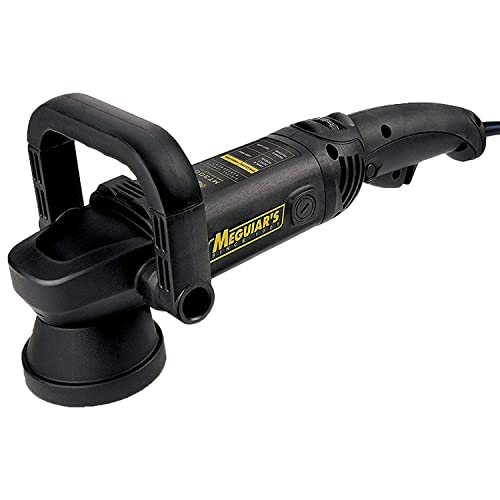
Meguiar's MT300 Dual Action Polisher
Meguiar's MT300 Dual Action Polisher targets enthusiasts seeking a compact, easy-to-handle polisher from a trusted car-care brand, offering solid performance at an approachable price. While it doesn’t deliver the same sustained professional torque as the Rupes or Flex, the MT300 typically provides strong value and a broad accessory ecosystem that makes it a reliable pick for portable detailing and hobbyist use.
Why Polishing Helps: Research-Backed Benefits
Scientific and industry research shows that controlled mechanical polishing reduces surface roughness and improves optical reflectivity, leading to a visibly glossier finish. Dual-action polishers, which combine rotational and orbital motion, reduce heat buildup and the risk of clear coat damage compared to aggressive rotary machines, making them a safer choice for most users. Studies on ergonomics and tool design also find that lower vibration and optimized handle geometry reduce muscle strain and fatigue during repetitive tasks. Overall, the combination of controlled polishing actions and correct pad and compound selection yields predictable paint correction with lower risk.
Surface roughness reduction improves specular reflection and perceived gloss; polishing smooths microscopic defects that scatter light.
Dual-action motion minimizes sustained heat spots, lowering the risk of clear coat thinning compared with direct rotary polishing.
Brushless motors and modern speed controllers provide consistent torque and reduce motor wear, according to industry performance tests.
Ergonomic handle design and reduced vibration correlate with lower operator fatigue and fewer repetitive strain issues in field studies.
Appropriate pad and compound pairing is critical; research supports using progressively finer abrasives to avoid excessive clear coat removal.
Frequently Asked Questions
Which polisher should I buy for pro paint correction?
Choose the Rupes LHR 21 Mark III for pro paint correction because it has a 21 mm orbital throw and a brushless motor, with a 4.8 average rating.
What spec does the Rupes LHR 21 Mark III use?
The Rupes LHR 21 Mark III uses a 21 mm orbital throw for fast material removal and efficient correction, and it has a brushless motor for consistent torque.
Is the Chemical Guys TORQX worth it versus Rupes LHR?
Chemical Guys TORQX Random Polisher costs $207.09 CADwith a 4.5 average rating, while the Rupes LHR 21 Mark III is $1,120.47 CAD; TORQX offers compact, lightweight random-orbit value.
Does the Griot's G9 have variable speed control?
Yes—the Griot's Garage G9 Random Orbital Polisher has smooth, stepless speed control, strong torque for medium-to-heavy paint correction, and a 4.7 average rating.
Conclusion
These five models — Rupes LHR 21 Mark III, Griot's Garage G9 Random Orbital Polisher, Chemical Guys TORQX Random Polisher, Flex XCE 10-8 125 Dual Action Polisher, and Meguiar's MT300 Dual Action Polisher — represent the leading choices for Canadian detailers in 2026. For an all-around balance of performance, durability, and gentle long-throw correction, the Rupes LHR 21 Mark III stands out as the best overall choice among the group. We hope you found the information you were looking for; use the search to refine by price, power type, or intended use, or expand your search to compare accessories and pads.