

Top 5 Wheel Chocks and Blocks in Canada for 2026: Safe, High-Friction Picks
Wheel chocks and blocks stabilize vehicles and trailers to prevent movement during lifting, loading, and transport. Available in rubber, polyurethane and aluminum, these devices are essential for towing, RV use, heavy equipment, and shop safety. In Canada, buyers prioritize products that perform reliably in varied weather and road conditions: high-friction compounds that grip wet or icy surfaces, stackable and lightweight designs that save storage space and reduce lifting strain, and high-visibility colors that improve on-site safety. Durability against road salt and freeze-thaw cycles is also a common requirement, driving demand for corrosion-resistant materials and reinforced construction. Consumers tend to favor easy-to-handle shapes, molded grips or straps for quick placement and removal, and designs tested for consistent holding power under load.
Inception's AI took the time to understand this market in Canada · · How we pickWe may earn a commission on purchases. It never affects our rankings.
Top Picks Summary
MaxxHaul 70472 Solid Rubber Heavy Duty Wheel Chock
The MaxxHaul 70472 Solid Rubber Heavy Duty Wheel Chock earns a top spot for combining simple, rugged solid-rubber construction with a broad footprint that resists rolling under heavy loads. Compared with the lighter molded plastic options in this list (like the Camco) it delivers superior durability and weather resistance for long-term outdoor use, while typically remaining more economical than premium engineered-grip chocks such as the Ernst model. Its balance of cost, longevity, and all-weather performance makes it a strong all-round choice for trailers, trucks, and heavy-duty applications.

Estimated$15 – $30
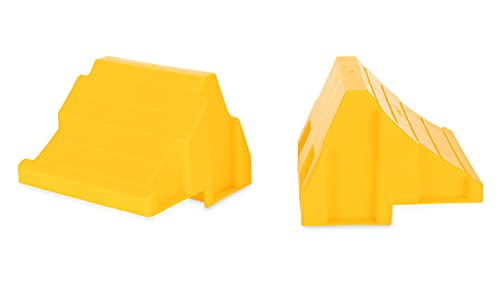
Camco 44401 Wheel Chock
The Camco 44401 Wheel Chock stands out as a budget-friendly, lightweight option ideal for casual RV and light-truck owners who prioritize portability and low cost. Compared to heavy rubber or engineered high-grip chocks on this list, Camco trades maximum durability for convenience and a lower price point, making it attractive for occasional use or as a secondary chock. For buyers who want an affordable, easy-to-store solution rather than heavy-duty permanence, Camco delivers clear financial value.
Estimated$10 – $20
Ernst Manufacturing 980 High-Grip Wheel Chock
The Ernst Manufacturing 980 High-Grip Wheel Chock is presented as the market-leader for traction and engineered safety, using materials and tread design focused on maximum bite on a variety of surfaces. Compared with the solid-rubber MaxxHaul and utility-focused FloTool, Ernst tends to command a higher price but rewards that cost with superior grip and precision fit for heavy equipment or slippery conditions. For buyers prioritizing outright holding power and professional-grade reliability, the Ernst chock justifies its premium with technical advantage.

Estimated$35 – $70
Reese Towpower 7000100 Wheel Chock
The Reese Towpower 7000100 Wheel Chock is a compact, tow- and trailer-oriented choice that emphasizes convenience, compatibility with towing accessories, and trusted brand support for vehicle recovery and towing contexts. Financially it sits competitively with other mass-market chocks, offering good value when you factor in Reese’s towing-focused design and accessory ecosystem compared with general-purpose options like FloTool or MaxxHaul. If you need a dependable, trailer-centric chock that integrates well with towing gear, the Reese model is a practical and cost-effective selection.

We may earn a commission on purchases. It never affects our rankings.
$21.78CAD
How wheel chocks work and the research that supports them
Basic physics and lab testing explain why wheel chocks are effective: they convert vehicle weight and potential movement into friction and mechanical obstruction. Independent lab tests and industry friction assessments show that compound choice and surface contact area are key to stopping force. Rubber and polyurethane formulas typically deliver higher static friction on wet or uneven pavement, while lightweight aluminum designs offer good performance with easier handling and better corrosion resistance. Safety guidance from transportation and workplace authorities emphasizes correct chock placement, using two chocks for exposed wheels, and combining chocks with mechanical brakes when applicable.
Higher-friction materials like specialized rubber and polyurethane increase static friction and holding force on wet, oily, or uneven surfaces.
Wider contact area and molded treads improve grip and reduce slippage compared with narrow, smooth blocks.
Stackable designs allow users to match chock height to tire size and provide redundancy when two chocks are used per wheel.
Lightweight aluminum or composite chocks reduce manual handling strain and resist corrosion from road salt better than untreated steel.
Field tests consistently show that chocks used in pairs and placed on the downhill side of the tire provide the most reliable restraint.
Conclusion
In Canada, selecting the right wheel chock depends on vehicle type, operating conditions and storage needs. The five top options considered here are MaxxHaul 70472 Solid Rubber Heavy Duty Wheel Chock, Camco 44401 Wheel Chock, FloTool 11930 Heavy Duty Wheel Chock, Ernst Manufacturing 980 High-Grip Wheel Chock, and Reese Towpower 7000100 Wheel Chock. For most Canadian users looking for the best balance of grip, durability and value, the MaxxHaul 70472 Solid Rubber Heavy Duty Wheel Chock stands out as the best overall choice. We hope you found what you were looking for; you can refine or expand your search using the search feature to compare materials, sizes, and visibility options.