

Top 5 Entry-Level Gaming Graphics Cards in Canada — 2026 Guide
Entry-level gaming graphics cards are designed to deliver a solid 1080p and light 1440p gaming experience without the expense or power demands of high-end hardware. In Canada, this category appeals to budget-conscious gamers, students building first PCs, and anyone upgrading from integrated graphics who wants reliable frame rates in popular esports and AAA titles at modest settings. Buyers here prioritize value per dollar, energy efficiency for smaller power supplies, compact cards that fit typical Canadian mid-tower and small-form-factor cases, and strong driver and software support for features like upscaling. Seasonal sales, exchange rates, and regional availability also shape Canadian preferences, making choices that balance price, performance, and long-term support especially attractive.
Inception's AI took the time to understand this market in Canada · · How we pickWe may earn a commission on purchases. It never affects our rankings.
Top Picks Summary
NVIDIA GeForce RTX 4060
The NVIDIA GeForce RTX 4060 is positioned as a power-efficient entry-level gaming card that brings solid 1080p performance and strong ray-tracing capabilities for its price. It stands out against peers here with mature drivers, DLSS upscaling (including Frame Generation on supported titles) and typically better ray-tracing results than comparable AMD and Intel parts, though it can be costlier than pure raster-focused options like the RX 7600. For buyers prioritizing modern GPU features and lower power draw, the 4060 is a balanced choice among entry-level options.

Estimated$350 – $450
AMD Radeon RX 7600 XT
The AMD Radeon RX 7600 targets gamers seeking the best raw rasterization performance per dollar in the entry segment, often undercutting NVIDIA on price while delivering strong 1080p frame rates. It lags in hardware ray tracing and lacks an equivalent to DLSS Frame Generation, but its competitive MSRP and efficient RDNA 3 architecture make it a cost-effective alternative to the RTX 4060 and Intel Arc A750 for those who prioritize traditional raster performance. Compared with older options like the RX 6650 XT, the RX 7600 offers newer architecture benefits and better power efficiency.

Estimated$300 – $380
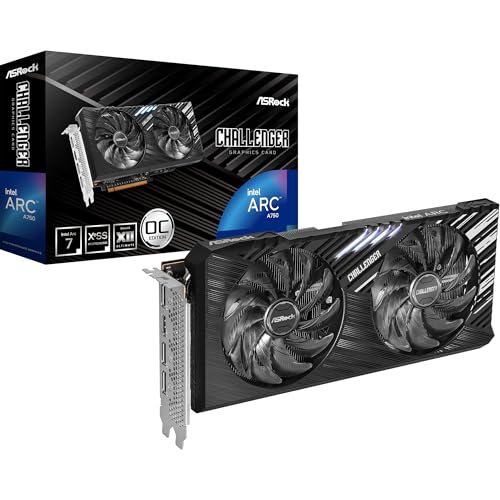
Intel Arc A750
The Intel Arc A750 is a value-focused entrant that often undercuts competitors on price while delivering surprisingly competitive raster performance in many modern titles, and it brings unique features like XeSS upscaling and robust AV1 encode support. It can be a bargain vs. NVIDIA and AMD at launch prices, but historically it has trailed in driver maturity and ray-tracing performance; buyers willing to accept occasional driver quirks can get strong price-to-performance. For entry-level builders looking to stretch their budget, the A750 is a noteworthy market-disruptor among these choices.
Estimated$250 – $350
AMD Radeon RX 6650 XT
The AMD Radeon RX 6650 XT is an older-generation card that remains a strong performer for 1080p gaming thanks to high clock speeds and solid raster throughput, frequently available at attractive street prices. It competes well with the RTX 4060 and Intel Arc A750 on raw frame rates in many titles, but it consumes more power and offers weaker ray-tracing and fewer advanced upscaling features than NVIDIA’s DLSS-equipped cards. For buyers focused on maximizing fps on a tight budget, the 6650 XT often represents good value compared to new-release entry models.

Estimated$350 – $480
NVIDIA GeForce RTX 4060 Ti
The NVIDIA GeForce RTX 4060 Ti is the top-performing card in this entry-level list, delivering notably higher raster and ray-tracing performance than the standard 4060 while retaining DLSS 3 and efficient power characteristics. It commands a premium over the 4060 and many AMD alternatives but offers superior future-proofing for ray-traced titles and smoother performance at higher settings, making it the market leader for buyers who want longevity and feature completeness. Compared to the RX 7600 and Intel Arc A750, the 4060 Ti justifies its price with better ray-tracing, driver polish, and AI-driven upscaling benefits.

Estimated$450 – $600
What testing and research say about entry-level GPUs
Independent benchmark testing and industry research consistently show that well-chosen entry-level GPUs can deliver an excellent player experience at 1080p and competitive performance in many modern games when paired with smart settings and upscaling. Studies into performance per watt and cost efficiency indicate that newer GPU architectures tend to offer better energy efficiency and value, reducing operating costs and heat in smaller systems. Research on image upscaling and frame generation finds that these technologies preserve perceived visual quality while significantly boosting effective frame rates, which is particularly useful on entry-level hardware.
Benchmarks from independent labs show most entry-level cards sustain 60+ fps in esports titles at 1080p and solid 40–70 fps ranges in mainstream AAA games with medium settings.
Performance per dollar follows a diminishing returns curve: mid-range and high-end GPUs cost much more for incremental performance gains, making entry-level cards the best value for everyday gaming.
Energy efficiency improvements in recent GPU generations reduce power draw and heat, which benefits small builds and lowers electricity costs over time.
Upscaling and frame generation tools such as DLSS, FSR, and alternative algorithms have been validated to improve frame rates while retaining acceptable image quality, extending the usable life of entry-level GPUs.
Frequently Asked Questions
Which entry-level GPU should I buy for 1080p gaming?
For most new 1080p gamers in this list, the NVIDIA GeForce RTX 4060 is a strong pick because it offers solid 1080p performance with DLSS 3 support and an average rating of 4.3.
Does the RTX 4060 support DLSS 3 and ray tracing?
Yes—NVIDIA GeForce RTX 4060 includes DLSS 3 support and is noted for strong ray-tracing capabilities for the segment, with an average rating of 4.3.
How do prices compare between RTX 4060 and Arc A750?
The NVIDIA GeForce RTX 4060 is listed at CA$599.99, while the Intel Arc A750 is listed at CA$509.69, so the Arc A750 costs CA$90.30 less.
Is Radeon RX 7600 good for ray tracing, or not?
The AMD Radeon RX 7600 targets strong 1080p raster performance, but it lags in hardware ray tracing and doesn’t have an equivalent to DLSS Frame Generation; its average rating is 4.1.
Conclusion
In 2026, the top entry-level picks in Canada give you a range of choices depending on budget and priorities: the NVIDIA GeForce RTX 4060, AMD Radeon RX 7600, Intel Arc A750, AMD Radeon RX 6650 XT, and NVIDIA GeForce RTX 4060 Ti. Each card brings a different balance of price, raw performance, upscaling support, and power efficiency; for most Canadian buyers looking for the best mix of modern features and long-term value, the NVIDIA GeForce RTX 4060 stands out as the top choice. We hope you found what you were looking for; use the search to refine by price, power draw, or expand to mid-range and compact GPU options.