

Custom AGVs Canada 2026: Top 5 Tailored Automated Guided Vehicles
Published on Friday, January 23, 2026
Custom Automated Guided Vehicles (AGVs) are purpose-built mobile robots designed to meet specific operational requirements across industries such as warehousing, manufacturing, healthcare, food processing, and e-commerce. In Canada, demand for custom AGVs has grown as businesses face labor shortages, tighter safety regulations, and the need to improve throughput in constrained facilities and cold environments. Custom AGVs are appealing because they combine navigation and safety systems with tailored payload, size, and integration options, enabling solutions that off-the-shelf robots cannot provide. Canadian buyers prioritize reliability, local service and support, cold-climate readiness, bilingual interfaces where needed, and predictable return on investment. For decision makers, custom AGVs deliver measurable gains in uptime, space efficiency, and worker safety while fitting into existing IT and material-handling ecosystems.
Top Picks Summary
Clearpath Robotics OTTO 1500
The OTTO 1500 is best-in-class for heavy-duty custom automated guided vehicle (AGV) applications because it combines a high payload capacity with industrial-grade navigation, safety sensors, and hardened hardware suited to replace forklifts and tow systems. Compared with the smaller platforms on this list it delivers superior throughput and lower per-ton transport cost for large loads, although its higher upfront CAPEX is most easily justified where long-term TCO and heavy-material handling are priorities.
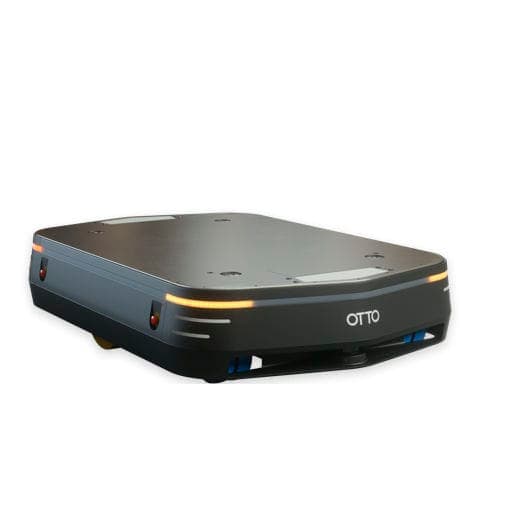
Where to buy Clearpath Robotics OTTO 1500 in Canada: the trusted retailers we track in this market, with the best price we have observed at each. Prices are checked regularly and can change, and the retailer confirms the final price at checkout.
We may earn a commission on purchases. It never affects our rankings.
$200,000 – $350,000
Clearpath Robotics OTTO 100
The OTTO 100 is a compact, industrial-grade AGV designed for custom implementations where nimbleness, integration of bespoke fixtures, and robust safety are required in production and intralogistics environments. Relative to the OTTO 1500 it sacrifices payload for agility and lower CAPEX, and compared with mid-size AMRs it offers a more durable sensor and safety stack that suits regulated or harsher indoor environments.
Where to buy Clearpath Robotics OTTO 100 in Canada: the trusted retailers we track in this market, with the best price we have observed at each. Prices are checked regularly and can change, and the retailer confirms the final price at checkout.
We may earn a commission on purchases. It never affects our rankings.
$80,000 – $140,000
MiR250
The MiR250 is a versatile mid-size AMR well suited to custom automated guided vehicle projects that need rapid deployment, modular payload accessories, and open APIs for integration with WMS/ERP systems. In contrast to heavy OTTO units it targets lighter, higher-frequency transfers with a lower acquisition cost and faster ROI, and it competes with collaborative robots by offering fleet management and flexible navigation for multi-zone workflows.

Where to buy MiR250 in Canada: the trusted retailers we track in this market, with the best price we have observed at each. Prices are checked regularly and can change, and the retailer confirms the final price at checkout.
We may earn a commission on purchases. It never affects our rankings.
$35,000 – $70,000
Locus Robotics Origin
Locus Origin is a market-leading warehouse AMR optimized for high-throughput order fulfillment and custom AGV workflows that prioritize pick rate and multi-robot coordination backed by enterprise analytics. Compared to point solutions like Chuck or modular platforms like MiR, Locus emphasizes software-first scalability and operational visibility that can justify higher subscription or service fees through measurable productivity gains in dense e-commerce operations.

Where to buy Locus Robotics Origin in Canada: the trusted retailers we track in this market, with the best price we have observed at each. Prices are checked regularly and can change, and the retailer confirms the final price at checkout.
We may earn a commission on purchases. It never affects our rankings.
$50,000 – $90,000
6 River Systems Chuck
Chuck is a collaborative, low-cost mobile robot engineered to augment pickers and accelerate custom AGV rollouts in pick-and-pack warehouses through plug-and-play software and straightforward integrations. Versus heavy-duty OTTO vehicles and fleet-centric Locus systems, Chuck offers the lowest entry cost and fastest time-to-value for small-to-mid-size operations, though it is focused on human-robot picking collaboration and smaller payload tasks.

Where to buy 6 River Systems Chuck in Canada: the trusted retailers we track in this market, with the best price we have observed at each. Prices are checked regularly and can change, and the retailer confirms the final price at checkout.
We may earn a commission on purchases. It never affects our rankings.
$25,000 – $55,000
Why Research Supports Custom AGVs
Academic studies and industry reports consistently show that automation solutions, when matched to operational needs, improve throughput, reduce workplace injuries, and lower long-term operating costs. Evidence from robotics industry analyses, standards bodies, and case studies demonstrates that tailored mobile robots provide higher utilization and faster payback than poorly matched generic systems. For newcomers, the benefits are best understood through familiar, repeatable outcomes: fewer manual handoffs, more predictable cycle times, and safer material flows.
Productivity gains: Industry analyses and case studies commonly report throughput improvements in the range of about 15 to 40 percent after introducing customized mobile automation, depending on workflow and integration.
Safety and injury reduction: Research and safety audits show that automating repetitive transport tasks reduces strain-related injuries and improves compliance with workplace safety guidelines.
Space and layout efficiency: Custom AGVs can be engineered to operate in tighter aisles or multi-level facilities, increasing usable storage density compared with manual processes.
Energy and battery improvements: Advances in battery and power management systems yield longer run times and predictable duty cycles, lowering downtime and maintenance windows.
Integration benefits: Studies highlight that projects which integrate AGVs with warehouse management and manufacturing execution systems see faster adoption and better KPI alignment than siloed automation efforts.
Frequently Asked Questions
Which AGV is best for heavy payload custom projects?
Clearpath Robotics OTTO 1500 is best for heavy-duty custom AGV work because it’s designed for very large payloads (typ. up to ~1,500 kg) and heavy-tow applications, with an enterprise-grade safety suite and redundant navigation for reliable operation around people.
What payload spec does the MiR250 support?
The MiR250 is a mid-size AMR with a roughly 250 kg payload capacity, intended for modular material-handling tasks, and it includes safety sensors plus dynamic path planning to operate alongside workers without fixed infrastructure.
How does OTTO 100 pricing compare to OTTO 1500?
The provided product data doesn’t list any prices for Clearpath Robotics OTTO 100 or Clearpath Robotics OTTO 1500, so I can’t compare cost or value using exact amounts.
Which AGV works better for flexible cart towing indoors?
Clearpath Robotics OTTO 100 is designed as a compact autonomous tow/transport platform for flexible material movement and tugging carts or trailers, while OTTO 1500 targets very large payloads (typ. up to ~1,500 kg) for heavy-tow manufacturing and distribution.
Conclusion
Custom AGVs are a practical way for Canadian operations to solve unique material handling challenges while improving safety and productivity. The top options for 2026 each serve different needs: Clearpath Robotics OTTO 1500 for heavy-duty and long-range tasks, Clearpath Robotics OTTO 100 for compact industrial transport, MiR250 for flexible mid-size intralogistics, Locus Robotics Origin for high-volume collaborative picking, and 6 River Systems Chuck for human-led e-commerce fulfillment. For many large or heavy-load projects the Clearpath Robotics OTTO 1500 stands out as the best overall choice because of its payload capacity and industrial-grade navigation, while the other models remain excellent choices for narrower or more collaborative workflows. We hope you found what you were looking for; use the site search to refine by payload, navigation type, industry, or to expand your search to hybrid and fleet-management solutions.