5 Best Underwater Inspection Drones in Canada, 2026
Published on Monday, January 5, 2026
Depth rating is what separates these five. The Blueye X3 reaches 305 m, the Chasing M2 Pro Max 200 m, the Geneinno T1 Pro 175 m, and the QYSEA FIFISH V6s 100 m; the PowerVision PowerDolphin Wizard is a surface craft with a tilting camera rather than a submersible. Underwater inspection drones are engineered for the purpose of surveying and monitoring underwater structures and environments. They provide vital insights for industries like construction, oil, and emergency services while showcasing their ability to operate in challenging conditions. In Canada, where vast bodies of water require ongoing inspection for safety and compliance, these drones have seen a surge in popularity. Their capabilities allow companies to perform inspections more efficiently, safely, and cost-effectively than traditional methods, making them an appealing choice for professionals seeking to ensure the integrity of underwater infrastructure. With advanced technology, these drones not only reduce the risks associated with underwater inspections but also gather high-quality data quickly and accurately.
Top Picks Summary
QYSEA FIFISH V6s
The FIFISH V6s is rated to 100 metres and shoots 4K UHD at 25/30 fps from a 1/2.3-inch Sony CMOS sensor behind a 166 degree lens. Six thrusters give it true six-degrees-of-freedom movement, so it can hover, roll and hold an angle against current instead of only pitching up and down. At 4.1 kg it is light enough for one person to carry to the water, and the tether is Kevlar-cored rather than plain cable.

Geneinno T1 Pro
The Geneinno T1 Pro is rated to 175 metres (574 ft), deeper than the standard T1's 150 m, and ships here with a 200 m tether. Its 4K/30fps camera shoots 12 MP stills and streams a 1080p live view to the tablet controller, lit by two spotlights totalling about 3,000 lumens. Six thrusters (four vertical, two horizontal) push it to roughly 2 m/s, and the 97.2 Wh battery runs about four hours per charge, or eight with the optional second pack. Accessory ports take sonar, a water-quality sensor, a dual-beam laser measurer, or a robotic claw.

Chasing M2 Pro Max
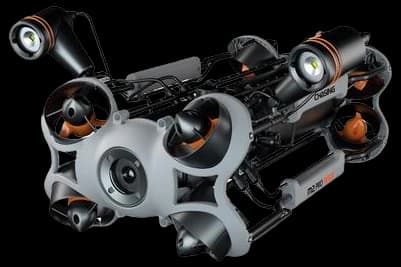
The Chasing M2 Pro Max is the industrial pick here: a 200 metre depth rating with roughly a 400 metre operating radius on its tether, and eight vectored thrusters that give six degrees of freedom at up to 3 knots. A 1/2.3-inch Sony CMOS sensor handles 4K video and 12 MP stills with electronic stabilisation, and dual 4,000 lumen floodlights (8,000 lm combined) dim steplessly. Five accessory ports plus a slide-in mount let you swap in sonar, a laser scaler, a grabber arm, or other sensors without tools.
PowerVision PowerDolphin Wizard
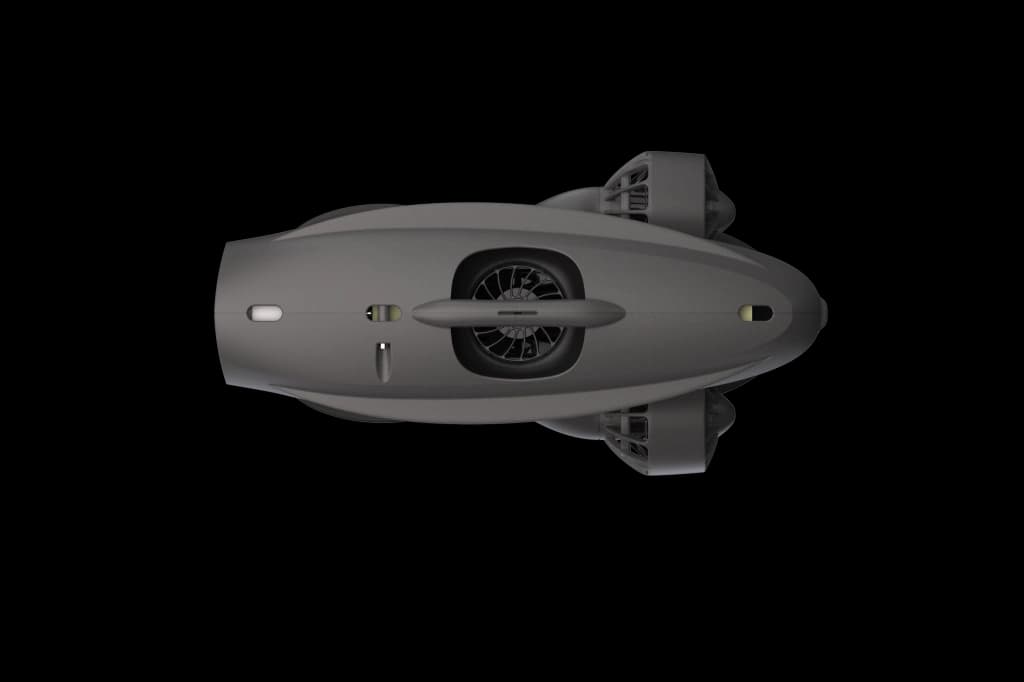
The PowerDolphin Wizard is the odd one out here: it is a surface craft, not a submersible. A dual-joint camera in the nose swings through 220 degrees, from 70 degrees above the waterline to 150 degrees below it, recording 4K at 30 fps from a 1/2.3-inch 12 MP sensor, so you survey by looking down from the surface rather than by diving to a structure. It runs at up to 4 m/s, holds a 350 metre link to the controller, and manages about 2.5 hours per charge in low-speed mode. The bundled PowerSeeker sonar maps the bottom and marks fish to roughly 40 metres. That suits shoreline, hull-side and shallow-bottom work, and rules it out for close inspection of anything deep.
Blueye X3
The Blueye X3 is the professional tool on this list: 305 metres of depth rating, four 350 W thrusters, and 256 GB of onboard storage so a long dive does not fill the card. Its main camera records Full HD 1920x1080 at 25/30 fps with a 115 degree field of view and tilts 30 degrees up or down, and 3,300 lumens of lighting carry it in dark water. Tethers run up to 300 metres, and the battery gives roughly two hours, or five with the high-capacity pack. It is bought for hull and infrastructure survey work rather than for 4K footage.
6000-7000$
Rugged design, high mobility, and advanced imaging capabilities make underwater inspection drones essential tools for professionals.
Understanding Underwater Inspection Drones
Underwater inspection drones are revolutionizing the way industries monitor underwater environments. Here’s what you need to know:
Designed for Challenging Conditions: Underwater drones are built to withstand varying pressures and temperature changes, making them suitable for inspecting deep water sites and harsh environments.
Enhanced Data Collection: These drones can be equipped with high-resolution cameras and sonar, allowing for detailed imagery and real-time data analysis.
Cost-Effective Solutions: By reducing the need for divers and complex equipment, underwater inspection drones significantly cut operational costs for companies over time.
Improved Safety: Utilizing drones eliminates the risks associated with human divers, especially in hazardous underwater conditions.
Efficiency in Operations: Inspections that once took days can now be completed in hours, leading to quicker decision-making and repairs.
Environmental Monitoring: These drones not only assist in infrastructure inspections but also play a vital role in monitoring aquatic ecosystems for conservation purposes.
Frequently Asked Questions
Which drone should I buy for deep underwater inspection?
For the deepest reach, the Blueye X3 is rated to 305 metres. If 100 metres is enough, the QYSEA FIFISH V6s pairs a 4K UHD camera with six thrusters for omnidirectional 6D movement and holds an average rating of 4.7.
Does the Chasing M2 Pro Max support 4K video and range?
Yes. The Chasing M2 Pro Max shoots 4K video and 12 MP stills from a 1/2.3-inch Sony CMOS sensor, and is rated to 200 metres depth with a roughly 400 metre operating radius on its tether. It runs eight vectored thrusters and dual 4,000 lumen floodlights, and has an average rating of 4.6.
How does Geneinno T1 Pro price compare for features?
The Geneinno T1 Pro lists at $4,200.00 CADhere, which buys a 4K/30fps camera with 12 MP stills, a 175 metre depth rating, six thrusters, and about four hours of runtime per charge. Its average rating is 4.5.
Which of these underwater drones goes the deepest?
The Blueye X3 at 305 metres, followed by the Chasing M2 Pro Max at 200 metres, the Geneinno T1 Pro at 175 metres, and the QYSEA FIFISH V6s at 100 metres. The PowerVision PowerDolphin Wizard is not comparable, as it operates from the surface rather than diving.
Conclusion
In summary, underwater inspection drones are essential tools for ensuring the usability and integrity of underwater structures in Canada. As their popularity continues to rise in 2026, we hope you found the information helpful in assessing your options. If you have any specific questions, feel free to use the search bar to explore further.