Rechargeable Hearing Aids in Canada, 2026: 5 Prescription Models Compared
Published on Thursday, January 1, 2026
Every hearing aid on this page is a Class II medical device in Canada. That means it must hold a Health Canada medical device licence, and it is fitted, programmed and dispensed by a regulated hearing healthcare professional — an audiologist or a hearing instrument practitioner — after a hearing test. None of these five can be bought ready-to-wear online, and the price you pay is set by the clinic that programs the device to your audiogram. This distinction matters because most inexpensive "rechargeable hearing aids" listed on Amazon.ca are personal sound amplification products (PSAPs): they make everything louder rather than being shaped to your specific hearing loss, and they are not licensed as hearing aids. The United States created a separate over-the-counter hearing aid category in 2022; Canada has no direct equivalent, so "OTC hearing aid" carries no regulatory meaning here. The five prescription models compared below — Phonak Paradise P90-R, Starkey Evolv AI, ReSound Omnia, Widex Moment 440 mRIC R D and Signia Pure Charge&Go AX — all use sealed lithium-ion batteries that run a full day on one charge. All five are established, widely fitted platforms rather than current-generation flagships: their manufacturers have since launched Phonak Infinio/Sphere, Starkey Genesis AI, ReSound Nexia and Signia IX, so ask a clinic which generation it is quoting.
Top Picks Summary
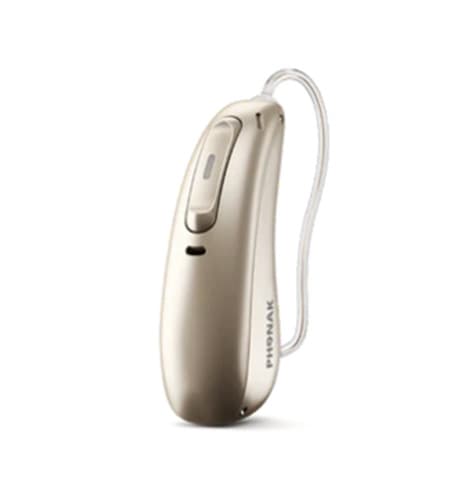
Phonak Paradise P90-R
The Phonak Audéo Paradise P90-R is a prescription receiver-in-canal hearing aid, fitted and programmed to your audiogram by an audiologist or hearing instrument practitioner rather than sold ready-to-wear. Its AutoSense OS 4.0 sound classifier switches programs automatically as you move between quiet rooms, restaurants and traffic, and it handles hands-free Bluetooth calls from both iPhone and Android without a streamer accessory. Phonak quotes about 24 hours of use from a three-hour charge, with a 30-minute top-up worth up to roughly six hours. Paradise launched in 2020 and is still widely fitted, though Phonak has since released the Lumity and Infinio/Sphere platforms that a clinic may quote instead.
Starkey Evolv AI
The Starkey Evolv AI is a prescription hearing aid fitted by a hearing healthcare professional, built around on-device sound processing that adapts automatically rather than requiring manual program changes. Beyond hearing, it doubles as a wellness wearable: the My Starkey/Thrive app tracks steps and activity and can send fall-detection alerts to chosen contacts. It comes in rechargeable (-R) and disposable-battery versions across four technology tiers, and streams directly to iOS and Android. Evolv AI launched in 2021; Starkey has since moved its flagship line to the Genesis AI platform, so ask which generation a clinic is quoting.

ReSound Omnia
The ReSound Omnia builds on ReSound's signature M&RIE (Microphone & Receiver-In-Ear) design, which can be ordered with a microphone in the ear canal for more natural, directional sound that uses the ear's own pinna effect. Its headline upgrade over the earlier ReSound ONE is improved processing for understanding speech in background noise. With rechargeable lithium-ion batteries, direct streaming to iOS and Android (ASHA), and granular control through the ReSound Smart 3D app, the Omnia is a flexible, highly customizable choice for modern users.

Widex Moment 440 mRIC R D
The Widex Moment 440 mRIC R D offers an unparalleled listening experience with its ZeroDelay technology, providing extremely quick sound processing for minimal lag during sound transfer. This ensures users receive a natural and immediate auditory experience, making conversations and interactions feel more authentic. The compact design and rechargeable battery add convenience, while the customizable settings cater to individual hearing preferences. Widex continues to push the boundaries of technology, making this model highly competitive in the hearing aid market.
$2,500 – $3,200
Signia Pure Charge&Go AX
The Signia Pure Charge&Go AX stands out with its innovative Augmented Xperience technology, which separates speech from background noise for crystal-clear sound. The convenient rechargeable feature ensures all-day performance without the hassle of changing batteries. Its sleek design and connectivity options make it compatible with various devices, enhancing user experience. Signia's commitment to advanced technology and user satisfaction positions this product as a leading choice in the hearing aid industry.

The features worth comparing on a rechargeable hearing aid are how long one charge genuinely lasts once streaming is included, how much a short top-up charge buys you, whether it streams directly to both iPhone and Android without a separate accessory, its IP moisture and dust rating, and how finely a clinician can fine-tune it to your audiogram.
Prescription Hearing Aids vs. PSAPs in Canada
The most useful thing to understand before shopping is that "hearing aid" is a regulated term in Canada while "sound amplifier" is not. Here is what separates the two, and what rechargeability does and does not change.
A hearing aid sold in Canada is a Class II medical device and must hold a Health Canada medical device licence. A personal sound amplification product (PSAP) is not licensed as a hearing aid and is not fitted to your hearing loss.
Dispensing is regulated by the provinces and territories. In practice you need a hearing test and a fitting by an audiologist or hearing instrument practitioner, which is why none of the five models below has a legitimate add-to-cart price.
Over-the-counter hearing aids are a U.S. FDA category. Health Canada has licensed some self-fitting hearing aid devices and software, but Canada has no direct OTC hearing aid category, so the term has no regulatory weight here.
Rechargeability is a convenience and waste feature. A sealed lithium-ion cell removes the routine battery change, but it does not by itself improve clarity, amplification or speech-in-noise performance.
Streaming shortens runtime. Manufacturer "up to" battery figures generally assume little or no Bluetooth audio, so a day of calls and podcasts will cut a charge substantially.
Sealed batteries age. Capacity fades over the life of the device, and the cell has to be replaced by the manufacturer or the clinic rather than by the wearer.
Frequently Asked Questions
Do you need a hearing test or a prescription to buy hearing aids in Canada?
Yes. Hearing aids are Class II medical devices in Canada and must carry a Health Canada medical device licence. Dispensing is regulated by the provinces and territories, and in practice you need a hearing test and a fitting by an audiologist or hearing instrument practitioner, who programs the device to your audiogram. Every model on this page is a prescription-fit hearing aid, not something you order ready-to-wear.
Are the cheap rechargeable hearing aids sold on Amazon.ca real hearing aids?
Usually not. Most inexpensive rechargeable ear-worn devices sold online in Canada are personal sound amplification products (PSAPs). They raise the volume of everything around you instead of being shaped to your specific hearing loss, and they are not licensed as hearing aids. If a listing shows no Health Canada medical device licence and involves no fitting appointment, treat it as an amplifier rather than a hearing aid.
Can you buy over-the-counter (OTC) hearing aids in Canada?
Not in the way American buyers can. OTC hearing aids are a U.S. FDA category created in 2022. Health Canada has licensed some self-fitting hearing aid devices and software, but Canada has no direct OTC hearing aid category, and provincial dispensing rules still generally involve a regulated hearing healthcare professional. "OTC hearing aid" is a U.S. term with no Canadian regulatory equivalent.
How long do these rechargeable hearing aids last on one charge?
All five are designed to run a full day on a single charge. Phonak quotes roughly 24 hours of use from a three-hour charge on the Audéo Paradise P90-R, with a 30-minute top-up worth up to about six hours. Manufacturer figures assume limited Bluetooth streaming, so a day of hands-free calls and audio will shorten the runtime noticeably.
Conclusion
Rechargeable batteries remove the fiddliest part of owning a hearing aid, but they do not change the part that decides whether you actually hear better: the fitting. In Canada that means a hearing test and programming by an audiologist or hearing instrument practitioner. Worth asking any clinic about the trial or return period, the warranty term, whether the quoted model is the current generation, and what is included in the bundled price. The price ranges shown here are indicative for a pair before provincial programs, private insurance or veterans' benefits — always ask for a written quote.