

Discover the Top 4 Ionic Purifiers for 2026 in Canada
As homeowners increasingly prioritize indoor air quality, ionic purifiers have become a common pick for cleaner, fresher air. These devices produce negative ions that attach to airborne particles, causing them to clump together and settle out of the air onto floors and surfaces, where the dust, allergens and other pollutants can then be vacuumed or wiped away. In Canada, demand has grown for models that purify efficiently and suit the room they sit in. Part of the appeal is low maintenance: several use permanent collector plates or washable filters instead of cartridges you replace every few months. Noise varies more than the marketing suggests, though. Three of the four units here are fan-driven and run roughly 23 to 50 dB depending on speed, so check the rating before putting one in a bedroom. One more thing worth knowing before you buy: some ion-generating units emit ozone, which irritates the airways and can worsen asthma, and a few add a deliberate ozone mode. The four ionic purifiers below are compared on filtration, coverage, noise and ozone behaviour.
Inception's AI took the time to understand this market in Canada · · How we pickWe may earn a commission on purchases. It never affects our rankings.
Top Picks Summary
Sharp Plasmacluster Ion Air Purifier FP-F30UH
The Sharp Plasmacluster Ion Air Purifier FP-F30UH pairs a True HEPA and activated-carbon stack with Sharp's Plasmacluster emitter, which releases both positive and negative ions to work on odours and static. The filtration does the particle work here: AHAM rates it for 143 sq ft at 4.8 air changes per hour, and its CADR figures are 92 for smoke, 101 for dust and 109 for pollen. Controls stay simple, with three fan speeds plus a 60-minute Express Clean burst and no ozone mode to worry about. A sensible pick for a bedroom or home office at a competitive price.

Estimated$300 – $350
Airthereal APH260 Air Purifier
The Airthereal APH260 is the value pick here: a three-stage system with a medical-grade H13 True HEPA filter, activated carbon and a UV-C lamp, plus an ionizer stage. Airthereal rates it for rooms up to 355 sq ft, which makes it a living-room or large-bedroom machine rather than a desk unit. It skips app control and air-quality sensing, but the filtration itself works on the same principle as far pricier boxes, and the particle capture is done by the HEPA filter rather than by the ions.

Estimated$140 – $190
OION Technologies B-1000 Permanent Filter Ionic Air Purifier
The OION Technologies B-1000 Permanent Filter Ionic Air Purifier is built around a permanent electrostatic collector that you wipe clean instead of replacing, backed by a washable carbon filter and a UV-C sanitizer. There is no replacement cartridge to buy, and at roughly 7.5 W and about 25 dB it is the quietest and lowest-draw unit on this list. The trade-off is that a collector-plate ionizer captures less than a True HEPA filter and only works if you actually keep the plate clean, so it suits a small room where low running cost and low noise matter more than raw particle removal.
Estimated$100 – $200
Heaven Fresh HF 380A Ionic Air Purifier
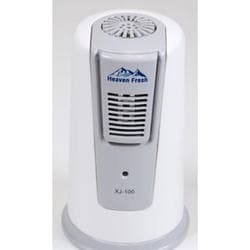
The Heaven Fresh HF 380A is the widest-coverage unit on this list, rated for 60 m2 (about 650 sq ft) and moving 106 cfm. It stacks seven stages: an anti-bacterial pre-filter, a HEPA filter rated at 99.97% dust removal, activated carbon, a TiO2 photocatalyst, a 254 nm UV-C germicidal lamp and a corona-discharge ion generator. It also adds an optional ozone sanitizer on a timer for strong odours, and that mode is the one thing to be deliberate about: it is meant for treating an empty room, not for running while you are in it. At 24 inches tall and around 15 lbs this is a floor-standing tower rather than a desktop unit.
Estimated$140 – $160
All four of these purifiers pair ionization with a filter stage that physically captures particles, which is what does most of the actual cleaning. Coverage ranges from a 143 sq ft AHAM rating on the Sharp up to 650 sq ft on the Heaven Fresh. Noise runs from about 25 dB on the OION B-1000 to roughly 50 dB on the Airthereal at full speed. Permanent collector plates and washable filters on several models cut ongoing filter costs. Check a model's ozone behaviour before running it in an occupied bedroom.
How Ionic Purifiers Work, and Where They Fall Short
Ionic purifiers charge airborne particles so they clump and settle. That is a real mechanism, but it is not the same as capturing particles in a filter, and some ion-generating units also emit ozone. Here is what the evidence actually supports and what to check before you buy.
Negative ions attach to dust, pollen and smoke particles and make them heavy enough to fall out of the air. The particles land on floors, walls and furniture rather than being captured, so they can be stirred back up and still need to be cleaned away.
The US EPA's review of the evidence found ionizers less effective at removing dust, tobacco smoke, pollen and fungal spores than either high-efficiency particle filters or electrostatic precipitators. If particle removal is the goal, a True HEPA stage does the heavy lifting.
Claims that breathing ionized air relieves asthma or improves mood are not supported by regulatory reviews of the evidence. Treat wellness claims printed on an ionizer box as marketing rather than clinical findings.
Corona-discharge ion generators can produce ozone as a by-product, and some units add a deliberate ozone mode. The EPA notes ozone can cause chest pain, coughing and throat irritation, may worsen asthma, and at concentrations within public health limits has little ability to remove indoor pollutants anyway.
California requires air cleaners sold in the state to be certified by the California Air Resources Board, with ozone emissions no higher than 0.050 ppm. Canada has no equivalent mandatory list, so checking a model against CARB's certified-device list is a practical way to screen out heavy ozone emitters here too.
Do not assume an ionizer is silent. Three of the four models here are fan-driven and run roughly 23 to 50 dB depending on speed; the OION B-1000 is the quietest at about 25 dB. Some ionic purifiers also combine ionization with HEPA or activated-carbon filtration for better particle and odour performance.
Frequently Asked Questions
Is the Sharp Plasmacluster FP-F30UH better for odors?
Choose the Sharp Plasmacluster Ion Air Purifier FP-F30UH if you want Plasmacluster ion output working on odours and static on top of a True HEPA and activated-carbon stack. It is rated 4.5 and lists around CA$297.
What exact ion tech does the FP-F30UH use?
Sharp's Plasmacluster emitter, which releases both positive and negative ions rather than negative ions alone. It sits behind a True HEPA and activated-carbon stack, and there is no user-selectable ozone mode: the controls are three fan speeds plus a 60-minute Express Clean cycle. AHAM rates the unit for 143 sq ft at 4.8 air changes per hour.
How does the Airthereal APH260 price compare?
The Airthereal APH260 is the cheapest of the four at about CA$139.99, having listed as high as CA$189.99, against roughly CA$297 for the Sharp. It holds a 4.3 average rating and covers up to 355 sq ft with H13 True HEPA, activated carbon, a UV-C lamp and an ionizer.
Do any of these ionic purifiers avoid filter replacements?
Yes. The OION Technologies B-1000 Permanent Filter Ionic Air Purifier uses a permanent electrostatic collector plus a washable carbon filter, so there is no replacement cartridge to buy. It is rated 4.0, draws about 7.5 W and runs near 25 dB. You do have to wipe the collector down regularly for it to keep working.
Conclusion
In summary, the world of ionic purifiers offers diverse options for anyone looking to enhance their indoor air quality in Canada. Among the top contenders, the Sharp Plasmacluster Ion Air Purifier FP-F30UH stands out for its advanced technology and reliability. Following closely are the Airthereal APH260, known for its compact design and efficient filtration, as well as the OION Technologies B-1000 Permanent Filter Ionic Air Purifier, which boasts a permanent filter that reduces maintenance hassle. Lastly, the Heaven Fresh HF 380A Ionic Air Purifier combines effective purification with a sleek design perfect for modern homes. We hope you found the ideal air purifier for your needs within this selection. For further options or to refine your search, feel free to explore other models available in the market.