

Top 5 Whole House Humidifiers for Optimal Comfort in Canada: 2026 Picks
A whole-house humidifier is not an appliance you unbox and plug in. Every unit on this page mounts to your furnace ductwork, taps a water supply line, and wires into the HVAC system — which in most Canadian jurisdictions means a licensed HVAC installer and, depending on the municipality, a permit. That is the trade-off: you give up a plug-in tank for humidity that is even across the house and controlled from one humidistat. Canadian winters make the case on their own. Heated indoor air in a Prairie or central-Canadian January routinely sits well under 20 percent relative humidity, which dries out sinuses and skin and shrinks hardwood and trim. Buyers here tend to shop on furnace compatibility, capacity for the square footage, pad or canister replacement cost, and hard-water tolerance. The three formats below — bypass, powered flow-through, and steam — differ mainly in how much water they can put into the air per day and how much they depend on the furnace running.
Inception's AI took the time to understand this market in Canada · · How we pickWe may earn a commission on purchases. It never affects our rankings.
Top Picks Summary
Aprilaire 800 Steam Humidifier
The Aprilaire 800 Steam Humidifier stands out as the premier choice for whole house humidification, boasting a robust steam capacity accommodating homes up to 6,200 square feet. Its precise control system and energy efficiency set it apart from competitors, making it ideal for larger spaces. Unlike bypass and flow-through models, the steam technology ensures a consistent humidity level without requiring warm air circulation, effectively combating dryness in any season.

We may earn a commission on purchases. It never affects our rankings.
$1,150.00CAD
GeneralAire 1000A Bypass Humidifier
The GeneralAire 1000A Bypass Humidifier excels in providing versatile and efficient humidity control with a powerful output suitable for homes up to 2,500 square feet. Its bypass design allows for water and air flow that is energy-efficient, making it a great budget-friendly choice. While less powerful than steam models like the Aprilaire 800, its affordability and ease of installation make it an attractive option for smaller households.

Honeywell HE360A Powered Flow-Through Humidifier
The Honeywell HE360A Powered Flow-Through Humidifier is engineered for reliability and low maintenance, offering a powerful solution for whole house humidification. With a coverage area of up to 3,600 square feet, it effectively adds moisture without the need for constant filter replacements, making it a reliable choice for homeowners. Compared to evaporative models, it operates with a robust fan system that enhances humidity distribution across larger spaces.
Estimated$300 – $400
AprilAire 500 Whole-Home Bypass Humidifier
The AprilAire 500 Whole-Home Bypass Humidifier earns a top spot for its proven reliability, wide HVAC compatibility and strong dealer/service network across North America, making it a dependable choice for Canadian homes during long, dry winters. Compared with the Skuttle 2001, the AprilAire emphasizes precision control and seamless integration with whole-home humidistats, offering long-term financial value through easy access to replacement parts and fewer service visits in the Canadian market.

We may earn a commission on purchases. It never affects our rankings.
$320.00CAD
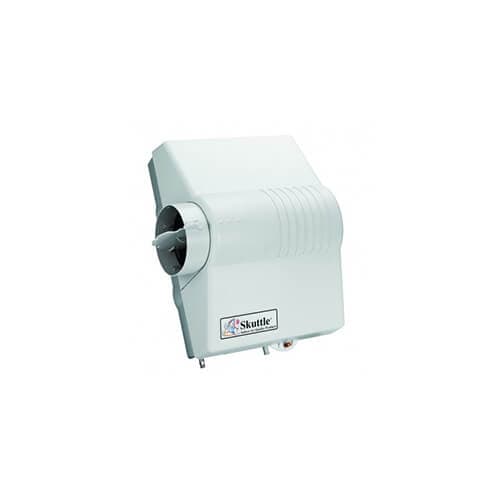
Skuttle 2001 Bypass Flow-Through Humidifier
The Skuttle 2001 Bypass Flow-Through Humidifier stands out for its flow-through design that reduces mineral buildup and lowers routine maintenance — a clear technical advantage in many Canadian regions with hard water. Versus the AprilAire 500, the Skuttle 2001 typically delivers a simpler installation and a more competitive upfront price, giving homeowners a cost-conscious, durable option that minimizes ongoing consumable costs while still providing whole-house humidity control for 2025 Canadian comfort needs.
Estimated$250 – $350
Why Humidity Control Matters: Simple Science and Evidence
Getting whole-house humidity right in Canada is less about hitting one number and more about tracking the weather. A humidifier that keeps a house comfortable at 0 °C will fog and frost the windows at -25 °C, and the moisture that condenses on cold glass, window trim and unheated attic sheathing is what causes the damage. Health Canada publishes the target range; CMHC's practical rule is to run whatever level keeps condensation off the windows.
Health Canada's target: keep indoor relative humidity below 50 percent in summer and roughly 30 to 35 percent in winter. Anything persistently above 50 percent encourages mould and dust mites.
The Canadian winter rule: lower the humidistat as the outdoor temperature drops. Window condensation, frost at the edge of the glass and damp sills are the signal that the setting is too high for the weather — CMHC's guidance is to reduce it until condensation stops, not to hold one number all season.
Capacity and power differ by format: bypass units rely on furnace airflow and typically deliver around 12 gallons per day; fan-powered flow-through models add their own blower and roughly 18 gallons per day; steam units such as the Aprilaire 800 produce 11.5 to 34.6 gallons per day and need a dedicated high-amperage 120/208/240 VAC circuit that an electrician usually has to run.
Hard water is the main maintenance cost. Minerals scale the evaporator pad, water panel or steam canister, so plan on replacing the pad or canister at least once per heating season — more often on well water or in hard-water regions.
A humidistat paired with an outdoor temperature sensor is what actually prevents condensation damage: the control automatically backs off the humidity target as it gets colder outside, which a manual dial will not do.
Frequently Asked Questions
Can I install a whole house humidifier myself?
In most cases, no. Every unit on this page mounts into furnace ductwork, connects to a water supply line and wires into the HVAC system, so most Canadian municipalities expect a licensed HVAC installer and often a permit — plumbing and electrical work are the parts that trigger it. Steam models such as the Aprilaire 800 also need a dedicated high-amperage circuit, which normally means an electrician. If you want something you can plug in yourself, you are looking for a portable console humidifier, not one of these.
What humidity level should I run in a Canadian winter?
Health Canada recommends keeping indoor relative humidity below 50 percent in summer and around 30 to 35 percent in winter. The practical part is that the winter number has to move: as the outdoor temperature falls, lower the humidistat until condensation and frost stop forming on your windows. A humidistat with an outdoor temperature sensor does this automatically and is the single best defence against window, trim and attic moisture damage.
Which humidifier should I choose for a big home?
The Aprilaire 800 Steam Humidifier is the highest-capacity unit here, producing 11.5 to 34.6 gallons per day depending on whether it is wired for 120, 208 or 240 VAC, with Aprilaire rating it for homes up to 6,200 sq ft. It carries an average rating of 4.4 and uses automatic digital control. Because it boils its own water it keeps up in deep cold without depending on furnace runtime — the trade-off is the dedicated electrical circuit and a steam canister that needs replacing as it scales.
Does the Aprilaire 800 have automated digital humidity control?
Yes — the Aprilaire 800 ships with automatic digital humidifier control, and its defining spec is high-output steam humidification of 11.5 to 34.6 gallons per day for large homes.
Conclusion
Choosing between these five comes down to house size, furnace setup, and how much installation work you are willing to pay for. All five are duct-mounted units that need a water line and HVAC wiring — budget for the installer alongside the unit. The five models covered here offer a range of approaches: Aprilaire 800 Steam Humidifier, GeneralAire 1000A Bypass Humidifier, Honeywell HE360A Powered Flow-Through Humidifier, AprilAire 500 Whole-Home Bypass Humidifier, Skuttle 2001 Bypass Flow-Through Humidifier. For a large or very leaky home in a deep-freeze climate, the Aprilaire 800 is the strongest pick because it makes its own steam and does not wait for the furnace to run — but it is also the one that needs its own electrical circuit. If your house is closer to average size and the furnace runs regularly through the winter, the GeneralAire 1000A, Honeywell HE360A, AprilAire 500 and Skuttle 2001 cost far less to buy and install. We hope you found what you were looking for; use the site search to refine by capacity, price, or installation type if you want to expand or narrow your options.