

Top 6 Floating Globes in Canada for 2026: Stylish Levitating Globes and Decorative Globes
Published on Thursday, February 26, 2026
Quick answer: a floating globe hangs in mid-air because an electromagnet in its base, corrected many times a second by a position sensor, balances gravity on a magnet-cored sphere. The float is active, not passive, so the base has to stay powered — usually over USB or a small DC adapter — and most models add LED lighting and slow rotation. Two of the six picks below are not conventional levitating world globes, and it is worth knowing which before you buy: the MOVA Globe 4.5" does not levitate at all, it sits in an acrylic cradle and turns itself on ambient light with no batteries or cords, and the VGAzer floats a moon rather than a world map. The other four are magnetic-levitation world globes with LED-lit bases, the largest being the RUIXINDA at 6 inches across. Levitating and floating globes have become a standout category in Canadian home decor. Combining elegant design with clever engineering, these pieces capture attention in living rooms, home offices, libraries, and reception areas. Canadian shoppers are attracted to floating globes because they marry visual impact with practical benefits: they serve as conversation starters, support learning about world geography and cultures, and offer a compact, modern accent for a wide range of interior styles. Demand in Canada favors designs that balance craftsmanship and durability, with many buyers looking for finishes that fit Scandinavian, midcentury modern, and contemporary aesthetics. Consumers also appreciate low-maintenance displays that add personality to small spaces, double as study aids for students, or act as unique gifts. Overall, floating globes blend art, education, and a dash of scientific wonder through magnetic levitation or precision rotation, making them a versatile and lasting decorative accent for Canadian homes and offices.
Top Picks Summary
- MOVA Globe 4.5" Blue with Relief Map
- VGAzer Levitating Moon Lamp Floating and Spinning
- ScienceGeek Magnetic Levitation Floating Globe with LED Light
- Woodlev Magnetic Levitating Globe with Wood Base
- MOKOQI Magnetic Levitation Floating World Map Globe with LED Light
- RUIXINDA Magnetic Levitating Globe 6 Inch
MOVA Globe 4.5" Blue with Relief Map
The MOVA Globe earns its spot as the premium choice for floating globes thanks to its patented solar-driven rotation and finely detailed relief map that requires no batteries or magnetic base. Compared with the magnetic-levitation options in this list, MOVA trades levitation theatrics for a maintenance-free, museum-quality presentation and typically commands a higher price due to its materials and proprietary engineering. For buyers prioritizing elegant, low-maintenance desktop display and accurate cartography, MOVA is the high-end option among these floating-globe choices.

VGAzer Levitating Moon Lamp Floating and Spinning
The VGAzer levitating moon lamp stands out as a decorative, lower-cost alternative that emphasizes atmospheric lighting and a textured lunar surface over geographic accuracy. Technically it uses magnetic levitation to float and spin while offering strong visual impact at a budget price, making it more affordable than MOVA or artisan wood-base globes but less suitable if you want a true world-map globe. For buyers seeking a striking ambient piece for bedrooms or living rooms, VGAzer delivers maximum visual appeal per dollar among the floating items listed.

ScienceGeek Magnetic Levitation Floating Globe with LED Light
ScienceGeek positions itself as a balanced, educational floating globe: reliable magnetic levitation with built-in LED lighting and readable map detail at a mid-range price. Compared to the premium MOVA and the decor-focused Woodlev, ScienceGeek focuses on STEM-friendly performance and straightforward setup, offering better value for classroom or desk demonstration use. If you want a technically dependable levitating globe that doubles as an educational tool without splurging on premium materials, ScienceGeek is a strong market-leader choice.
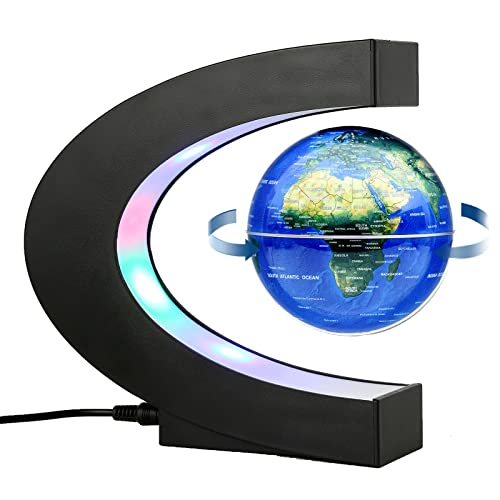
Woodlev Magnetic Levitating Globe with Wood Base
Woodlev distinguishes itself by combining magnetic levitation with a warm wooden base for a hybrid of classic design and modern levitation technology, appealing to buyers who value interior design as much as novelty. Financially it often sits above mass-market plastic bases because of its crafted aesthetic, but it outshines cheaper models for buyers seeking a premium look that integrates with home or office decor. Compared with bright LED-leaning rivals like MOKOQI, Woodlev trades lighting intensity for artisanal presentation and material quality.
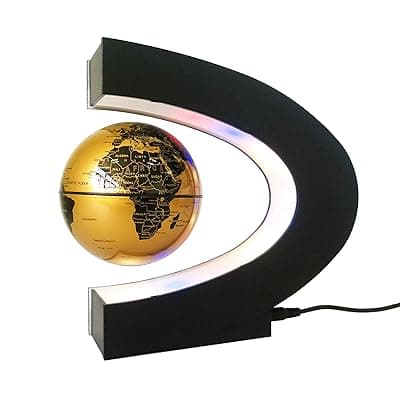
Where to buy Woodlev Magnetic Levitating Globe with Wood Base in Canada: the trusted retailers we track in this market, with the best price we have observed at each. Prices are checked regularly and can change, and the retailer confirms the final price at checkout.
We may earn a commission on purchases. It never affects our rankings.
$119 – $199
MOKOQI Magnetic Levitation Floating World Map Globe with LED Light
MOKOQI is notable for delivering bright LED illumination, clear world-map detail, and competitive pricing that makes levitating globes accessible to many buyers. Technically it offers the typical magnetic levitation experience found in this category while undercutting pricier designer options; its financial advantage is strong value-per-feature compared with MOVA’s premium engineering and Woodlev’s handcrafted bases. For shoppers wanting vivid lighting and solid map readability without paying top-tier prices, MOKOQI represents a practical, budget-conscious choice among floating globes.
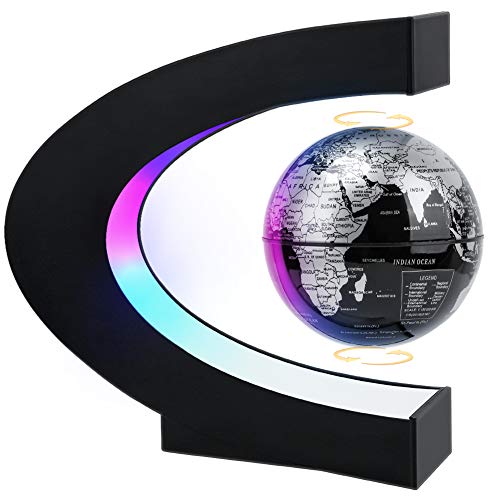
RUIXINDA Magnetic Levitating Globe 6 Inch
The RUIXINDA 6-inch levitating globe is positioned as a compact, entry-level floating globe delivering straightforward levitation and an affordable price point for first-time buyers. It typically provides simpler finishes and fewer premium features than MOVA or Woodlev but excels on cost and ease of setup, making it the best-value starter option among the products listed. If you want to test levitation decor on a desktop without a large investment, RUIXINDA offers the most economical technical entry into floating globes.

How levitating globes actually work
Levitating globes rely on active electromagnetic stabilisation rather than a clever arrangement of permanent magnets. Understanding the mechanism explains most of what owners report: why the base must stay plugged in, why setup takes patience, and why some "floating" globes never actually leave their stand.
Active levitation, not passive: an electromagnet in the base lifts a magnet-cored sphere while a position sensor and controller adjust the coil current many times a second to hold a fixed gap. A purely static arrangement of permanent magnets cannot hold a stable float at all — this is Earnshaw's theorem, and it is why every true levitating globe has electronics in its base.
It has to stay powered: because the float is actively corrected, cutting power drops the globe. Bases are typically USB or a small DC adapter and draw only a few watts, and most add LED lighting in the base, in the sphere, or both.
Setup is a balancing act: the globe must be released at the exact height and centre of the field. Nearby steel furniture, magnets, speakers or a draught can push it off balance, which is the single most common complaint in owner reviews of budget models.
Not everything sold as "floating" levitates: ambient-light globes such as the MOVA rotate inside an acrylic cradle using an internal motor driven by a photovoltaic cell. They never leave the base, but they also need no cord, no batteries and no setup.
Educational value: three-dimensional visual aids support spatial thinking and geography learning, and a globe that rotates or lights up holds attention better than a flat map — which is why these turn up as often on student desks as on office shelves.
Frequently Asked Questions
How does a levitating globe work?
An electromagnet in the base lifts a magnet-cored globe, and a position sensor feeds a controller that adjusts the coil current many times a second to hold the globe at a fixed gap. The correction has to be active: Earnshaw's theorem shows that a stable float cannot be achieved with permanent magnets alone, which is why every genuine levitating globe has electronics and a power input in its base.
Do floating globes need to be plugged in?
Yes. Because levitation is actively corrected by electronics, the base must stay powered or the globe drops — these are typically USB or small DC-adapter bases drawing only a few watts. The one exception on this page is the MOVA Globe 4.5", which does not levitate: it rotates inside an acrylic cradle on ambient light, with no batteries and no cord.
Which floating globe should I buy for my desk?
For a true levitating world globe, the RUIXINDA is the largest option here at 6 inches with an LED base, auto-rotation and touch control, rated 4.3; the ScienceGeek and MOKOQI listings are the cheaper LED-lit alternatives, rated 4.2 and 4.1. Choose the MOVA Globe 4.5" only if you want the premium cordless look rather than levitation — it is rated 4.7 but it rotates in a cradle rather than floating.
Does the MOVA Globe 4.5" use batteries or charging?
No. The MOVA Globe 4.5" Blue with Relief Map is driven by an internal photovoltaic cell that runs on ordinary ambient room light, so it needs no batteries, no charging and no cord. Its Amazon listing is explicit on this point. The trade-off is that it rotates in place inside its acrylic base rather than levitating.
Conclusion
If you are shopping in Canada for a floating globe, this page highlights six options: MOVA Globe 4.5" Blue with Relief Map, VGAzer Levitating Moon Lamp Floating and Spinning, ScienceGeek Magnetic Levitation Floating Globe with LED Light, Woodlev Magnetic Levitating Globe with Wood Base, MOKOQI Magnetic Levitation Floating World Map Globe with LED Light, and RUIXINDA Magnetic Levitating Globe 6 Inch. Two are worth calling out before you choose: the MOVA rotates in its cradle rather than levitating, and the VGAzer floats a moon rather than a world map. Among the true levitating world globes here, the RUIXINDA is the largest at 6 inches, while the ScienceGeek and MOKOQI listings are the budget entries — so the sensible way to pick is by the size you want on the desk and the budget you want to spend, since the underlying levitation technology is much the same across them. We hope you found what you were looking for; you can refine or expand your search using the search function to compare sizes, finishes, or lighting options and find the perfect floating globe for your space.