

Top 5 Pull Boxes in Canada for 2026:, Code-Ready Junction Solutions for Cold Climates
A pull box is an accessible enclosure inserted in a conduit run so conductors can be pulled, supported and spliced without exceeding bend or tension limits. In Canada the size of that box is not a matter of preference: for conductors No. 4 AWG and larger, Rule 12-3036 of the Canadian Electrical Code sets the minimum dimensions — a straight pull must be at least eight times the trade size of the largest raceway entering the box, and an angle or U pull at least six times the largest raceway plus the sum of the other raceway entries in the same row on the same wall. Below No. 4 AWG, box volume is governed instead by the conductor-count rules in Section 12. On top of sizing, everything installed must be approved equipment under Rule 2-024, which in practice means a CSA, cUL or cETL mark — a US-only UL listing is not accepted by Canadian inspectors. The picks below are judged on those two filters first, then on how the enclosure holds up to Canadian cold, meltwater and road salt.
Inception's AI took the time to understand this market in Canada · · How we pickWe may earn a commission on purchases. It never affects our rankings.
Top Picks Summary
Thomas & Betts PVC-SC-100 Pull Box
A small rigid-PVC enclosure for general-purpose pulling and splicing, and the value entry point among the five. PVC does not corrode, which is why it is the default in buried, coastal and road-salted locations where a steel box would need protection. Worth checking before you buy: the Amazon listing linked here resolves to the Thomas & Betts E982EFN-CTN PVC field service split box in 3/4 in., a small splice enclosure rather than a large conduit pull box, so confirm the catalogue number and interior volume against your conduit size and conductor count.

Estimated$50 – $60
IPEX Scepter JB664 Junction Box
A heavy-wall PVC junction and pull box built for cold, wet and chemically aggressive installations, and the strongest all-round choice here for Canadian outdoor work. IPEX moulds the Scepter line in Canada, so the boxes are certified to Canadian requirements rather than adapted from a US catalogue. It costs roughly twice the entry-level PVC boxes and delivers materially better impact resistance and sealing in return, while staying lighter and easier to mount than a steel enclosure.

Carlon E989N Pull Box
An economical, widely stocked nonmetallic pull box for residential and light-commercial runs that still need genuine weather protection. Its 8 x 8 x 4 in. body is the roomiest nonmetallic option among these five, which matters on angle pulls where CEC Rule 12-3036 requires six times the largest raceway plus the sum of the other entries in that row. Note that this entry links to an Amazon search rather than a single listing, so confirm the exact catalogue number, the certification mark and the seller before ordering.
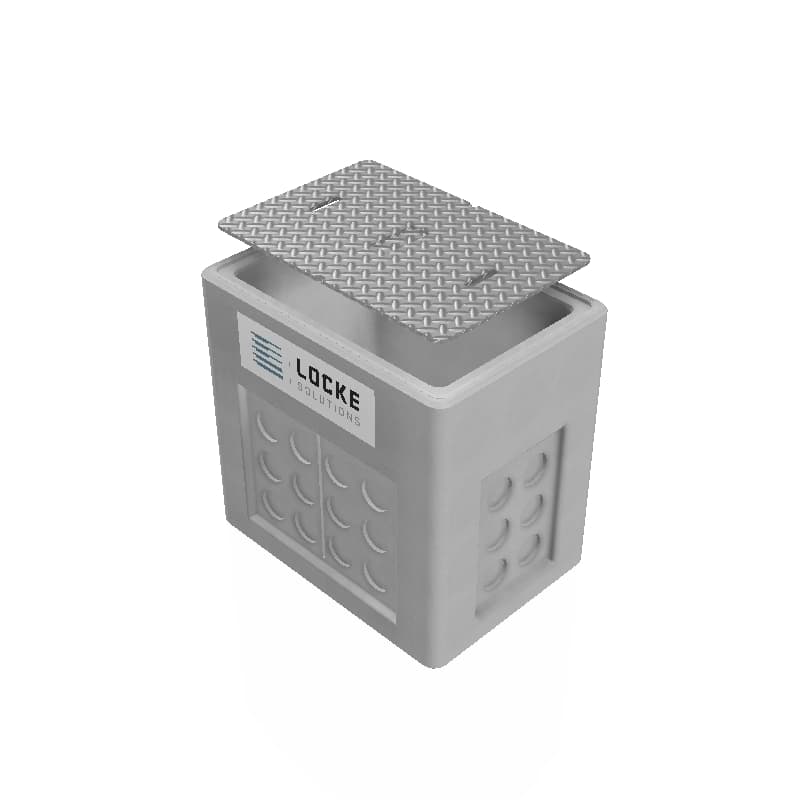
We may earn a commission on purchases. It never affects our rankings.
Estimated$12 – $35
Arlington FP524F Fan/Fixture Mounting Box
This listing resolves to the Arlington FB900-1 fan and fixture mounting box for cathedral and sloped ceilings in new construction — a fixture-support box, not a conduit pull box. It is a good product for what it is: it braces a ceiling fan or heavy luminaire against the framing and gives a code-compliant wiring point at the fixture. It is not sized or intended for pulling conductors through a conduit run and should not be used as a splice or pull point on a feeder. Included here for reference; use one of the PVC or steel enclosures above where Rule 12-3036 applies.

Estimated$60 – $70
Hubbell Raco 698 Pull Box
Raco steel boxes are a long-standing trade staple, but the catalogue number matters here. Raco 698 is a non-gangable masonry box — a 4-gang steel device box of roughly 90 cubic inches — while the Amazon listing linked on this page resolves to the Raco 165, a 4 in. octagonal box of about 21.5 cubic inches. Neither is a screw-cover pull box. Raco's actual pull-box line is the SC and RSC series: 16-gauge steel screw-cover enclosures in sizes such as 6 x 6 x 4 and 8 x 8 x 4 in., rated NEMA 3R for outdoor rain, sleet and snow. Order by that series number if a steel pull box is what you need.

Estimated$120 – $250
Research and Standards Behind Pull Box Performance
Pull box selection in Canada is driven by three documented constraints: the dimensional rules in Section 12 of the Canadian Electrical Code (CSA C22.1), the certification requirement in Rule 2-024, and the ingress rating the installation environment demands. The notes below summarise what each one actually requires.
Sizing is prescriptive, not judgement: for No. 4 AWG and larger, CEC Rule 12-3036 requires a straight pull box at least 8x the trade size of the largest raceway, and an angle or U pull at least 6x the largest raceway plus the sum of the other entries in that row.
Certification decides approval: Rule 2-024 permits only approved equipment, so an enclosure needs a CSA, cUL or cETL mark. A box carrying a US-only UL listing is a common cause of a failed inspection in Canada.
NEMA type is not the same as an IP number: NEMA 3R covers rain, sleet and snow; NEMA 4 and 4X add hose-directed water and corrosion resistance; 6P covers prolonged submersion. Match the type to meltwater, sprinklers and washdown, not to the price tag.
Material follows the environment: PVC and Noryl bodies do not corrode and are the default for buried, coastal and salted-road locations, while steel enclosures give mechanical protection and a continuous bonding path where impact or tampering is the risk.
Access is the point of the box: a pull box must remain accessible after finishing, so cover clearance and mounting position matter as much as cubic inches when the run is later modified or re-pulled.
Frequently Asked Questions
What size does a pull box have to be under the Canadian Electrical Code?
For conductors No. 4 AWG and larger, CEC Rule 12-3036 sets the minimum. On a straight pull, the box must be at least eight times the trade size of the largest raceway entering it — so a 2 in. conduit needs at least a 16 in. straight run inside the box. On an angle or U pull, the distance from each raceway entry to the opposite wall must be at least six times the trade size of the largest raceway in that row, increased by the sum of the diameters of the other raceway entries in the same row on the same wall. Below No. 4 AWG, Rule 12-3036 does not apply and the box is sized by the conductor-count volume rules in Section 12 instead.
Can I install a US pull box in Canada if it is UL listed?
Not on its own. CEC Rule 2-024 allows only approved equipment to be installed, and approval in Canada means certification by a body accredited by the Standards Council of Canada — look for a CSA, cUL or cETL mark on the enclosure. A box carrying only a US UL listing has no standing with a Canadian inspector, which is why identical-looking boxes sold on both sides of the border can carry different markings. Check the mark on the box itself, not the marketing copy on the listing.
Which of these five is the best pull box for a general indoor run?
The Thomas & Betts PVC pull box, at $55.70, is the value pick for general-purpose pulling and splicing: rigid PVC that will not corrode, multiple knockouts on the sides and back for flexible conduit entry, and a simple cover for quick access. It carries an average rating of 4.4 here. Note that the Amazon listing linked on this page resolves to the Thomas & Betts E982EFN-CTN PVC field service split box in 3/4 in., so confirm the catalogue number and the box's interior volume against your conduit size before ordering.
Which box holds up best to Canadian cold and wet conditions?
The IPEX Scepter JBX664, at $124.95 and rated 4.1 here, is the cold-climate choice among these five. It is a heavy-wall PVC box in a compact 6 x 6 x 4 in. footprint with roughly 172 cubic inches of splice room, and IPEX documents the Scepter enclosure line down to -40 C with NEMA Type 4 and 4X protection against hose-directed water and corrosion. The Carlon E989N is the alternative when you need more room — an 8 x 8 x 4 in. nonmetallic body with a gasketed screw cover, rated NEMA 4, 4X and 6P and listed for direct burial.
Conclusion
In Canada the right pull box is the one that satisfies Rule 12-3036 on dimensions and Rule 2-024 on certification, then survives the climate it sits in. Of the five products profiled here, the Thomas & Betts PVC pull box and the IPEX Scepter JBX664 are the two genuine conduit pull-box choices, with the Carlon E989N the roomier nonmetallic value option. The Arlington FB900 listing is a fan and fixture mounting box and the Hubbell Raco entry resolves to a small octagonal device box, so neither should be used as a pull point — check the catalogue number on the listing before you order. For most general-purpose Canadian installations the Thomas & Betts PVC box is the best-value starting point, and the IPEX Scepter is the pick where the box sees cold, wet or chemically aggressive conditions. Use the search to narrow by size, material or NEMA type.