

Best Foreground Plants for Freshwater Aquascapes in Canada — Top 7 for 2026
Low-growing and carpeting foreground plants are foundational to modern freshwater aquascapes, creating lush carpets, open foregrounds, and a sense of scale in planted tanks. In Canada, hobbyists increasingly favor species that combine steady spread with low-light tolerance and resilience to seasonal shipping and water chemistry variations. Buyers look for plants that establish quickly, resist algae when properly maintained, and match their tank's technical level—whether low-tech, low-light setups or high-tech, CO2-enriched aquariums. Availability from trusted tissue-cultured suppliers and clear care information are decisive factors for Canadian aquascapers, because guaranteed pest-free, healthy stock reduces acclimation problems and improves long-term success. This guide highlights seven top foreground plants available in Canada in 2026, comparing their growth habits, light and CO2 needs, and why each is a strong pick for different experience levels and tank styles.
Inception's AI took the time to understand this market in Canada · · How we pickWe may earn a commission on purchases. It never affects our rankings.
Top Picks Summary
Tropica Hemianthus Callitrichoides Cuba 1-2-Grow!
Tropica's HC Cuba 1-2-Grow! is the benchmark ultra-dwarf carpet for foregrounds, prized for its tiny leaves and jewel-like appearance that create an instant high-end aquascape. As a sterile, ready-to-plant mat it offers predictable results and faster visual payoff than loose plugs, though it typically demands higher light and CO2 than hardier options like Monte Carlo or Marsilea. Its premium look and reliable tissue-culture quality justify a higher unit cost for aquascapers aiming for fine detail in small tanks.

We may earn a commission on purchases. It never affects our rankings.
$11.19CAD
Tropica Micranthemum tweediei Monte Carlo 1-2-Grow!
Tropica's Monte Carlo 1-2-Grow! is a resilient, low-growing carpet that bridges the gap between delicate HC and coarse grasses, offering easier establishment and greater shade tolerance. Packaged as a sterile mat for consistent planting, it is often more forgiving—and therefore more cost-effective in long-term maintenance—than Hemianthus Cuba, making it a smart choice for hobbyists seeking a lush foreground without the premium upkeep. Compared to Eleocharis and Lilaeopsis it gives a fuller carpet effect with less trimming and replanting frequency.

We may earn a commission on purchases. It never affects our rankings.
$6.75CAD
Tropica Eleocharis acicularis Mini 1-2-Grow!
Tropica's Mini Hairgrass 1-2-Grow! delivers a fine, grassy foreground that adds movement and texture, favoring flow and contrast in planted layouts. Its mat format accelerates establishment versus sowing runners, and its faster spreading habit and tolerance of a broader range of light/CO2 conditions often make it a more budget-friendly route to full coverage than ultra-dwarf carpets. Technically it suits aquascapes seeking vertical texture rather than the carpet-thick look of Glossostigma or Monte Carlo.

We may earn a commission on purchases. It never affects our rankings.
$11.19CAD
Marsilea Hirsuta
Tropica's Marsilea hirsuta 1-2-Grow! offers a clover-like, low-profile foreground that is impressively hardy and quick to spread from its sanitary mats, making it one of the most low-maintenance carpet choices. Its tolerance for varied lighting and softer trimming needs makes it economically attractive for beginners compared with delicate tissues like HC or Glossostigma that require stricter conditions. Marsilea's distinctive foliage also pairs well with finer carpets and grassy foregrounds to add botanical contrast without extra cost or CO2 dependency.

Aquaflora Glossostigma elatinoides Tissue Culture
Aquaflora's Glossostigma tissue-culture is a classic, ultra-low carpet option offered in sterile cups that guarantee pest-free stock and predictable spreads for high-density foreground coverage. While Glossostigma can be more demanding in light and maintenance than Monte Carlo or Marsilea, the tissue-culture format reduces risk and long-term replacement costs, delivering high visual payoff in small tanks where a flat, smooth carpet is desired. Compared with Tropica's 1-2-Grow mats it may require more hands-on trimming but rewards with the signature smooth carpet aesthetic prized in show aquascapes.

We may earn a commission on purchases. It never affects our rankings.
$14.99CAD
Tropica Lilaeopsis brasiliensis 1-2-Grow!
Tropica's Lilaeopsis brasiliensis 1-2-Grow! creates a grassy, miniature-lawn foreground with narrow leaves and a calm, low-maintenance profile, delivered as an easy-to-plant mat for quick uniform coverage. It is technically less demanding than Glossostigma or HC and sits between hairgrass and true carpets in texture, offering a cost-effective option for aquascapers wanting a neat foreground without intensive trimming or CO2 regimes. Its visual subtlety makes it a strong companion plant to Monte Carlo or Marsilea when mixed carpets are desired.

We may earn a commission on purchases. It never affects our rankings.
$13.00CAD
Dennerle Sagittaria subulata In-Vitro
Dennerle's Sagittaria subulata In-Vitro is a compact, lance-leafed foreground/stem hybrid that excels in durability and rapid establishment from sterile culture tubes, providing excellent value for beginners and large-volume plantings. Although it does not form the ultra-fine carpets of HC or Glossostigma, its tolerance of a wide range of conditions and lower light needs make it one of the most budget-friendly foreground choices for robust, low-effort layouts. Its structural leaves add vertical accents in the front of the tank, contrasting well with the flatter carpets from Tropica and Aquaflora.
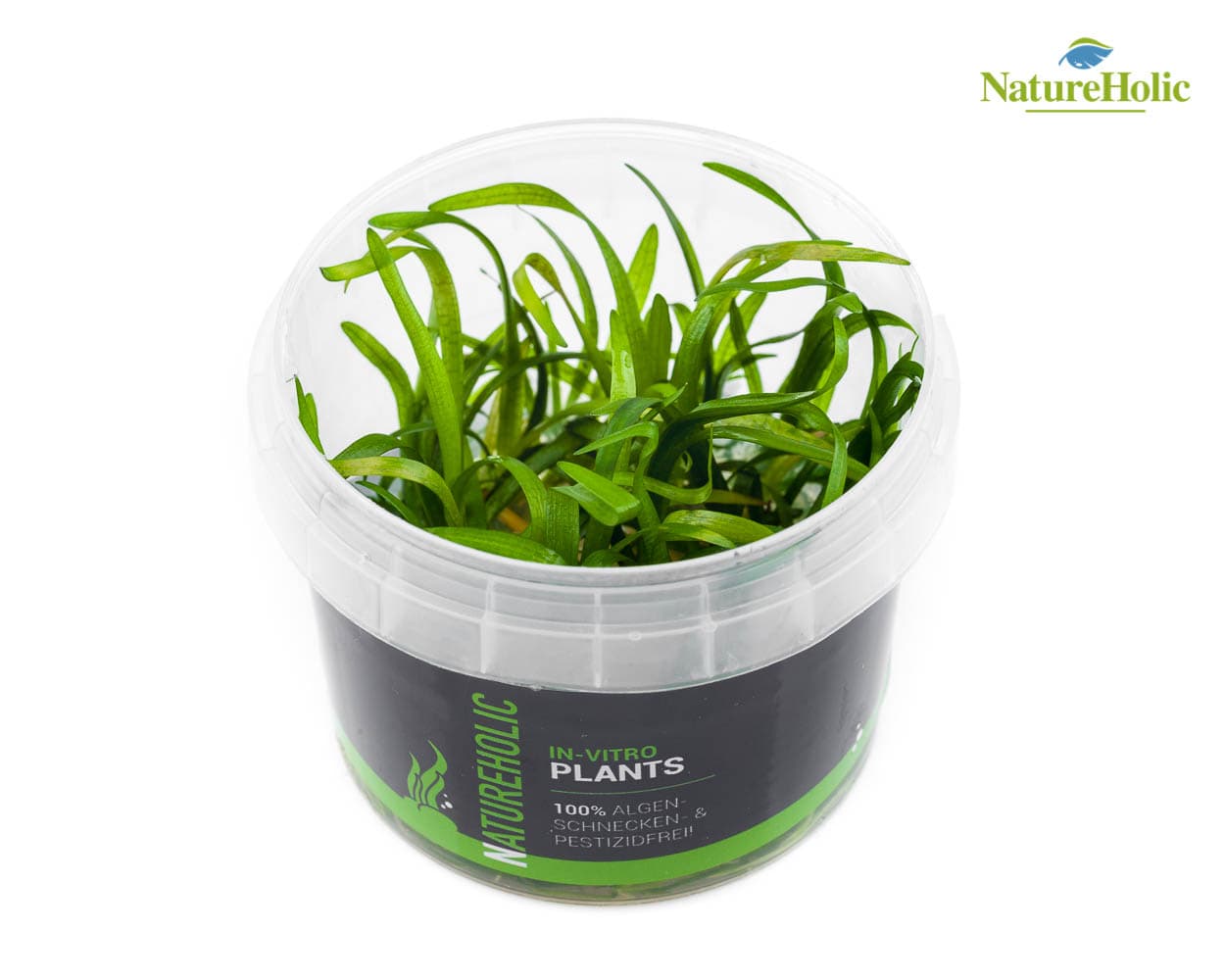
Estimated$14 – $32
What science and hobby research say about carpeting foreground plants
Scientific and hobbyist research converge on several key benefits of foreground and carpeting aquatic plants. Studies in aquatic ecology and applied aquaculture show that rooted and carpeting plants help reduce dissolved nutrients, stabilize substrate, create ecological niches for microfauna, and outcompete nuisance algae when appropriate maintenance and nutrient balance are in place. Tissue-cultured plants are supported by plant pathology and horticulture practice as a reliable way to reduce pests, diseases, and invasive hitchhikers during distribution. Understanding species-specific light and carbon needs is essential: some carpeting species perform well in low-tech setups, while others require CO2 injection and higher light to carpet effectively.
Nutrient control: Rooted foreground plants take up nitrate and phosphate, reducing excess nutrients that fuel algae growth when balanced with tank stocking and feeding.
Algae competition: Dense carpets reduce light and nutrient availability on the substrate surface, making it harder for filamentous and spot algae to establish.
Habitat and biodiversity: Carpets provide shelter and feeding surfaces for fry, shrimp, and beneficial microfauna, supporting a healthier tank ecosystem.
Substrate stability: Rhizome and runner-forming species help bind substrate particles and promote a stable root zone for long-term plant health.
Tissue culture benefits: Tissue-cultured stock minimizes risk of snails, black beard algae, and external pathogens commonly carried on wild-harvested plants.
Practical trade-offs: Research and long-term hobby experience show that faster-spreading or denser carpeting plants often need stronger lighting and CO2, while some species tolerate low-tech conditions at the cost of slower coverage.
Frequently Asked Questions
Which foreground carpet plant should I choose for Canada?
If you want the densest ultra-dwarf look, choose Tropica Hemianthus Callitrichoides Cuba 1-2-Grow! (4.7 rating), a sterile ready-to-plant mat that’s prized for a dense, lush foreground and faster visual payoff than loose plug.
Does Monte Carlo 1-2-Grow handle moderate light better?
Yes—Tropica Micranthemum tweediei Monte Carlo 1-2-Grow! is described as more forgiving of moderate light levels, forming a thick, even carpet from runners, and it’s packaged as a sterile mat for consistent planting.
What’s the value of HC Cuba versus Mini hairgrass?
Tropica Hemianthus Callitrichoides Cuba 1-2-Grow! costs $19.99 CADwhile Tropica Eleocharis acicularis Mini 1-2-Grow! is also $19.99 CAD; both use sterile 1-2-Grow mat formats, but HC is an ultra-dwarf carpet and Mini hairgrass is fine, grassy tufts.
Are these plants better for CO2 tanks or low-tech?
HC Cuba 1-2-Grow! performs best under high light with CO2 injection for compact growth, while Monte Carlo 1-2-Grow! is more forgiving of moderate light levels and still responds well to CO2 and trimming.
Conclusion
These seven foreground plants offer reliable choices for Canadian aquascapers in 2026: Tropica Hemianthus Callitrichoides Cuba 1-2-Grow!, Tropica Micranthemum tweediei Monte Carlo 1-2-Grow!, Tropica Eleocharis acicularis Mini 1-2-Grow!, Tropica Marsilea hirsuta 1-2-Grow!, Aquaflora Glossostigma elatinoides Tissue Culture, Tropica Lilaeopsis brasiliensis 1-2-Grow!, and Dennerle Sagittaria subulata In-Vitro. For most Canadian hobbyists seeking a balance of low-light tolerance, steady spread, and resilience to shipping and seasonal water variation, Tropica Micranthemum tweediei Monte Carlo 1-2-Grow! is the best overall choice. If you prefer faster high-tech carpeting, consider Tropica Hemianthus Callitrichoides Cuba 1-2-Grow!; if you want low-maintenance, low-tech options, Tropica Marsilea hirsuta 1-2-Grow! and Dennerle Sagittaria subulata In-Vitro are excellent alternatives. We hope you found what you were looking for—use the site search to refine by light level, CO2 needs, or to expand your search to midground and background plant options.