

Top 6 Contact Adhesives for Saddle Bonding in Canada for 2026
High-tack contact adhesives for saddle bonding are formulated to create an immediate, durable bond between panels, flaps, trim and structural components on both leather and synthetic substrates. This category is essential for professional saddlers, leatherworkers and equestrian repair shops because it combines instant grab for fast assembly with long-term flexibility and resistance to the shear and peel stresses that saddles endure. In Canada, buyers prioritize adhesives that tolerate wide temperature swings, offer predictable open time for on-site repairs, and meet low-VOC or safer indoor-use preferences. Accessibility at local retailers and reliable distributor supply, clear surface-preparation guidance, and manufacturer technical data are additional factors that influence purchasing decisions. The top products in this category balance strong initial tack, durable cured elasticity, and practical working windows so repairs and assembly stay efficient without sacrificing long-term performance.
Inception's AI took the time to understand this market in Canada · · How we pickWe may earn a commission on purchases. It never affects our rankings.
Top Picks Summary
Barge All-Purpose Cement
Barge All-Purpose Cement is a long-established, solvent-based contact adhesive prized in saddlery for its strong, flexible bond and generous open time that lets craftsmen reposition heavy leather panels before final set. It holds a best-in-class position for saddle bonding because it balances high shear strength with affordability and wide availability, making it a cost-effective choice compared with premium European specialty adhesives like Renia. Compared with faster-setting options such as Weldwood, Barge is often preferred for larger or more complex leather assemblies where working time and flexibility matter most.

LePage Heavy Duty Contact Cement
LePage Heavy Duty Contact Cement is a robust, weather-resistant contact adhesive that offers strong, permanent bonds and improved heat and moisture tolerance—attributes that make it a market-leader choice for saddles exposed to outdoor use. It commands a premium relative to commodity contact cements but delivers better environmental durability than many cheaper formulations, positioning it ahead of basic economy options for long-lived tack and seam integrity. Compared with leather-specific products like Master's, LePage is often stronger for panel bonding, while Master's may be gentler for fine edgework.

Renia Colle de Cologne
Renia Colle de Cologne is a European leather specialist contact adhesive that targets professional saddlers with a refined formulation designed for low staining, controlled tack and minimal shrinkage—qualities valued for high-end saddle restoration and bespoke work. Its technical strengths are precision and material compatibility, offering a premium alternative to mass-market cements; the trade-off is higher unit cost but potentially lower rework and better finish preservation. Compared to heavier industrial adhesives like LePage, Renia emphasizes finish safety and artisanal control useful in luxury saddle applications.

We may earn a commission on purchases. It never affects our rankings.
$72.53CAD
DAP Weldwood Original Contact Cement
DAP Weldwood Original Contact Cement is a widely available, economical neoprene-based contact adhesive that provides fast tack, strong initial grab and good flexibility for leather-to-leather and leather-to-wood saddle repairs. It earns a best-in-class value position for saddle bonding by balancing reliable performance with broad retail availability, making it a cost-effective choice for hobbyists and shops compared with the more specialized Stabond C-111. While not specifically engineered for heavy-duty saddlery, its lower price and ease of use make it the practical option for routine repairs and short-run jobs.
![Dap 00271 Weldwood The Original Contact Cement 1-Pint [Tools & Hardware]](https://m.media-amazon.com/images/I/51yIvvNzcoL._SL500_.jpg)
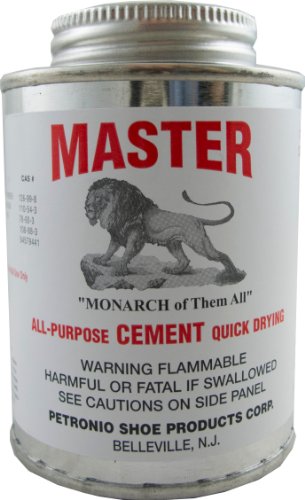
Master's Leather Cement
Master's Leather Cement is formulated specifically for leatherwork, providing a flexible, seam-friendly bond that preserves the look and hand of fine leathers commonly used in saddlery. It holds a niche position for detailed edge bonding and repairs where a leather-safe formulation and minimal surface marking are more important than the absolute tensile strength of panel contact cements like Weldwood or Barge. While typically more expensive per ounce than generic contact cements, its leather-specific chemistry can reduce damage and trimming costs on premium saddles.
Stabond C-111
Stabond C-111 is a market-leading, specialty contact adhesive formulated for leatherwork and saddlery, delivering superior flexibility, long-term resistance to sweat and heat, and a high-strength leather-to-leather bond that professional saddlers prefer. Its formulation is optimized for dynamic loads and thin glue lines, giving better longevity and performance on full saddles or high-use repairs, but it typically commands a premium compared with the more economical DAP Weldwood. For applications where durability, resilience to flexing and long-term service are critical, Stabond C-111 is often the technically superior—and financially justifiable—choice.

Estimated$25 – $150
What research and testing say about contact adhesives for saddle work
Laboratory adhesion testing and industry technical studies show that properly formulated contact adhesives deliver strong initial tack and sustained bond strength on leather and many synthetic saddle materials. Standard test methods used by manufacturers and labs evaluate peel resistance, shear strength and flexibility to predict how adhesives will react to repetitive loads and temperature changes. Research highlights the importance of substrate preparation, the chemical compatibility of adhesive with leather finishes, and the trade-offs between fast grab and repositioning time. Low-VOC and water-based formulations reduce indoor exposure risks while modern solvent-based contact cements retain advantages in temperature tolerance and long-term flexibility for demanding equestrian applications.
Adhesion tests (peel and shear) are used to measure resistance to the forces saddles experience. Higher peel resistance reduces seam lift; higher shear strength reduces delamination under load.
Open time and initial tack are a balance: short open times give instant grab for quick assembly, while longer open times permit repositioning during complex repairs.
Temperature and humidity tolerance matter in Canada: cold-weather performance and resistance to heat-related softening are commonly measured in lab conditioning tests.
Surface preparation is critical: cleaning, de-greasing and light abrasion improve mechanical bonding and reduce failure risk, a finding repeated in multiple industry technical guides.
Low-VOC and water-based adhesive options reduce indoor air concerns; regulatory guidance from Canadian authorities encourages lower VOC content for consumer and trade products.
Frequently Asked Questions
Which contact cement is best for saddle bonding?
Barge All-Purpose Cement is best for most saddle bonding because it’s neoprene-based, stays flexible after curing for curved panels, and has a long open time for repositioning larger leather pieces; it’s rated 4.7.
Does LePage heavy duty contact cement handle outdoor tack?
LePage Heavy Duty Contact Cement is designed for weather resistance with water and aging resistance, plus improved heat and moisture tolerance, making it suitable for saddles exposed to outdoor use; it’s rated 4.2.
Is Renia Colle de Cologne worth the higher price?
Renia Colle de Cologne costs $72.53 CADand targets pro saddlers with low staining, controlled tack, minimal shrinkage, and a thin non-bulky bond line for preserving saddle shape; it’s rated 4.5.
What warranty coverage comes with Barge all-purpose cement?
The provided product details don’t list any warranty duration for Barge All-Purpose Cement ($30.99 CADrated 4.7), so warranty coverage isn’t specified.
Conclusion
In the Canadian saddle and leather repair market these six adhesives—Barge All-Purpose Cement, LePage Heavy Duty Contact Cement, Renia Colle de Cologne, DAP Weldwood Original Contact Cement, Master's Leather Cement and Stabond C-111—represent the most reliable options for 2026. Each product brings strengths: Barge All-Purpose Cement for its all-around leather performance, LePage for regional availability and heavy-duty formulation, Renia for specialty leather care, DAP Weldwood for a proven traditional contact cement, Master's Leather Cement for leather-focused formulation and Stabond C-111 for shoemaking-grade bonds. For most professional saddlers and repair shops looking for the best blend of tack, flexibility and availability, Barge All-Purpose Cement stands out as the best overall choice. We hope you found what you were looking for; use the search to refine by properties like low-VOC, open time or retailer availability, or expand your search to compare technical data sheets and safety information.