

Canada 2025: Top 5 Aluminum Clincher Rim-Brake Compatible Rims — Top Picks, Trade-Offs & Buying Guide
Aluminum clincher rims with machined or reinforced braking surfaces are designed to deliver reliable modulation and efficient heat dissipation for rim-brake systems. These rims remain the go-to choice for many road, touring and mixed‑surface riders who value predictable stopping power, repairability and compatibility with a wide range of tires and brakes. In Canada, where conditions range from dry summer roads to cold, salted winters and long-distance touring routes, buyers often prioritize durable sidewall reinforcement, predictable wet-weather braking, and a balance between weight and stiffness. This category appeals to cyclists who want proven mechanical performance, easy maintenance, and rims that work well with traditional caliper and cantilever brakes without the cost or special handling requirements associated with carbon braking surfaces.
Inception's AI took the time to understand this market in Canada · · How we pickWe may earn a commission on purchases. It never affects our rankings.
Top Picks Summary
Mavic Open Pro UST
Mavic Open Pro UST stands out as the premium, best-in-class aluminum clincher rim for rim-brake bikes thanks to its UST tubeless-ready treatment combined with a time-proven machined braking surface. It balances light weight and durability better than many competitors on this list, offering professional-level finishing and reliable heat dissipation that justify a higher price while still retaining the clincher convenience. Compared with simpler, budget rims here it provides a modern tubeless option and refined manufacturing tolerances that benefit precise builds and long-term serviceability.

Estimated$220 – $320
DT Swiss R460
The DT Swiss R460 is positioned as a market-leading choice for riders who want a dependable, sporty aluminum clincher rim with excellent stiffness-to-weight characteristics and a precision-machined brake track. Technically it realises DT Swiss's engineering focus on spoke flange geometry and consistent dimensions, offering easier wheelbuilding and predictable braking compared with deeper or less tightly controlled rims in this list. Financially it sits between premium and budget options, delivering OEM-grade performance that represents strong value for frequent road use and high-mileage applications.

Velocity A23
Velocity A23 is the standout value option on this list, providing a classic 23mm braking surface and robust construction that keeps replacement and upgrade costs low for rim-brake riders. Compared with higher-end models like the Mavic UST or DT Swiss R460, the A23 trades some weight and finesse for exceptional affordability and ease of repair, making it ideal for commuting, training wheels, and durable wheel builds. Its popularity stems from consistent availability and simple proven design, which lowers lifecycle costs while delivering predictable braking performance.

Estimated$140 – $220
HED Belgium Plus
HED Belgium Plus brings a performance-oriented, shallow-profile aluminum clincher that emphasizes ride quality and crosswind stability, benefiting riders who want a race-capable rim without the premium price of carbon. Technically it offers a refined rim shape and reinforced brake track that competes well with DT Swiss for stiffness and with Mavic for finished tolerances, while often undercutting them on price for similar ride feel. This model is a strong middle-ground choice for racers who prioritize handling and comfort alongside reliable rim-brake stopping power.

Estimated$480 – $650
Alexrims DA22
Alexrims DA22 represents the budget-friendly, fleet-oriented option in the aluminum clincher rim category, delivering solid basic performance and wide availability at a lower cost than the boutique rivals on this list. While it lacks the refined machining or tubeless-ready features of the Mavic or the engineered spoke interfaces of DT Swiss, its low price and durable construction make it an attractive choice for entry-level builds, commuter bikes, and large-volume wheel manufacturers. For riders and shops prioritizing upfront cost and dependable everyday use, the DA22 provides straightforward value.
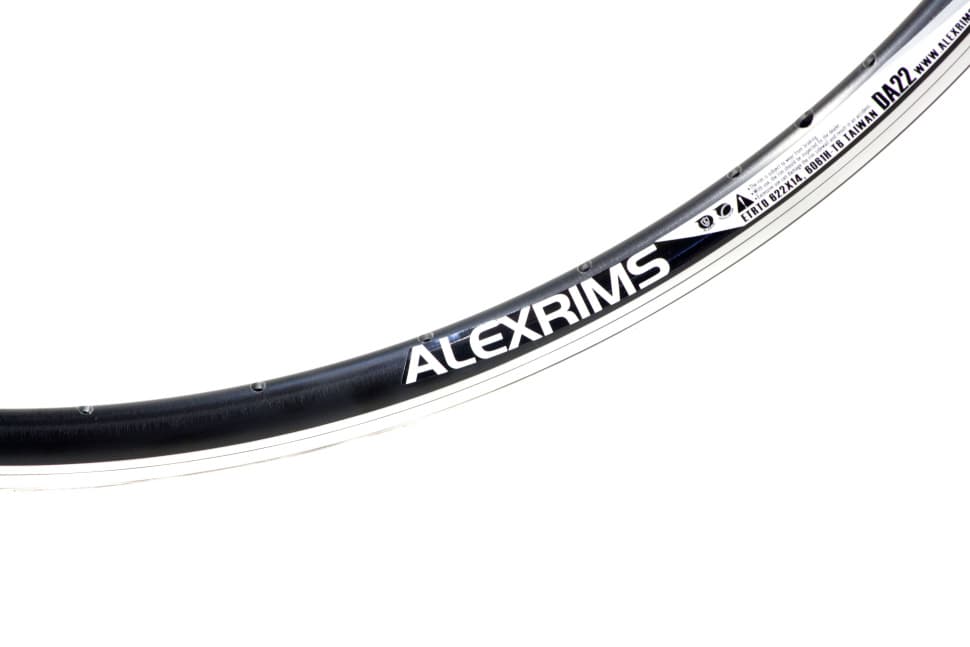
Estimated$120 – $200
Why aluminum clincher rims work — research-backed benefits
Engineering studies and industry test labs consistently highlight aluminum rims for their thermal conductivity, straightforward brake-surface servicing, and tolerance to a wide temperature range. While the cycling field contains diverse testing methods, the consistent takeaways are that well-designed aluminum braking surfaces reduce rim overheating risk, are easier to re‑true after impacts, and perform predictably in mixed weather when paired with appropriate brake pads. For beginners, the most important concepts are heat transfer, material wear, and design trade-offs between weight, stiffness and longevity.
Thermal performance: Aluminum alloys conduct heat away from the brake track faster than many composite alternatives, lowering peak rim temperatures during long descents — this is repeatedly shown in independent thermal comparison tests.
Brake modulation and pad interaction: Machined or appropriately treated aluminum braking surfaces provide consistent friction behavior across a range of temperatures and help prevent glazing when using compatible brake pads, as reported in manufacturer laboratory evaluations.
Durability and wear: Reinforced sidewalls and hardened brake tracks slow wear from pads and grit — field durability reviews and shop-life measurements show aluminum clincher rims typically require simpler, less expensive maintenance than carbon braking rims.
Safety trade-offs: Studies of failure modes indicate that aluminum rims are more likely to bend rather than catastrophically fail, making them easier to ride home or repair after a pothole strike compared with some lightweight alternatives.
Environmental factors: In climates with road salt and moisture (common in Canada), treated or anodized braking surfaces and corrosion-resistant spoke beds extend service life — corrosion testing and user reports support this recommendation.
Tubeless and clincher compatibility: Engineering notes from rim and tire makers show many modern aluminum clinchers can be built tubeless-ready without compromising rim-brake performance, but rim bed and bead profiles must meet tubeless standards to ensure safety.
Performance balance: Independent wheel test labs and buyer surveys illustrate the common trade-off: low-mass rims save weight and improve acceleration, while moderately deeper or reinforced rims improve durability and braking consistency for touring and everyday riding.
Frequently Asked Questions
Which rim should I buy for rim-brake road touring?
Choose the Mavic Open Pro UST if you want a UST tubeless-compatible aluminum clincher with a machined brake track, plus a proven double-wall box-section for long-term durability and stiffness; it’s rated 4.5.
What brake surface spec does Velocity A23 use?
Velocity A23 uses a machined brake track for rim-brake compatibility and straightforward truing, and it has a lightweight 23mm external-width alloy rim; it’s rated 4.3.
Is Velocity A23 good value compared to DT Swiss R460?
Velocity A23 costs CA$162 and includes a machined brake track and 23mm external-width alloy rim, while the DT Swiss R460 costs $193.34 CADwith a precisely machined brake track and durable double-wall construction; ratings are 4.2 vs 4.4.
Are these rims compatible with rim-brake wheelsets?
Yes—Velocity A23 is explicitly a machined brake track alloy rim for rim-brake compatibility, and the DT Swiss R460 also has a precisely machined braking surface for predictable rim-brake modulation; both are clincher rims rated 4.2 and 4.4.
Conclusion
In the Canadian context, aluminum clincher rim-brake compatible rims remain an excellent choice for riders who prioritize predictable braking, easy maintenance and broad tire compatibility. The five rims highlighted here — Mavic Open Pro UST, DT Swiss R460, Velocity A23, HED Belgium Plus, and Alexrims DA22 — represent a range of priorities from tubeless-ready versatility (Mavic Open Pro UST) to value and touring durability (Velocity A23, Alexrims DA22). For most Canadian riders seeking the best balance of durability, braking control and everyday performance, the DT Swiss R460 stands out as the recommended all-around choice on this list. We hope you found what you were looking for; use the site search to refine by weight, brake-surface treatment, tubeless capability or price if you want to narrow or expand your options.