

Top 6 Fishing Landing Nets and Gaffs in Canada for 2025 – Best Rubberized Mesh, Knotless Nets and Telescoping Gaffs
Landing nets, rubberized mesh nets, and gaffs are essential tools for anglers who want secure retrieval with minimal harm to fish. In Canada, the modern angler increasingly prefers knotless rubber nets, rubberized mesh, and telescoping handles for their fish-friendly properties, durability in cold freshwater and saltwater conditions, and easy transport for hiking or boat use. These designs reduce scale and slime damage, lower the risk of hook tangles, speed up netting, and support catch-and-release ethics—qualities that make them especially appealing in Canadian fisheries where conservation and practical performance are priorities. Buyers also balance factors like frame material, handle length and locking systems, net depth and mesh size, and whether the tool is optimized for freshwater trout, walleye, bass, or larger saltwater species.
Inception's AI took the time to understand this market in Canada · · How we pickWe may earn a commission on purchases. It never affects our rankings.
Top Picks Summary
The Rising Brookie is a niche, trout-focused knotless rubber net built for lightweight rivers and small-species handling, offering an affordable, ultra-portable design that protects delicate fins and scales. It outperforms larger generalist nets when targeting brook trout or panfish due to its compact hoop and low weight, though it’s not intended for larger, heavy-duty landings.
Show More Knotless Rubber Landing Nets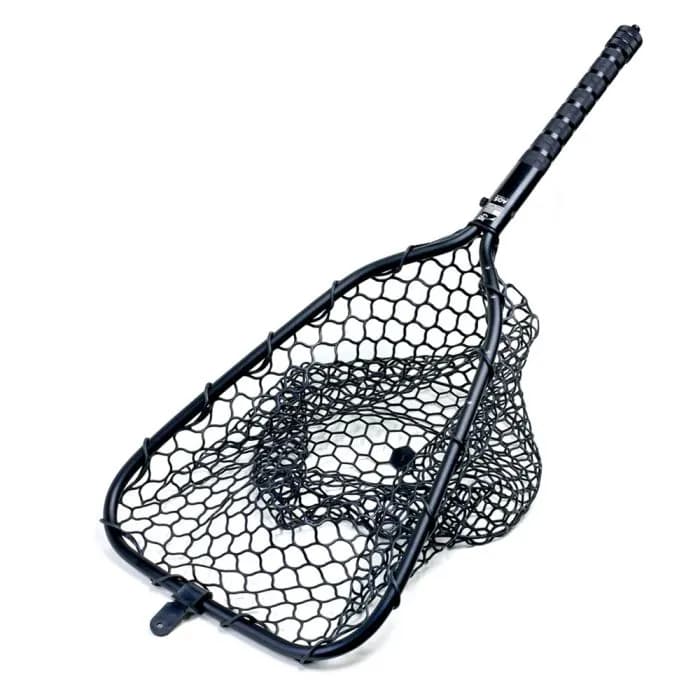
Estimated$60 – $120
Frabill's Conservation Series is best-in-class for telescoping-handle landing nets because it pairs a fish-friendly rubber net bag with a robust, lockable telescoping handle that balances strength and price for anglers targeting a wide range of species. Compared with the smaller, travel-focused EGO S2 and the budget Beckman fixed-handle option, Frabill delivers larger hoop options and more durable locking hardware, while remaining a more affordable everyday alternative to the premium StowMaster and the heavy-duty Ranger Octagon design.
Show More Telescoping Handle Landing Nets
Beckman’s Coated Knotless net is the budget-conscious pick for boat anglers who need a durable, low-maintenance landing tool without premium pricing. Its cost-effective coated knotless mesh and simpler frame make it less feature-rich than Frabill or EGO, but it offers excellent corrosion resistance and value for everyday boat use, making it a smart financial choice for anglers outfitting multiple boats or as a reliable backup net.
Show More Boat Landing Nets
Estimated$120 – $200
Beckman's Coated Knotless Net is the budget-minded, fish-friendly choice combining a knotless bag with a durable powder-coated hoop to keep upfront cost low for shore anglers. It trades off the premium hardwood finish and extended reach of the Brodin and the advanced folding mechanics of the StowMaster for a simple, protective, lower-priced option that still outperforms bare-mesh nets for catch-and-release care.
Show More Shore and Wading Landing Nets
Plusinno is the best-value budget option in the compact foldable catch-and-release category, offering a telescopic shaft and folding hoop at a price point significantly below the premium contenders. Technically it doesn’t match the premium coatings or long-term durability of Beckman or Frabill, but its affordability and widely available replacement parts make it the practical choice for casual anglers and beginners.
Show More Catch and Release Landing Nets
The Rapala Floating Fish Gaff offers a compact, economical gaff with a buoyant handle that prevents loss overboard, making it a strong value option for anglers targeting small-to-medium species. It undercuts higher-priced, heavyweight models on cost while delivering dependable stainless components for freshwater and light saltwater use, though it lacks the rugged construction and replaceable heavy tips of premium gaffs listed here.
Show More Fishing Gaff Hooks
Estimated$40 – $90
Why Fish-Friendly Nets Matter: Science-Backed Benefits
Scientific and fisheries-management research supports the use of knotless rubber nets and low-impact handling tools because they help preserve fish slime and scales, reduce infections, and increase post-release survival. For anglers new to the topic, these findings explain why selecting the right net or gaff is more than convenience: it directly affects fish health and the sustainability of fisheries. Below are clear, beginner-friendly takeaways drawn from general research and widely accepted best practices in fish handling.
Knotless rubber or rubberized mesh reduces abrasion of scales and the protective slime layer compared with knotted nylon nets, which helps lower infection risk and improves post-release survival.
Faster retrieval enabled by the right net depth and a telescoping handle reduces exhaustion and air exposure time for the fish, both of which contribute to better recovery after release.
Rubber nets are less likely to tangle with hooks, which reduces handling time and the need for invasive hook removal techniques that can injure fish.
Proper gaff use, limited to situations when a fish cannot be safely landed by net or when required by law, can be safer for both angler and fish when practiced by experienced users; correct placement and minimizing gut-hooking reduce mortal injury.
Supporting a fish horizontally using a wide, deep net and minimizing drops keeps internal organs safer and lowers stress compared with lifting by the lip or single contact points.
Fisheries science and conservation organizations recommend combining good gear choices with gentle handling, rapid photography and prompt release to maximize survival of released fish.
Frequently Asked Questions
Which net should I buy for catch and release?
Choose the EGO S2 Slider Rubber Net for catch-and-release because it has a knotless rubber net designed to minimize harm and reduce tangles, plus a quick-slider head and a lightweight carbon/aluminum construction. Rating is 4.6.
Does the Frabill Conservation Series use knotless rubber?
Yes—Frabill Conservation Series Landing Net uses knotless rubber netting to protect fish slime layers and minimize injury, and it also includes a telescoping handle with secure locks for adjustable reach. Rating is 4.7.
How does Beckman coated knotless net price compare?
Beckman Coated Knotless Landing Net is the budget-friendly option for boat anglers, with a rating of 4.5, and it uses a powder-coated/aluminum frame plus knotless rubberized mesh that protects fish skin and reduces snagging on hooks. Price isn’t provided.
What warranty comes with the EGO S2 Slider Rubber Net?
The EGO S2 Slider Rubber Net details provided don’t include any warranty duration, so I can’t confirm coverage length. It does have an average rating of 4.6 and features a knotless rubber net and S2 slider frame.
Conclusion
In Canada for 2026, choosing a landing net or gaff means balancing fish-friendly design, durability, and the right size for your target species. We hope this guide helped you identify the top options and understand why knotless rubber nets, telescoping handles, and fish-friendly designs are increasingly preferred. If you did not find exactly what you wanted, refine or broaden your search terms to compare materials, handle lengths, or species-specific nets to find the perfect match.