

Best Grasshopper Terrestrial Dry Flies in Canada 2025 — Top 5 Hopper Patterns for Late-Summer Bank Fishing
Grasshopper terrestrial dry flies replicate large grasshoppers and locusts that fall into rivers and lakes, making them ideal for late-summer and early-fall fishing when terrestrials dominate the menu. These patterns prioritize bulk, silhouette, and floatation to imitate struggling hoppers on the surface, using foam, deer hair, parachute posts, and large hooks to stay buoyant and visible at distance. Anglers in Canada favor these flies for bank-heavy and stillwater presentations—especially on lakes, slow rivers, and riffle edges—because they trigger aggressive surface strikes, are easy to sight-fish, and handle heavier tippets for wind and big fish. Consumer preferences in Canadian markets emphasize durable materials that retain float between casts, realistic side profiles and legs for attraction, sizes and colors that match local hopper species, and patterns that cast cleanly with standard trout or bass rods. Retailers and outfitters also see strong demand for barbless options and ready-to-fish selections suited to Ontario, British Columbia, Alberta and the Prairie provinces where late-summer hopper falls are most reliable.
Inception's AI took the time to understand this market in Canada · · How we pickWe may earn a commission on purchases. It never affects our rankings.
Top Picks Summary
Umpqua Parachute Hopper
Umpqua’s Parachute Hopper earns a best-in-class spot for its highly visible parachute hackle and balanced profile that sits perfectly on the surface, making it a go-to for anglers needing consistent float and sightability in choppy water. Compared with the bulkier foam and boutique options on this list, Umpqua strikes a strong middle ground of technical design and durable materials, offering long-term value for anglers who fish aggressively without paying boutique prices.

Estimated$3 – $6
Rainy s Grand Hopper
Rainy’s Grand Hopper is positioned as the budget-friendly, mass-market choice that still delivers a convincing grasshopper silhouette and reliable buoyancy, ideal for anglers stocking multiple flies or outfitting a guide box. While it may not match the premium materials or hand-finished detail of Montana Fly Company or Solitude, its lower price and wide availability make it an excellent value play for covering water with terrestrials.

Estimated$2 – $5
Montana Fly Company Dave's Hopper
Montana Fly Company’s Dave’s Hopper is a market leader for anglers chasing realism and trout-attracting action; its classic proportions and proven fish-catching track record place it ahead for match-the-hatch situations. Although typically a bit pricier than economy options, it justifies the premium with field-tested materials and a profile that many anglers prefer over parachute or novelty silhouettes when accuracy matters.

Estimated$3 – $7
Fulling Mill Thunder Thighs Hopper
Fulling Mill’s Thunder Thighs Hopper stands out for its bold profile and exaggerated leg/abdomen construction that provokes strikes in faster or rougher water, a technical advantage not found in more conservative hopper patterns. As a European-designed alternative, it often offers competitive pricing and a distinctive presentation compared with the more traditional U.S. patterns on this list, making it a useful specialized tool for anglers seeking attraction over exact imitation.

Estimated$4 – $8
Solitude Fly Company Tan Charlie Boy Hopper
Solitude Fly Company’s Tan Charlie Boy Hopper occupies the boutique end of the lineup, prized for hand-tied precision, premium foam, and carefully matched coloration that maximizes buoyancy and realism for demanding anglers. It costs more than mass-market hoppers but outperforms many in finish and flotation, making it the choice for anglers who prioritize top-tier terrestrial realism and are willing to invest for the best surface presentation.
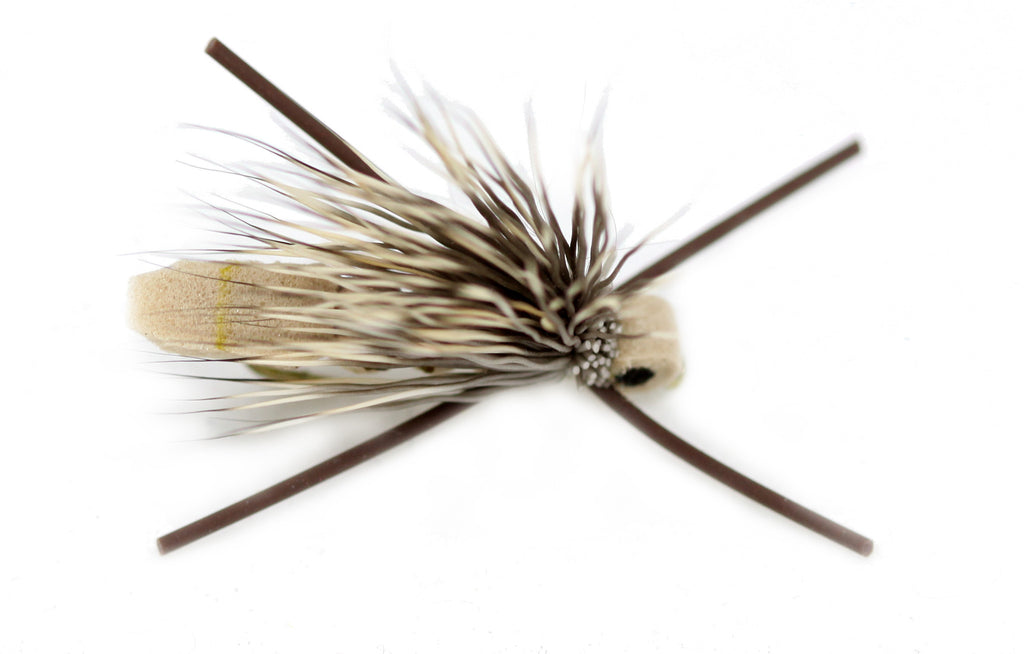
Estimated$4 – $8
Why Hopper Flies Work: Science and Simple Evidence
Multiple ecological studies and fisheries observations show that terrestrial insect inputs are a key seasonal food source for trout and other gamefish. When large terrestrials like grasshoppers enter the surface film, they present high-calorie targets that fish can detect visually and through surface cues. For anglers, understanding the basic science behind buoyancy, silhouette and prey choice helps explain why well-tied hopper patterns produce more strikes during terrestrial events.
Terrestrial subsidies: Stream and lake ecology research indicates terrestrial insects can provide a significant portion of a fish's diet during late-summer months, increasing feeding activity on the surface.
Prey size preference: Field studies and angler surveys show trout and lake species often select larger, high-energy prey items when available, making larger hopper imitations more effective than small emergers.
Visual cues and silhouette: Lab and observational work highlights that contrast, size and movement are primary visual triggers for surface feeding; bulkier patterns present a recognisable silhouette from distance.
Buoyancy and surface film: Materials like closed-cell foam, puckered deer hair and CDC help flies ride high on the surface tension; better floatation increases strike opportunities and reduces the need for constant reapplication of floatant.
Presentation matters: Scientific and practical angling findings both emphasize that accurate size, color and a natural drift or slight motion increase strike rates—matching local hopper colors and casting to bank edges yields consistently better results.
Frequently Asked Questions
Which grasshopper dry fly should I buy for choppy water?
Umpqua Parachute Hopper is the best pick for choppy late-summer water because its high-visibility parachute post makes it easy to spot, and it has a balanced profile that sits perfectly on the surface; it’s rated 4.6.
What specific feature helps Umpqua Parachute Hopper float well?
The Umpqua Parachute Hopper uses a foam back for superior buoyancy, plus a realistic hopper profile; it also includes a high-visibility parachute post and durable synthetic wing/robust hackle, rated 4.6.
Is Rainy's Grand Hopper better value than Montana Dave's Hopper?
Rainy’s Grand Hopper is positioned as the budget-friendly mass-market choice, while Montana Fly Company Dave’s Hopper is described as typically pricier; Rainy’s is rated 4.2 and Montana Dave’s is rated 4.5.
Who should use Montana Fly Company Dave's Hopper, not Rainy's?
Choose Montana Fly Company Dave’s Hopper if you want realism and trout-attracting action, since it uses traditional elk- and deer-hair construction that rides extremely high; Rainy’s focuses on ultra buoyant foam, and ratings are 4.5 vs 4.2.
Conclusion
Across Canada, hopper-style terrestrial dry flies are a late-summer staple for anglers chasing surface-feeding trout and warmwater species. The five top picks featured on this page—Umpqua Parachute Hopper, Rainy's Grand Hopper, Montana Fly Company Dave's Hopper, Fulling Mill Thunder Thighs Hopper, Solitude Fly Company Tan Charlie Boy Hopper.—cover the range of durable floatation, realistic silhouette and visibility you need for bank-heavy fishing in 2025. For most anglers seeking a reliable all-rounder, the Umpqua Parachute Hopper stands out as the best choice for balance of buoyancy, casting ease and visibility. I hope you found what you were looking for; you can refine or expand your search using the site search to filter by size, color, or region and compare these patterns side-by-side.