

Top 5 Multi-Robot Coordination Controllers for Welding Cells in Canada, 2026
Multi-robot coordination controllers synchronize multiple robots and additional axes inside welding cells to enable cooperative welding, dual-arm operations, and simultaneous multi-point welding. These controllers manage collision avoidance, task scheduling, and synchronized motion profiles to maximize throughput and weld quality. In Canada, adoption is driven by demand from automotive suppliers, aerospace fabricators, heavy equipment manufacturers, and energy sector shops in Ontario, Quebec, Alberta and British Columbia. Buyers prefer controllers that deliver deterministic real-time motion, easy integration with existing robot brands and MES systems, strong local support, and lifecycle value through remote diagnostics, security and software updates. For Canadian manufacturers facing skilled labor shortages and rising quality standards, multi-robot controllers promise higher productivity, more consistent welds, repeatable cycle times, and safer cells with built-in collision management and flexible cell scheduling.
Inception's AI took the time to understand this market in Canada · · How we pickWe may earn a commission on purchases. It never affects our rankings.
Top Picks Summary
FANUC R-30iB Plus Controller
The FANUC R-30iB Plus is positioned as a best-in-class general-purpose controller for multi-robot welding cells thanks to its deterministic motion core, broad robot family compatibility, and mature integrated welding packages that reduce integration time and software customization. Compared with the others on this list it often delivers lower integration cost and faster commissioning because of its extensive ecosystem and widely available trained integrators, while still providing the high I/O density and safety features required for tightly coordinated welding sequences.

Estimated$40,000 – $120,000
ABB IRC5 MultiMove Controller
ABB IRC5 with MultiMove is a market-leading choice for tightly synchronized multi-arm welding tasks, offering native coordinated kinematics across up to six robots and advanced path blending that minimizes cycle time and seam mismatch. Compared to the other controllers here it commands a premium upfront price but offsets that with superior multi-robot synchronization and path-quality advantages that reduce rework and increase throughput in complex welding cell layouts.

KUKA KR C5 Controller
The KUKA KR C5 excels in high-performance real-time control and modular architecture, giving systems integrators a compact, cybersecure platform optimized for energy efficiency and heavy-duty welding applications. Relative to the other products it is notable for a smaller hardware footprint and strong support for EtherCAT-based I/O and safety integration, which can lower installation costs and simplify retrofits in facilities prioritizing flexible cell design and future-proof networking.

Estimated$50,000 – $140,000
Yaskawa YRC1000 Controller
Yaskawa's DX200 delivers focused welding functionality and cost-effective multi-robot coordination tailored to small- and mid-size production cells, with straightforward programming and backward compatibility that smooths upgrades from legacy systems. Versus the higher-end multi-robot controllers in this list, DX200 typically offers a lower total system cost while still providing proven welding-specific routines and synchronization features adequate for many high-volume welding tasks.
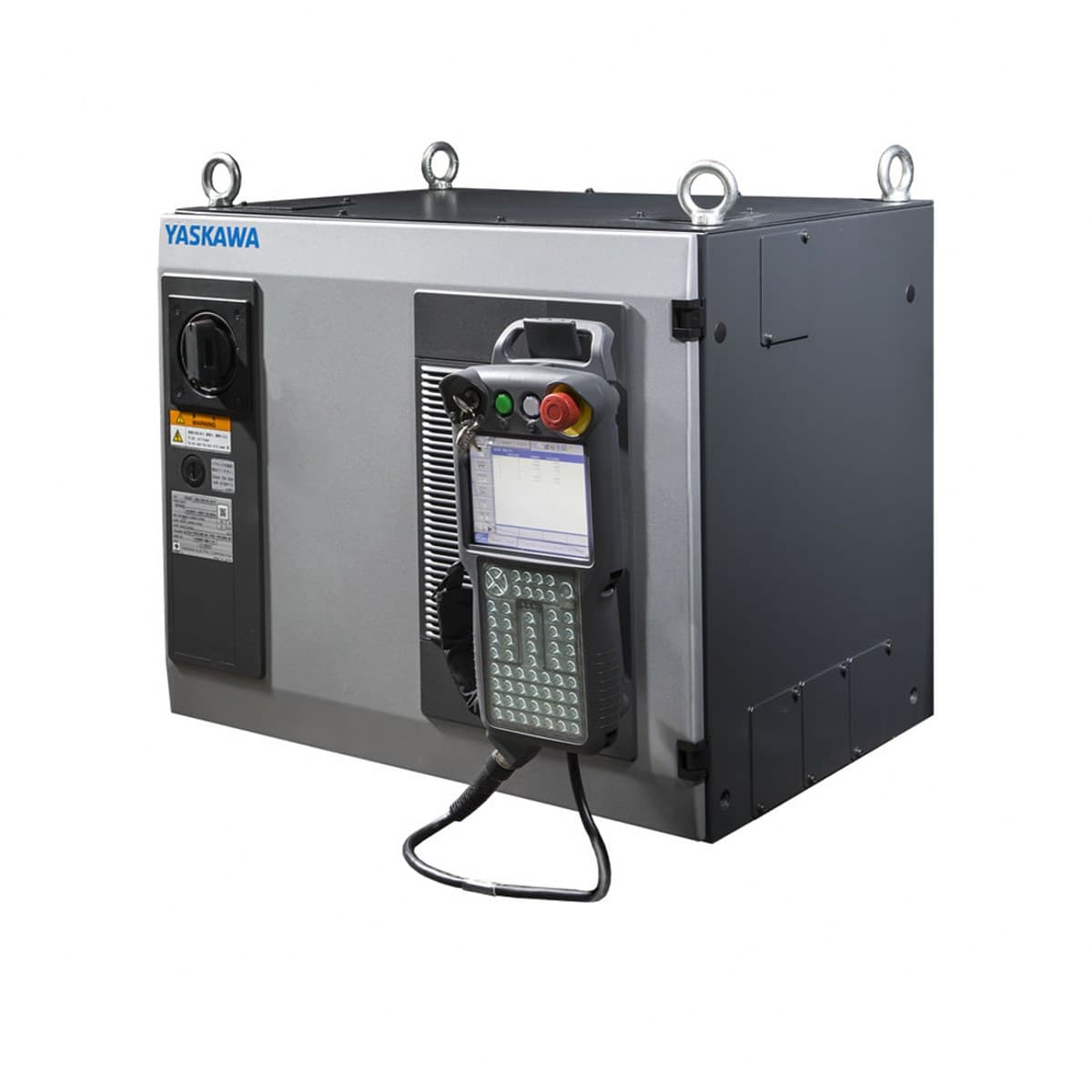
Estimated$35,000 – $110,000
Panasonic DTPS Welding Controller
Panasonic DTPS is a welding-centric controller that integrates advanced arc-control, seam-tracking, and power-source management to maximize weld quality and minimize consumable waste, making it especially valuable where arc stability and process monitoring are priority. When compared to general robot controllers listed here, DTPS brings superior process-level welding control that can reduce scrap and quality overheads, though it is typically used alongside a robot controller rather than as a standalone multi-robot motion coordinator.

Estimated$25,000 – $90,000
Research Highlights: Why Multi-Robot Coordination Improves Welding Performance
A body of engineering research and industrial studies shows that coordinated multi-robot control improves production efficiency and weld consistency compared with independently controlled robots. Key evidence comes from simulation studies, lab-scale welding experiments, and industrial pilot projects that evaluate synchronized trajectories, shared fixturing strategies, and collision-free cooperative motion. These works demonstrate benefits across throughput, process repeatability, and defect reduction when controllers apply synchronized motion, optimized path planning, and closed-loop welding parameter adjustments.
Coordinated motion reduces cycle time and idle time by allowing robots to work in parallel on interdependent tasks instead of waiting for single-task handovers.
Synchronized trajectories and shared welding parameters produce more consistent heat input and bead geometry, lowering rework and scrap rates.
Collision avoidance with deterministic real-time control reduces unexpected stoppages and improves overall cell availability.
Digital twin and simulation studies show that multi-robot scheduling and path optimization can raise throughput while preserving cycle robustness across part variants.
Research into adaptive control and sensor feedback integration demonstrates improved weld quality on variable assemblies by compensating for part fit-up and thermal effects.
Industrial reports highlight that integration with IIoT and remote diagnostics shortens troubleshooting time and improves mean time between failures in multi-robot cells.
Frequently Asked Questions
Which controller should I buy for synchronized welding cells?
Choose the ABB IRC5 MultiMove Controller if you need tightly synchronized multi-arm welding, since it provides coordinated kinematics across up to six robots with advanced path blending to minimize cycle time and seam mismatch; it’s rated 4.6.
Does the ABB IRC5 MultiMove support up to six robots?
Yes—the ABB IRC5 MultiMove Controller supports coordinated kinematics across up to six robots, and it uses real-time kinematics and path blending to help minimize cycle times in multi-robot welding cells; rating 4.6.
What price is listed for the FANUC R-30iB Plus?
No price is provided for the FANUC R-30iB Plus Controller in the data shown, so I can’t confirm a Canada price or value comparison; rating listed is 4.7 and it includes deterministic motion control options for synchronized multi-robot coordination.
Who is the KUKA KR C5 controller not for?
The data only says the KUKA KR C5 excels in heavy-duty welding applications and real-time synchronization, but it doesn’t list industries or exclusions, so I can’t determine who it isn’t for; the listed rating is 4.5.
Conclusion
In the Canadian context, multi-robot coordination controllers are a strategic investment for manufacturers seeking higher throughput, repeatable weld quality, and safer, more flexible welding cells. The five leading options covered here are FANUC R-30iB Plus Controller, ABB IRC5 MultiMove Controller, KUKA KR C5 Controller, Yaskawa DX200 Controller, and Panasonic DTPS Welding Controller. For most advanced multi-robot welding applications the ABB IRC5 MultiMove Controller stands out as the best overall choice due to its dedicated MultiMove architecture, scalability for complex cells, and strong integration tools. We hope you found what you were looking for; you can refine or expand your search using the site search to compare features, request demos, or find local Canadian integrators and support options.