

Top 5 Arc Process and Stability Monitoring Systems for Weld Monitoring in Canada — 2026
Arc process and stability monitoring equipment for weld monitoring consists of instrumentation and analyzers that track arc current, voltage, waveform shape, and plasma characteristics to detect instability, porosity risk, and process drift. These systems are increasingly integrated with AI analytics to provide predictive alerts and adaptive parameter control across MIG, TIG, and laser welding applications. In Canada, buyers favor solutions that combine robust data capture, real-time alerts, and clear operator feedback with compliance to local codes and industry standards. Canadian shops prioritize reliability in cold and variable environments, bilingual technical support, cloud-ready connectivity for Industry 4.0 integration, and demonstrable return on investment through reduced rework, higher first-pass yield, and traceable quality records. The result is strong demand from fabrication shops, oil and gas, transportation, aerospace, and construction sectors seeking consistent weld quality, streamlined audits, and scalable monitoring across multi-station production lines.
Inception's AI took the time to understand this market in Canada · · How we pickWe may earn a commission on purchases. It never affects our rankings.
Top Picks Summary
Lincoln Electric WeldScore Quality Monitoring System
The WeldScore Quality Monitoring System from Lincoln Electric is a best-in-class arc-process and stability monitor that combines real-time arc-signature analysis with scalable plant-wide reporting, making it ideal for high-volume production lines. Its deep integration with Lincoln power sources and broad service network offers a cost-effective deployment and faster onboarding compared with some premium European systems, although its feature set is most advantageous in Lincoln-centric shops rather than heterogeneous fleets.

Fronius WeldCube Premium
Fronius WeldCube Premium delivers enterprise-grade arc process and stability monitoring with high-resolution waveform capture, advanced analytics and robust IoT connectivity for traceability and centralized quality control. It often outperforms competitors on software flexibility and multi-brand compatibility for AMT environments, though its premium pricing reflects the advanced analytics and cloud/IT integration capabilities not present in simpler shop-floor systems.

Miller Insight Centerpoint Weld Monitoring System
The Miller Insight/Centerpoint system focuses on user-friendly, real-time arc and stability monitoring that balances practical shop-floor usability with reliable data capture for weld quality assurance. It provides a lower-cost, field-hardened alternative to larger enterprise solutions, offering faster deployment and workflow simplicity compared with more analytics-heavy systems like Fronius or WeldQAS while trading off some high-end reporting and traceability features.
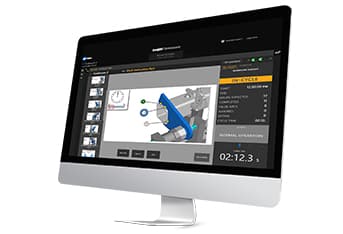
Estimated$7,000 – $16,000
HKS Prozesstechnik WeldQAS
HKS WeldQAS is a specialist arc process and stability monitoring platform designed for demanding industrial and automotive applications, offering precise arc-burst detection, automated quality scoring and modular hardware for inline inspection. Its technical depth and configurability make it the choice for high-precision manufacturing lines, but that specialization typically involves higher upfront integration and engineering costs than generalist offerings such as Lincoln or Miller.

Estimated$12,000 – $30,000
Kemppi WeldEye ArcVision
Kemppi WeldEye paired with ArcVision provides a modern, software-centric approach to arc process and stability monitoring, combining machine data, camera-based visualization and cloud analytics for rapid diagnostics and operator feedback. It competes strongly on usability and subscription-based software economics, delivering fast ROI for digital-first shops while offering slightly less hardware modularity than dedicated industrial players like HKS.

Estimated$5,000 – $12,000
Research and Evidence Behind Arc Monitoring Benefits
Scientific research and industry trials support the effectiveness of arc process monitoring in detecting defects early, reducing porosity and spatter, and improving overall process stability. Studies use controlled lab experiments, field trials, and machine-learning models trained on electrical waveform and sensor data to link measurable arc signals with specific defect modes. Evidence shows that continuous monitoring combined with analytics helps manufacturers reduce rework, stabilize parameters across shifts and operators, and enable predictive maintenance of welding equipment.
Waveform analysis correlates arc disturbances with common defects. Lab and field studies demonstrate that transient changes in current and voltage precede porosity and lack of fusion, allowing earlier intervention.
Machine-learning models trained on arc and sensor data improve defect classification. Several peer-reviewed papers and industry validation projects show that supervised models can separate healthy and failing weld signatures with high accuracy when supplied with labeled datasets.
Process drift detection reduces rework and scrap. Trials in production environments report improved first-pass yield and fewer repairs when continuous monitoring with threshold alerts is deployed.
Predictive maintenance and adaptive control reduce downtime. Analytics that flag imminent equipment issues or automatically suggest parameter adjustments extend consumable life and keep production stable.
Standards and institutional research back integration. Welding research organizations and standards bodies encourage data-driven monitoring; Canadian research centers and industry groups have run pilot projects demonstrating practical benefits for local manufacturing.
Frequently Asked Questions
Which weld monitoring system is best for high-volume production lines?
The Lincoln Electric WeldScore Quality Monitoring System is ideal for high-volume production lines, earning a 4.4 out of 5 rating for its real-time arc-signature analysis and plant-wide reporting.
What resolution does the Fronius WeldCube provide for waveform logging?
The Fronius WeldCube provides high-resolution arc waveform logging featuring advanced signal analysis for stability trends, supporting its 4.6 out of 5 average rating.
How much does the Fronius WeldCube cost?
Pricing details are not specified in the available product data for the Fronius WeldCube or any other listed monitoring systems.
What features does the Miller Insight Centerpoint offer for factory floors?
The Miller Insight Centerpoint Weld Monitoring System, rated 4.3 out of 5, offers enterprise-level aggregation of weld data across multiple stations for a factory-wide overview.
Conclusion
This 2026 Canadian overview of arc process and stability monitoring highlights five leading systems: Lincoln Electric WeldScore Quality Monitoring System, Fronius WeldCube Premium, Miller Insight Centerpoint Weld Monitoring System, HKS Prozesstechnik WeldQAS, and Kemppi WeldEye ArcVision. Each product targets real-time arc analysis, traceability, and predictive insights for MIG, TIG, and laser welding; among them, the Lincoln Electric WeldScore Quality Monitoring System stands out as the best overall choice for broad industrial use thanks to its balance of analytics, scalability, and North American support. We hope you found what you were looking for; use the site search to refine by application, price, or connectivity, or expand your search to compare additional specs and integrations.