

Top 5 Robotic Palletizers in Canada for 2026
Robot-based systems for high-speed palletizing and depalletizing with flexible pick patterns and mixed-load handling are transforming Canadian manufacturing and distribution. Trends include collaborative robots, vision-guided gripping, and cloud-based fleet management for production agility. In Canada, demand is driven by labour shortages, rising wage costs, increasing e-commerce volumes, and the need for consistent quality and traceability across food and beverage, consumer goods, and logistics. Buyers favor systems that combine throughput, reliability, easy integration with existing conveyors and warehouse management systems, safety features for shared human-robot workspaces, and remote diagnostics that reduce downtime across multi-site operations.
Inception's AI took the time to understand this market in Canada · · How we pickWe may earn a commission on purchases. It never affects our rankings.
Top Picks Summary
FANUC M-410iC Palletizing Robot
FANUC's M-410iC is a best-in-class high-throughput palletizing robot known for exceptional cycle times and heavy-payload handling, making it a go-to choice for high-volume lines. It holds its position through broad aftermarket support and rugged reliability that lower total cost of ownership compared with competitors like ABB and KUKA, while typically delivering higher throughput than collaborative options such as the UR20. For manufacturers focused on maximizing pallets-per-hour, its established ecosystem and proven drive train translate into predictable uptime and financial stability.

Estimated$120,000 – $350,000
ABB IRB 460 Palletizing Robot
ABB's IRB 460 is positioned as a versatile palletizer that balances high payload capability with simplified programming via ABB's RobotStudio simulation and offline programming tools. Compared with the FANUC M-410iC and KUKA QUANTEC PA it often offers faster setup and more flexible integration options, which can reduce engineering hours and short-term deployment costs. Its energy-efficient motion control and modular tooling also make it attractive for operators seeking a lower lifecycle cost without sacrificing precision.

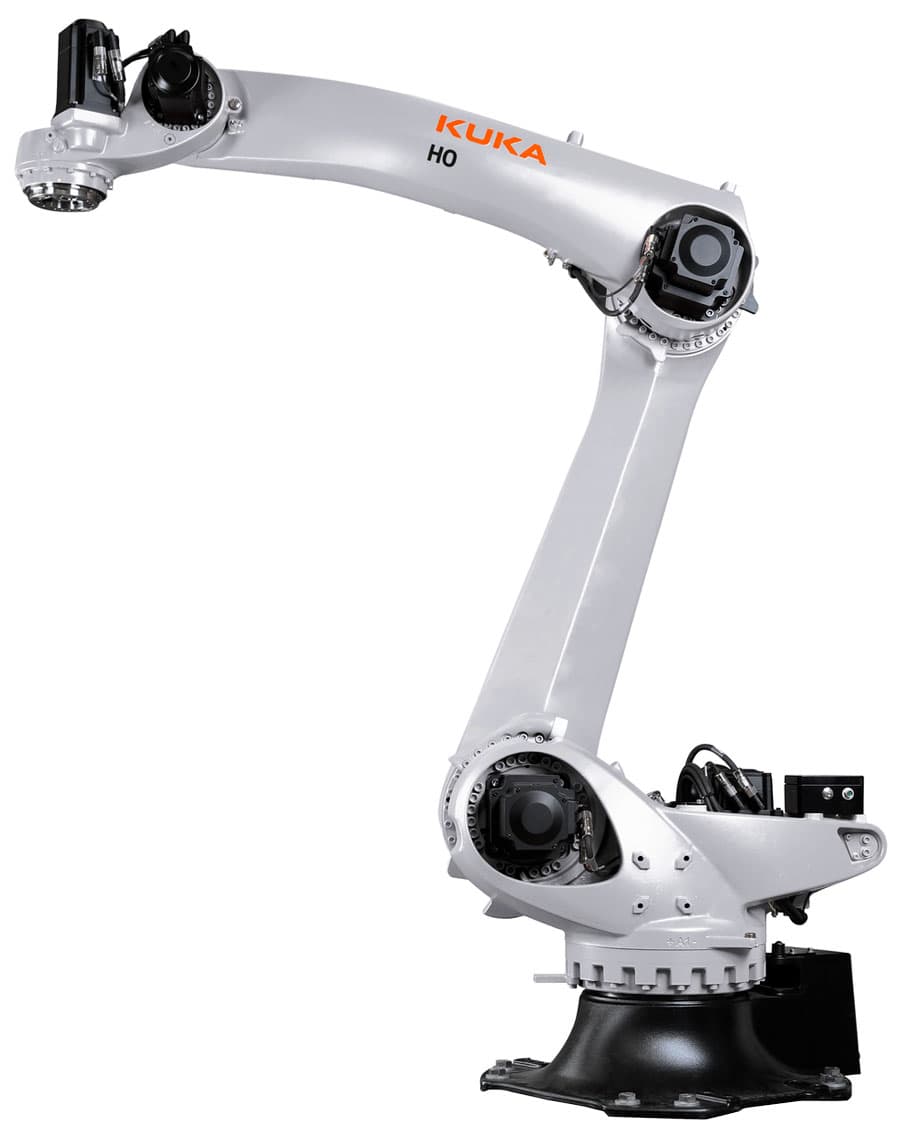
KUKA KR QUANTEC PA
KUKA's KR QUANTEC PA combines industrial-strength reach and modularity tailored for palletizing cells, delivering strong repeatability and ease of integrating custom end-of-arm tooling. Versus ABB and FANUC it often stands out for flexible footprint options and sealed variants suited to harsher environments, giving it technical advantages on lines where layout or washdown requirements matter. Its balance of performance and competitively priced controllers makes it a compelling mid-range choice for manufacturers wanting KUKA's ecosystem without the highest upfront premium.
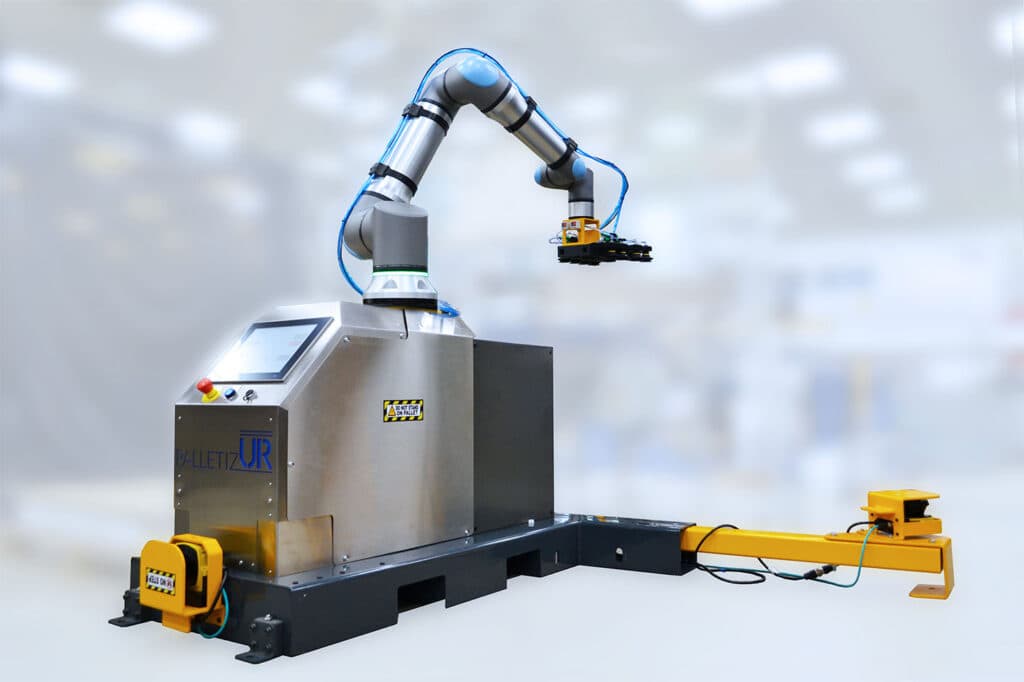
Universal Robots UR20 Palletizer
Universal Robots' UR20 Palletizer brings collaborative simplicity and very low integration cost to palletizing tasks that fall within its payload range, enabling fast redeployment across lines and quick ROI compared with larger industrial arms. While it cannot match the heavy-payload throughput of the M-410iC, IRB 460 or PL800, the UR20 excels for seasonal SKUs, pilot lines, and smaller facilities where capital expenditure and floor space are constrained. Its intuitive programming and safety features lower labor barriers and can significantly reduce commissioning time and upfront engineering spend.
Yaskawa Motoman PL800
Yaskawa's Motoman PL800 is a purpose-built palletizer that emphasizes reliable heavy-load stacking and straightforward patterning software for high-volume operations. It competes closely with FANUC and KUKA on payload and duty cycle but often undercuts them on initial equipment cost and offers smooth integration with Yaskawa controllers and vision modules, which can shorten deployment time. For operations prioritizing cost-effective throughput and strong local support, the PL800 presents a market-leading value proposition.

Estimated$130,000 – $360,000
What research and industry findings say about robotic palletizers
A growing body of industry reports and academic research supports the benefits of robotic palletizers for productivity, safety, and flexibility. Studies and case analyses consistently show measurable gains in throughput and reductions in manual handling injuries when robots replace repetitive palletizing tasks. Advances in vision systems and machine learning have improved gripping accuracy and mixed-case handling, while cloud-enabled fleet management and predictive maintenance have reduced unplanned downtime and optimized labor allocation. For buyers new to automation, the evidence indicates that careful selection, pilot testing, and integration planning are key to realizing the expected returns.
Productivity: Industry reports and manufacturer case studies show palletizing robots can increase throughput and consistency compared with manual lines, especially for continuous, repetitive loads.
Safety and ergonomics: Ergonomics research highlights reductions in musculoskeletal injuries and repetitive strain when manual pallet handling is replaced or augmented by robots.
Vision-guided gripping: Advances in computer vision and AI have significantly improved grasping of irregular and mixed loads, reducing the need for specialized end-of-arm tooling.
Flexibility and ROI: Operational studies indicate that flexible robotic palletizers, when matched to SKU profiles and cycle times, deliver faster payback than fixed automation in mixed-load environments.
Fleet management and uptime: Research into cloud-based maintenance and analytics demonstrates lower mean time to repair and better capacity planning across multi-robot installations.
Frequently Asked Questions
Is the FANUC M-410iC palletizer best for high volume?
The FANUC M-410iC Palletizing Robot is a go-to choice for high-volume lines because it’s described as a “high-throughput” palletizing robot with very high payload and advanced motion control for fast layer pick-and-place; it has an average rating of 4.7.
What feature helps the ABB IRB 460 handle varied pallets?
The ABB IRB 460 Palletizing Robot supports ABB palletizing software plus vision systems and flexible end-of-arm tooling, with a compact footprint for medium-to-heavy palletizing tasks; its average rating is 4.6.
How do prices compare between these robotic palletizers?
The provided product data doesn’t include any prices for the FANUC M-410iC, ABB IRB 460, or KUKA KR QUANTEC PA, so I can’t compare value by cost; ratings are available: 4.4, 4.5, and 4.4 respectively.
What warranty duration comes with the KUKA KR QUANTEC PA?
The provided data doesn’t list a warranty duration for the KUKA KR QUANTEC PA, so I can’t confirm coverage; it does note large reach options, modular pallet wizard tooling, and smooth dynamics for precise layer stacking, with an average rating of 4.4.
Conclusion
In the Canadian context, these robotic palletizers help manufacturers and distribution centers manage labour constraints, boost throughput, and improve consistency. The five options profiled here are the FANUC M-410iC Palletizing Robot, ABB IRB 460 Palletizing Robot, KUKA KR QUANTEC PA, Universal Robots UR20 Palletizer, and Yaskawa Motoman PL800. For heavy-duty, high-speed palletizing where throughput and proven reliability matter most, the FANUC M-410iC Palletizing Robot is often the best choice. ABB IRB 460 delivers a balanced mix of speed and flexibility; KUKA KR QUANTEC PA is appropriate for large payloads and harsh environments; Universal Robots UR20 Palletizer excels for collaborative, small-to-medium loads and quick redeployment; and Yaskawa Motoman PL800 focuses on cycle-time optimization for high-volume lines. We hope you found the guidance you were looking for — refine or expand your search using the site search to match payloads, cycle times, end-of-arm tooling, or integration needs.