

Top 5 Collaborative Welding Robot Cells in Canada for 2026
Collaborative welding robot cells are compact, safe, and easy-to-deploy automation solutions designed for small-batch production and hybrid workflows where human welders and robots work side by side. In Canada, adoption is growing among SMEs, job shops, and manufacturers responding to skilled labor shortages, rising labor costs, and demand for consistent, high-quality welds. These cells emphasize simple programming interfaces, force-limited interaction for worker safety, minimal floor space, and rapid redeployment to new jobs, making them attractive for shops that need flexible automation without large capital outlay or major safety fencing. Canadian buyers also value local service networks, energy efficiency, and compatibility with existing welding equipment and industry 4.0 data practices.
Inception's AI took the time to understand this market in Canada · · How we pickWe may earn a commission on purchases. It never affects our rankings.
Top Picks Summary
Universal Robots UR10e Welding Cell
The UR10e Welding Cell is best-in-class for small-to-medium manufacturers seeking fast, low-risk deployment of collaborative welding automation; its lightweight, highly programmable UR10e arm and modular cell components minimize integration time and lower initial capital outlay compared with heavier industrial cobots. It stands out for ease of use, broad ecosystem of tooling and third-party fixtures that reduce engineering hours and total cost of ownership relative to more rigid, high‑throughput solutions in this list.

Estimated$80,000 – $150,000
FANUC CRX-10iA Welding Cobot
FANUC's CRX-10iA Welding Cobot is a market-leading choice when prioritizing industrial robustness and repeatability in collaborative welding, offering payload and accuracy that approach conventional robots while retaining safety features for shared workspaces. Though typically higher in upfront cost than UR and some welding‑centric systems, its proven FANUC control platform and ecosystem deliver superior uptime and predictable throughput for higher-volume cells.

Estimated$70,000 – $120,000
ABB GoFa CRB 15000 Welding Cell
The ABB GoFa CRB 15000 Welding Cell combines collaborative safety with high payload and speed, making it ideal for manufacturers who need near-industrial cycle times inside a collaborative footprint; ABB leverages integrated welding software and motion expertise to reduce cycle time and rework compared with simpler cobot cells. While capital expense can be above smaller cobot offerings, its technical performance and advanced safety features justify the investment for mixed production lines chasing throughput gains.

Estimated$90,000 – $180,000
Fronius SmartCell
Fronius SmartCell positions itself as the welding‑process specialist within collaborative cells, bundling Fronius power sources and arc‑control algorithms with cell automation to deliver consistent weld quality and reduced consumable costs versus generic cobot welding packages. Its technical edge is process optimization and data-driven welding parameter management, which can shorten development time and lower rework expenses when integrated with UR, FANUC or ABB manipulators.
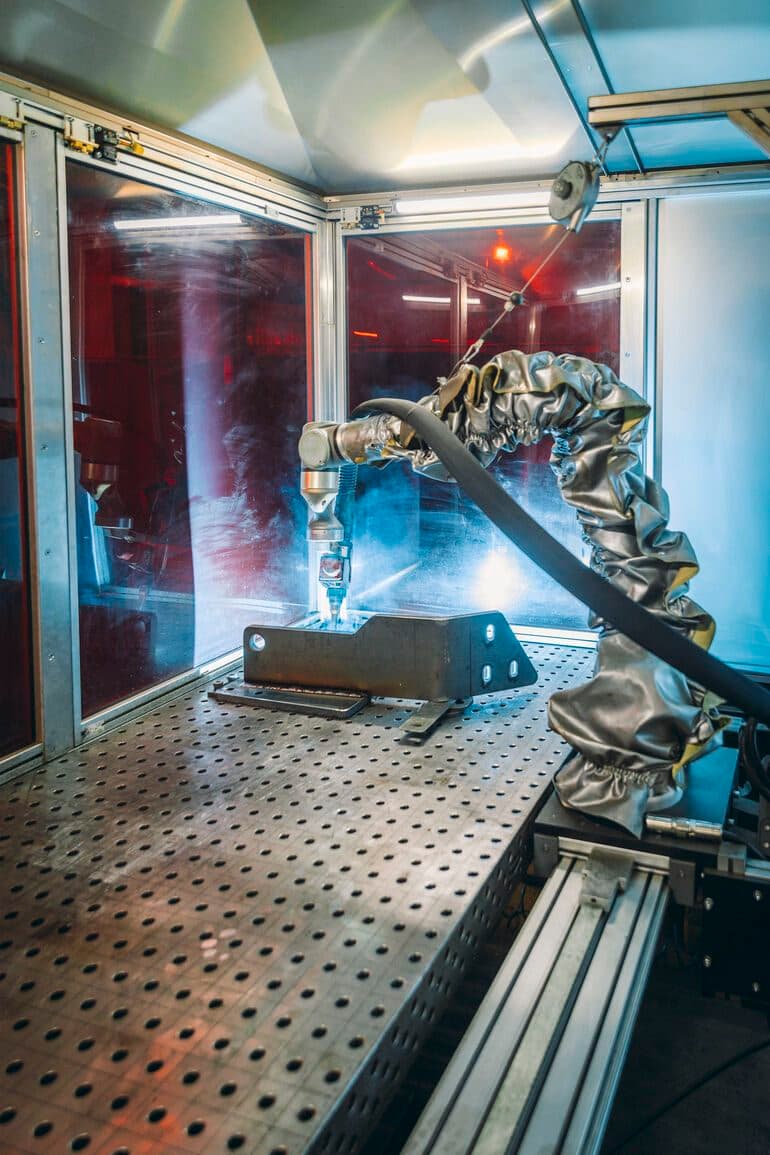
Estimated$60,000 – $120,000
Lincoln Electric Cobot Welding System
The Lincoln Electric Cobot Welding System is tailored for turnkey, production-ready collaborative welding, combining Lincoln's welding expertise with partner cobots and intuitive welding controls to shorten commissioning and training time for shops scaling automation. Financially it competes well via packaged configurations and service programs that reduce integration overhead and ongoing welding consumable costs compared with piecemeal solutions on this list.

We may earn a commission on purchases. It never affects our rankings.
$162,400.00CAD
Research, Standards, and Practical Benefits
Scientific research, industry safety standards, and business case studies collectively support the benefits of collaborative welding cells. Safety frameworks such as ISO 10218 and ISO/TS 15066 define collaborative operation requirements and force/pressure limits that manufacturers use to certify cobot cells. Academic and industry studies show measurable gains in weld consistency, ergonomics, and return on investment when cobots handle repetitive tasks while technicians focus on setup, inspection, and complex welding. Practical evaluations also highlight how integrated power sources, sensor feedback, and teach-by-demonstration programming reduce setup time and lower the skill barrier for automation.
Safety standards: ISO 10218 and ISO/TS 15066 provide the safety foundation for collaborative robot operation and are widely referenced for cobot welding cell certification.
Ergonomic benefits: Studies report reductions in repetitive strain and musculoskeletal injury risk when cobots take on high-frequency welding tasks.
Quality and consistency: Controlled parameters and repeatable motion from cobots reduce weld variability and rework rates, improving first-pass yield.
ROI timelines: Case studies from small and medium manufacturers typically show payback within 1 to 3 years depending on part volume and labor cost structure.
Flexibility and redeployment: Research into flexible manufacturing highlights that easy programming and modular cell design shorten changeover times and support high-mix, low-volume production.
Frequently Asked Questions
Which collaborative welding robot cell should SMEs choose in Canada?
Choose the Universal Robots UR10e Welding Cell for fast, low-risk deployment in small-to-medium Canadian manufacturers, since it has a lightweight, highly programmable UR10e 6-axis arm and a modular cell design for easier integration.
What welding capability does the UR10e Welding Cell offer?
The Universal Robots UR10e Welding Cell uses a collaborative 6-axis arm optimized for welding tasks and human-robot collaboration, plus a modular cell design to integrate torches, wire feeders, and safety fencing.
How does pricing compare for the FANUC CRX-10iA Welding Cobot?
The FANUC CRX-10iA Welding Cobot’s exact price isn’t provided here; the data only shows an average rating of 4.4 and features like precise motion control and intuitive FANUC programming for welding power sources.
Is the ABB GoFa CRB 15000 Welding Cell designed for heavier tooling?
Yes—the ABB GoFa CRB 15000 Welding Cell is built for larger weld fixtures and heavier tooling, with certified welding interfaces, offline programming and simulation support, and an average rating of 4.3.
Conclusion
In the Canadian context, collaborative welding robot cells offer a pragmatic path to safer, low-footprint automation for SMEs and job shops. The Top 5 options profiled here each bring strengths: Universal Robots UR10e Welding Cell for ease of programming and ecosystem flexibility; FANUC CRX-10iA Welding Cobot for robust industrial performance; ABB GoFa CRB 15000 Welding Cell for higher payload and heavy-duty workflows; Fronius SmartCell for tight integration of welding power and cell controls; and Lincoln Electric Cobot Welding System for deep welding expertise and application support. For most small and medium shops looking for the fastest route to flexible, dependable cobot welding, the Universal Robots UR10e Welding Cell is the best overall choice because of its balance of usability, ecosystem, and Canadian service availability. I hope you found what you were looking for; use the site search to refine by payload, footprint, or welding process, or expand your search to compare accessories, payloads, and local integrators.