

Top 5 Welding Robot Controllers and Programming Software in Canada (2026)
Advanced welding robot controllers and programming software now combine offline simulation, teach pendant programming, and cloud connectivity with industrial standards such as OPC UA to deliver faster commissioning, higher weld quality, and full traceability. In Canada, manufacturers in automotive, aerospace, oil and gas, and metal fabrication are adopting controllers and suites that support AI-assisted path generation, digital twins, and secure MES integration to reduce rework, speed up product changeovers, and meet stricter traceability and compliance demands. Canadian buyers tend to prefer systems that offer intuitive teach pendants, robust local service, predictable total cost of ownership, strong cybersecurity measures, and easy integration with existing MES or ERP systems. These preferences reflect the priorities of reducing skilled-labor dependency, improving uptime in multi-shift operations, and gaining measurable ROI through process optimization and reduced scrap.
Inception's AI took the time to understand this market in Canada · · How we pickWe may earn a commission on purchases. It never affects our rankings.
Top Picks Summary
FANUC R-30iB Plus Controller
The FANUC R-30iB Plus is a market-leading welding robot controller prized for its deterministic motion control, large installed base, and mature welding packages that drive high throughput and minimal downtime. Its broad compatibility and extensive aftermarket ecosystem yield lower total cost of ownership compared with newer controllers, making it a top choice for high-volume welding operations. Against the other products in this list, FANUC stands out for proven reliability and fast cycle performance, though it may be less modular in digital services than ABB or as openly integrable as KUKA.

Estimated$35,000 – $80,000
ABB OmniCore C30 Controller
The ABB OmniCore C30 is positioned as a best-in-class controller for welding thanks to its modular architecture, advanced digital services, and strong built-in welding toolsets that simplify cell integration and analytics. Its emphasis on connectivity and asset optimization can reduce engineering and integration costs relative to traditional controllers, delivering faster commissioning and data-driven maintenance. Compared with FANUC and Yaskawa, OmniCore excels at digitization and scalable system design, while offering comparable welding performance with a focus on Industry 4.0 features.

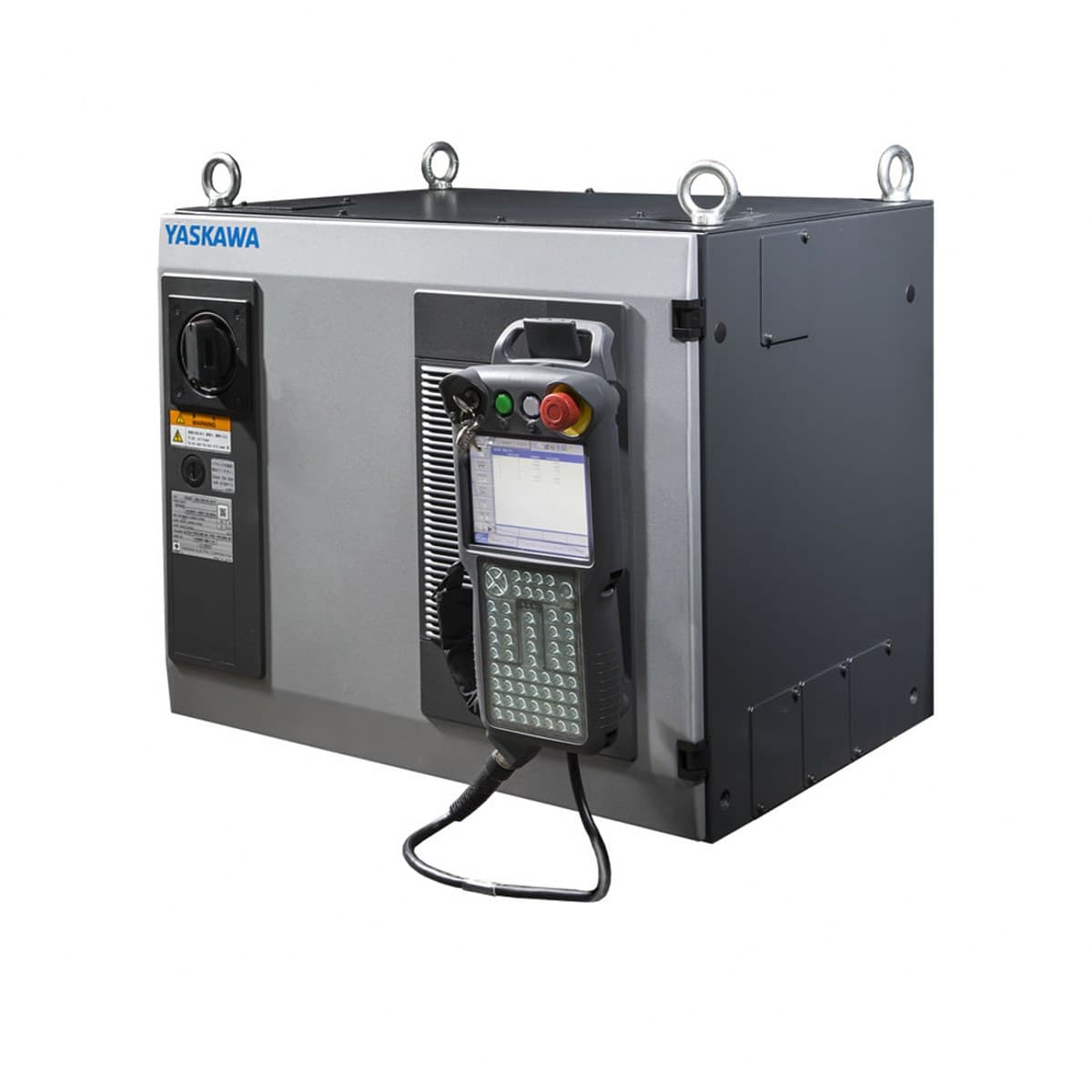
Yaskawa YRC1000 Controller
The Yaskawa YRC1000 offers a compact, cost-effective controller that balances precise motion with intuitive programming — a strong value proposition for small-to-mid-size welding shops. Its lower capital and installation costs provide attractive financial advantages for shops upgrading from manual or legacy systems, while delivering competitive path accuracy and standard welding packages. Compared to the higher-end offerings from FANUC, ABB, and KUKA, Yaskawa trades some ecosystem breadth for simpler deployment and quicker ROI.
Estimated$30,000 – $65,000
KUKA KR C5 Controller
The KUKA KR C5 controller is built for high-performance, multi-robot welding cells and emphasizes open connectivity (EtherCAT), integrated PLC capabilities, and robust cybersecurity for Industry 4.0 deployments. While its initial investment can be higher than compact controllers, the KR C5 reduces long-term engineering effort through seamless integration, centralized cell control, and energy-efficient motion, which can lower operating expenses in complex installations. Against the other controllers listed, KUKA is notable for its openness and advanced system integration features that simplify multi-robot welding and automation projects.

Estimated$30,000 – $70,000
Lincoln Electric WeldGuide RT Software
Lincoln Electric WeldGuide RT is specialized offline programming and arc-optimization software designed specifically for robotic welding, delivering rapid programming, adaptive deposition control, and welding-specific parameter libraries that cut arc time and reduce rework. As software rather than a hardware controller, it provides immediate productivity gains and the fastest path to improved weld quality when integrated with controllers from FANUC, ABB, Yaskawa, or KUKA, though it introduces license and integration costs. Compared with the controller products on this list, WeldGuide RT is unique in directly addressing weld-process optimization and programmer productivity, making it a high-ROI complement to any welding robot controller.

What research and industry data say about these systems
A growing body of academic and industry research supports the productivity, quality, and safety benefits of modern robot controllers and programming software. Studies and technical reports examine how offline programming and digital twins reduce commissioning time, how AI-assisted path planning shortens programming cycles, and how standardized connectivity like OPC UA enables reliable data exchange for traceability and process optimization. For buyers new to these topics, the evidence shows clear operational advantages when controllers and software are selected and implemented with attention to integration, cybersecurity, and workforce training.
Automation improves consistency and reduces defects: Peer-reviewed work in manufacturing journals shows that welding automation produces more repeatable welds than manual methods, cutting rework and scrap.
Offline programming and simulation reduce downtime: Industry reports and academic case studies demonstrate that virtual commissioning and simulation can cut on-line programming time and shorten production ramp-up windows.
Digital twins speed validation and optimization: Research indicates that digital twin models of weld cells help tune parameters, test new part variants, and lower the number of physical trials needed before production.
AI-assisted path generation lowers programming effort: Early studies and vendor benchmarks show that AI tools can generate or refine weld paths and parameter suggestions, reducing teach-pendant hours and operator variability.
Standardized connectivity and MES integration improve traceability: Technical white papers and standards guidance highlight how OPC UA and MES links enable consistent data capture for quality records and regulatory compliance.
Cybersecurity matters for connected systems: NIST guidance and industry analyses emphasize securing controllers and cloud links to prevent unauthorized access and maintain production integrity.
Frequently Asked Questions
Which controller should my shop buy for welding cells?
Choose the ABB OmniCore C30 Controller if you need complex multi-robot welding cells: it has real-time OmniCore architecture, synchronized welding functions, and built-in digital-twin/offline programming for faster commissioning; it’s rated 4.6.
What welding features does ABB OmniCore C30 support?
ABB OmniCore C30 includes advanced synchronized welding functions plus integrated sensor and power-source interfaces, and it also supports a strong digital twin and offline programming for fast commissioning and simulation; rating is 4.6.
How does Yaskawa YRC1000 value compare to FANUC R-30iB Plus?
The provided data doesn’t list prices for Yaskawa YRC1000 or FANUC R-30iB Plus, so I can’t compare value by cost; YRC1000 is rated 4.5 and FANUC R-30iB Plus is rated 4.7.
Does FANUC R-30iB Plus support industrial network connectivity?
Yes—FANUC R-30iB Plus supports Ethernet/IP, DeviceNet, and PROFINET networking, and it includes built-in welding packages and I/O for power sources and sensors; rating is 4.7.
Conclusion
This selection highlights five leading options for welding robot controllers and programming software in Canada in 2026: FANUC R-30iB Plus Controller, ABB OmniCore C30 Controller, Yaskawa YRC1000 Controller, KUKA KR C5 Controller, and Lincoln Electric WeldGuide RT Software. Each product brings strengths: FANUC for proven reliability, Yaskawa for flexible configurations, KUKA for kinematics and motion performance, and Lincoln Electric for specialized welding programming software; the ABB OmniCore C30 Controller stands out as the best overall choice for Canadian buyers who prioritize digital twin capabilities, cloud-ready architecture, and deep MES and OPC UA integration. We hope you found what you were looking for; use the site search to refine by features, industry, or service region to expand or narrow your results.