

Protein Chiral Columns Canada 2026: Top 5 Picks for ADME and Bioanalysis
Published on Saturday, January 24, 2026
Columns with immobilized proteins (for example alpha1-acid glycoprotein or ovomucoid) used as chiral selectors for biologically relevant molecules. Optimized for aqueous mobile phases and pharmaceutical ADME or bioanalytical applications. Protein chiral columns exploit stereoselective binding to natural carrier proteins such as AGP, HSA, BSA and ovomucoid to separate enantiomers of drugs, metabolites and other biologically relevant compounds. In Canada, demand for these columns is driven by biopharma development, clinical bioanalysis, regulatory expectations for enantiomeric characterization and the growing use of LC-MS workflows. Canadian labs and CROs typically prioritize robust reproducibility, aqueous mobile phase compatibility, low nonspecific binding, LC-MS friendly buffer options, clear documentation and reliable local technical support. Those preferences shape buying decisions: users choose columns that deliver predictable retention and selectivity for ADME studies, long column life under aqueous conditions, and consistent lot-to-lot performance from manufacturers with Canadian distribution or authorized resellers.
Top Picks Summary
Daicel CHIRALPAK AGP
CHIRALPAK AGP is a best-in-class alpha1-acid glycoprotein (AGP) based chiral column prized for excellent enantioselectivity on basic and moderately polar amine-containing drugs; its reproducible performance and high success rate in screening make it a go-to for method development in pharmaceutical labs. Compared with other protein phases in this list it often resolves basic analytes that HSA or BSA phases struggle with, delivering time and cost savings by reducing method development cycles for those compound classes.
Daicel CHIRALPAK HSA
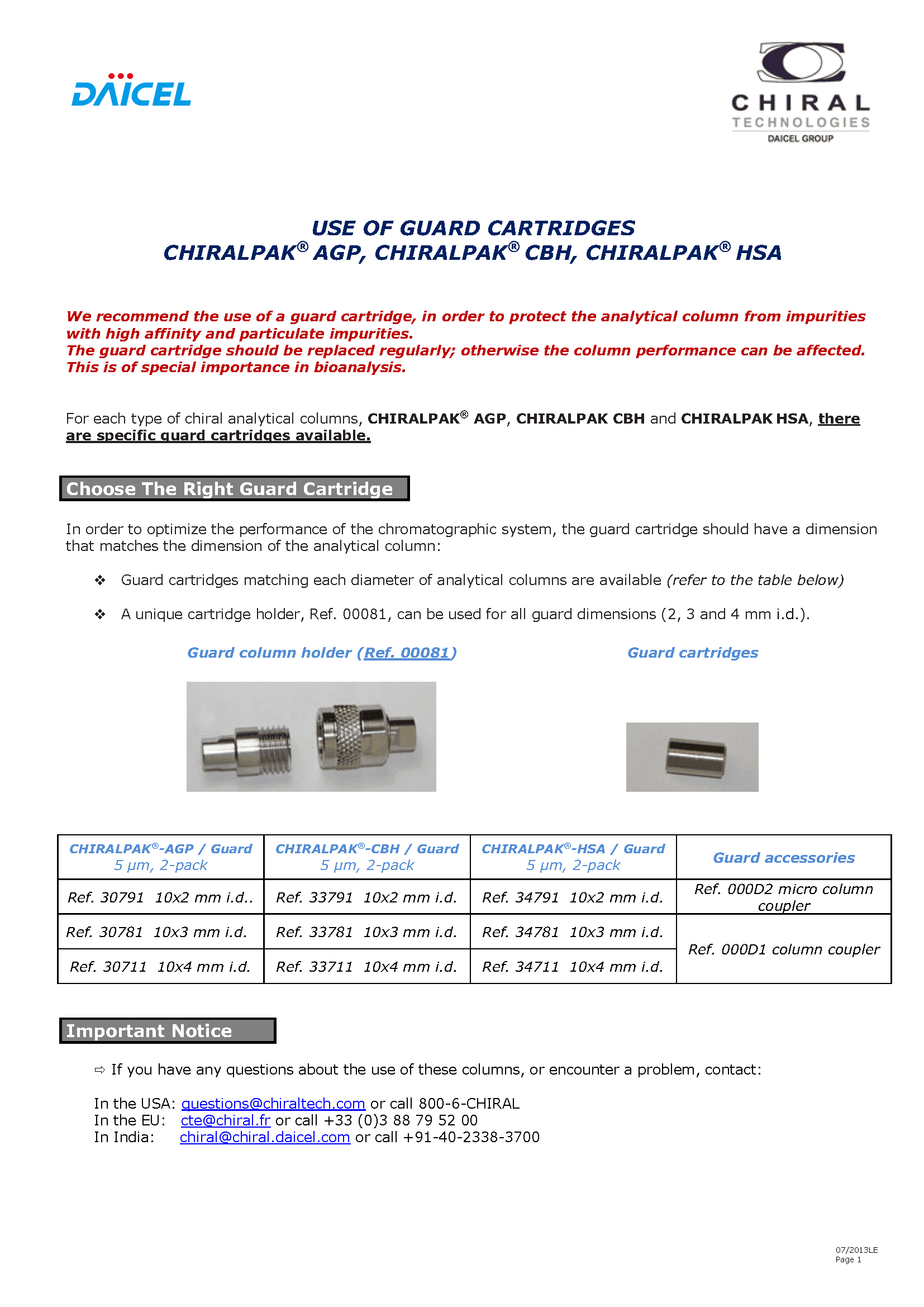
CHIRALPAK HSA uses immobilized human serum albumin and is a market-leading choice for separating acidic and neutral chiral compounds due to broad applicability and robust lifetime under routine LC conditions. It complements AGP and ovomucoid phases by offering different selectivity windows while providing a strong balance of reliability and cost-effectiveness for labs doing high-throughput chiral screening.
Chiral Technologies RESOLVOSIL BSA-7
RESOLVOSIL BSA-7 is a bovine serum albumin (BSA)-based stationary phase that excels at resolving stereoisomers with bulky or flexible scaffolds where human-derived proteins may be less effective. Technically, it can offer preparative scaling advantages and a lower per-column price point versus some human-protein CSPs, making it an attractive, cost-conscious alternative for labs chasing difficult separations after screening with Daicel or polysaccharide phases.
Phenomenex Lux Amylose-1
Lux Amylose-1 is a polysaccharide-based chiral phase valued as a complementary, often first-line column for chiral screening because of its broad solvent compatibility and distinct selectivity compared to protein-based CSPs. Financially and operationally it is attractive for routine screening and scale-up due to generally lower cost per run and robustness, so laboratories commonly run it in parallel with protein columns (HSA/AGP/OVM) to maximize hit rates.

Regis Technologies ULTRON ES-OVM
ULTRON ES-OVM leverages immobilized ovomucoid (OVM) to deliver very high enantioselectivity for certain basic and heterocyclic pharmaceutical targets, frequently rescuing separations that other protein phases do not resolve. While it can be pricier and sometimes demands tighter mobile-phase control than HSA or AGP columns, its unique selectivity profile makes it a market-leading choice when specificity is the priority and when other columns have failed.
What the research and applications show
Protein-based chiral stationary phases are supported by decades of peer reviewed research and practical method development in pharmaceutical and bioanalytical settings. Studies and method notes repeatedly show how immobilized proteins create stereoselective environments through multiple noncovalent interactions and distinct binding pockets. Immobilization of the protein to the silica or polymer support improves column stability and reproducibility compared with coated phases, and careful mobile phase selection allows direct coupling to mass spectrometers for ADME and pharmacokinetic studies.
Mechanism: Immobilized proteins present stereoselective binding sites that favor one enantiomer through shape complementarity, hydrogen bonding, electrostatic interactions and hydrophobic contacts.
Protein choice matters: AGP often shows strong selectivity for basic and lipophilic basic drugs, HSA is selective for acidic and neutral compounds, BSA and ovomucoid provide complementary selectivity windows.
Immobilized vs coated: Immobilized protein phases are more tolerant of aqueous mobile phases, show less leaching and offer better lot-to-lot reproducibility, which is critical for regulated bioanalysis.
LC-MS compatibility: Using volatile buffers at controlled ionic strength and pH allows coupling protein chiral columns to LC-MS for enantiomer-specific pharmacokinetic and ADME analyses.
Method transfer and validation: Published method development strategies and regulatory guidance support the use of protein chiral columns for enantiomeric purity, metabolite profiling and chiral bioanalysis.
Practical tips: Start method scouting with small bore columns, screen multiple protein selectors, control buffer composition and temperature, and include system suitability standards to monitor stability.
Frequently Asked Questions
Which protein chiral column for basic amine drugs?
Daicel CHIRALPAK AGP is a great fit for basic and moderately polar amine-containing drugs, because it’s an alpha1-acid glycoprotein (AGP) immobilized on silica that’s prized for excellent enantioselectivity and reproducible performance (average rating 4.6).
What exact ligand is immobilized in CHIRALPAK HSA?
Daicel CHIRALPAK HSA uses immobilized human serum albumin (HSA) on the stationary phase, optimized for acidic and neutral enantiomers with strong, predictable retention for compounds that bind to albumin (average rating 4.5).
Is CHIRALPAK AGP cheaper than RESOLVOSIL BSA-7?
No price information is provided for Daicel CHIRALPAK AGP or Chiral Technologies RESOLVOSIL BSA-7, so I can’t compare cost in CAD; what’s listed is their average ratings: 4.3 for CHIRALPAK AGP and 4.3 for RESOLVOSIL BSA-7.
When would I choose RESOLVOSIL BSA-7 over HSA?
Choose Chiral Technologies RESOLVOSIL BSA-7 when your stereoisomers have bulky or flexible scaffolds where human-derived proteins may be less effective, since it uses bovine serum albumin (BSA) immobilized on silica for complementary selectivity (average rating 4.3).
Conclusion
Protein chiral columns remain a powerful, specialized option for Canadian labs working on ADME, pharmacokinetics and bioanalytical chiral separations. The five top picks covered here are Daicel CHIRALPAK AGP, Daicel CHIRALPAK HSA, Chiral Technologies RESOLVOSIL BSA-7, Phenomenex Lux Amylose-1, and Regis Technologies ULTRON ES-OVM. Each offers different and complementary selectivity: CHIRALPAK AGP and CHIRALPAK HSA cover many common drug classes, RESOLVOSIL BSA-7 adds BSA-based selectivity, ULTRON ES-OVM brings ovomucoid-specific separation power, and Lux Amylose-1 can provide a complementary polysaccharide-based selectivity window when protein selectors do not resolve targets. For general ADME and bioanalytical work in Canada, Daicel CHIRALPAK AGP is often the best first choice because of its broad utility for basic drugs and well-established performance in aqueous, LC-MS friendly workflows. We hope you found what you were looking for; use the site search to refine by application, mobile phase compatibility, column dimensions or to expand your comparison across suppliers and specifications.