

Top 5 Timing Belt Conveyors in Canada 2026: Precision Indexing & Synchronization
Published on Saturday, January 24, 2026
Timing belt conveyors that use toothed belts and positive drive pulleys deliver exact positioning and repeatable indexing for pick-and-place and assembly operations. In Canada these systems are prized for enabling synchronized multi axis motion and accurate product registration across food and beverage, pharmaceutical, automotive, electronics, and e-commerce packing lines. Buyers prefer timing belt conveyors for their positive drive (no slip) performance, compact footprint, easy integration with servo and stepper systems, and modular construction that supports rapid changeovers. Current Canadian market trends driving demand include Industry 4.0 integration, demand for hygienic designs in food and pharma, energy efficiency targets, onshoring of critical manufacturing, and stronger service networks in Ontario, Quebec, Alberta and British Columbia. For engineers and procurement managers, the key appeals are predictable indexing accuracy, lower cumulative downtime, and systems that support IoT monitoring and predictive maintenance.
Top Picks Summary
Dorner 2200 Series Precision Move Conveyor
The Dorner 2200 Precision Move is positioned as a cost-effective, compact timing-belt conveyor optimized for high-accuracy indexing and synchronization in light-to-medium duty applications. It combines low-backlash belt tracking and modular framing for easy integration with servos and sensors, making it more economical for smaller parts lines than heavier systems like Bosch Rexroth while delivering better precision than many generic conveyors. Compared with mk and FlexLink offerings it trades some heavy-load capacity for lower upfront cost and faster installation, giving a strong total-cost-of-ownership advantage for many precision assembly stations.
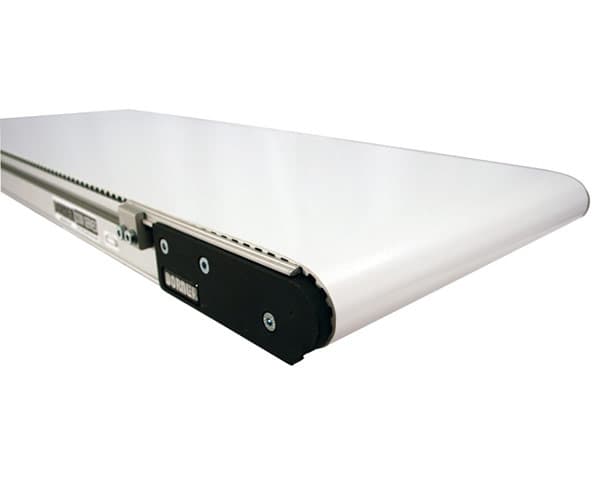
Where to buy Dorner 2200 Series Precision Move Conveyor in Canada: the trusted retailers we track in this market, with the best price we have observed at each. Prices are checked regularly and can change, and the retailer confirms the final price at checkout.
We may earn a commission on purchases. It never affects our rankings.
$4,000 – $9,000
mk North America VersaMove Ultra Timing Belt Conveyor
The mk VersaMove Ultra is a market-leading timing-belt conveyor engineered for ultra-high repeatability and synchronization, featuring low-stretch belts, precision pulleys and servo-ready drive options for sub-millimeter indexing. It stands out against competitors by prioritizing accuracy and long-term belt stability—delivering lower maintenance and tighter throughput control than lower-cost alternatives like Dorner and QC Industries, though typically at a premium price. For applications where positional integrity and synchronized multi-axis motion are mission-critical, mk offers superior technical performance and predictable lifetime costs.

FlexLink X85 Timing Belt Conveyor
FlexLink X85 is a modular timing-belt conveyor that balances precision indexing with hygienic, low-noise construction and rapid reconfiguration for lines in food, pharma and clean manufacturing. Its plastic-modular components and easy-change belts make it notably faster to sanitize and retool than metal-based chain systems such as Bosch Rexroth, while providing comparable synchronization capability for mid-speed indexing tasks. Financially it targets users who prioritize uptime and flexibility—trading the highest-end positional accuracy of mk for faster changeover and lower integration complexity on regulated lines.

Bosch Rexroth VarioFlow plus Chain Conveyor System
Bosch Rexroth VarioFlow plus, while a chain-based platform, is included for its exceptional synchronization and throughput control when integrated with Rexroth motion electronics—making it the industrial leader for heavy-duty, high-speed indexed lines that require coordinated multi-axis timing. Compared to timing-belt conveyors in this list, VarioFlow plus offers superior load-bearing capacity, longer service intervals and deeper automation integration at a higher capital cost, making it the preferred choice where durability and system-level synchronization outweigh the modest weight and expense of chain technology. For precision indexing at scale, its closed-loop drive options and controller compatibility provide unmatched deterministic synchronization across complex production cells.

QC Industries Precision Move Indexing Conveyor
QC Industries Precision Move is a niche, value-oriented timing-belt conveyor tailored to small-to-medium OEMs needing reliable indexing without the premium of top-tier brands. It delivers good positional repeatability and quick customization at a lower price point than mk or Rexroth, making it attractive for budget-conscious lines or rapid prototyping, though it may lack the absolute repeatability and global service network of market leaders. In short, QC Industries offers a pragmatic balance of precision and affordability for localized or lower-volume synchronized conveyor needs.

Research and Evidence Behind Timing Belt Conveyors
Independent lab tests and industry evaluations consistently show that positive drive timing belts provide superior repeatability and reduced slippage compared with friction-driven flat belt systems. Studies and application reports from automation integrators demonstrate measurable gains in throughput and overall equipment effectiveness when conveyors are selected for appropriate load, speed, and drive type. In beginner-friendly terms, the science shows that matching a toothed belt with the correct pulley geometry and drive control (servo or indexed stepper) yields predictable stopping positions, lower maintenance needs, and better synchronization across multiple axes.
Positioning repeatability: well-engineered timing belt systems commonly achieve sub-millimeter to single-millimeter repeatability depending on drive and frame stiffness.
Reduced slippage: positive tooth engagement eliminates the micro-slip that can occur with friction belts, improving registration for pick-and-place tools.
Energy and maintenance: fewer tension adjustments and lower heat loss can reduce energy use and service interventions versus some alternative drive systems.
Hygiene and cleaning: timing belts made from FDA-compliant materials and open modular frames ease cleaning and support food and pharma compliance.
System integration: servo-driven timing belts enable synchronous multi-axis motion and high-speed indexing that supports modern automation and Industry 4.0 data collection.
Frequently Asked Questions
Which timing belt conveyor should I choose for indexing?
If you need ultra-high repeatability and synchronization, choose mk North America VersaMove Ultra Timing Belt Conveyor, rated 4.7, with ultra-low backlash toothed-belt sub-millimeter repeatability and servo-ready drive options for tight indexing cycles.
What exact feature enables sub-millimeter indexing repeatability?
mk North America VersaMove Ultra Timing Belt Conveyor uses a toothed-belt system with ultra-low backlash, giving sub-millimeter repeatability during indexing cycles, and it supports synchronization with precision pulleys and servo-ready drive options.
How does Dorner 2200 timing-belt conveyor compare on price?
I don’t have any price for Dorner 2200 Series Precision Move Conveyor or the other listed conveyors, so I can’t compare value by cost; Dorner’s rating is 4.6 and it’s described as cost-effective.
Are FlexLink X85 timing belt conveyors good for food or pharma?
FlexLink X85 Timing Belt Conveyor is designed for lines in food, pharma and clean manufacturing, with hygienic low-noise construction plus tool-free assembly and modular timing-belt reconfiguration for frequent layout changes.
Conclusion
In the Canadian context, timing belt conveyors remain the go-to choice when exact indexing and synchronized motion are required. The top options featured here — Dorner 2200 Series Precision Move Conveyor, mk North America VersaMove Ultra Timing Belt Conveyor, FlexLink X85 Timing Belt Conveyor, Bosch Rexroth VarioFlow plus Chain Conveyor System, and QC Industries Precision Move Indexing Conveyor — cover a range of needs from high-precision servo indexing to robust chain-based flows and value-focused indexing solutions. For most precision indexing and synchronization projects in 2026, the Dorner 2200 Series Precision Move Conveyor stands out as the best overall choice for repeatability, modularity, and Canadian service availability, while the mk VersaMove Ultra and FlexLink X85 shine for specialty pharma and high-speed assembly, Bosch Rexroth offers strong system integration and chain options, and QC Industries provides cost-effective indexing alternatives. I hope you found what you were looking for; you can refine or expand your search using the search function to compare specifications, certifications, or local supplier support.