

Best Telephoto Lenses in Canada 2026: Top 2 Picks for Wildlife and Sports
Telephoto lenses are ideal for capturing distant subjects with stunning detail. Perfect for wildlife and sports photography, they allow you to shoot from afar without losing image quality. In Canada, photographers choose telephoto lenses to reach birds in boreal forests, elk in national parks, and athletes on distant fields or rinks. Popular trends for 2026 emphasize mirrorless-native telephoto options for Canon RF, Nikon Z, and Sony E mounts, improved optical stabilization, lighter carbon-fiber and magnesium alloy constructions, and wider compatibility with teleconverters. Canadian buyers also weigh weather sealing for year-round use, manageable weight for backcountry access, and value in the used and rental markets. Whether you are a hobbyist birdwatcher, a sports shooter at a local stadium, or a professional covering remote wildlife, telephoto lenses remain a core tool for sharp, high-resolution images at a distance.
Inception's AI took the time to understand this market in Canada · · How we pickWe may earn a commission on purchases. It never affects our rankings.
Top Picks Summary
The Canon RF 800mm f/11 IS STM is best-in-class for photographers who need extreme reach with minimal weight and cost — its fixed f/11 design and compact construction make handheld or gimbal use realistic compared with bulky prime and zoom super-telephotos. While it concedes light-gathering and AF speed to the faster-aperture or pro-grade zooms in this list, its price-to-reach ratio and portability give it a unique financial and practical advantage for travel and casual wildlife work.
Show More Super Telephoto Lenses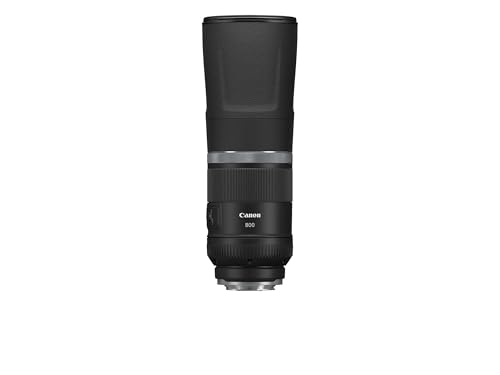
Tamron's SP 85mm f/1.8 brings a budget-conscious telephoto prime option that pairs a useful f/1.8 aperture with Vibration Compensation, offering many of the handheld and low‑light benefits of stabilized primes at lower cost. While it doesn't match the absolute speed or prestige of f/1.4 or f/1.8 flagship models, its combination of stabilization, solid optics and value positioning makes it an attractive alternative for photographers seeking an affordable, practical telephoto prime for portrait and event use.
Show More Telephoto Zoom Lenses
Estimated$1,100 – $1,400
How Telephoto Lenses Work and Why They Help
The benefits of telephoto lenses come from optical and mechanical principles that boost reach, subject isolation, and image detail. Longer focal lengths magnify distant subjects and compress perspective, while large apertures let more light reach the sensor and produce shallow depth of field for subject separation. Modern lens designs use advanced glass, coatings, and image stabilization to preserve sharpness. Research in optics and field tests show that effective stabilization and autofocus systems significantly increase keeper rates for handheld long-lens shots, and that optical quality metrics like MTF (modulation transfer function) predict real-world sharpness. Understanding these basics helps you choose lenses that match your shooting style and conditions.
Focal length increases magnification: longer lenses let you frame distant subjects without physically approaching.
Aperture affects light and depth of field: faster apertures (lower f-numbers) improve low-light performance and subject separation.
Image stabilization reduces motion blur: lab and field tests commonly show 3 to 5 stops of benefit, allowing slower shutter speeds handheld.
Autofocus systems and tracking algorithms improve subject acquisition: phase-detection and hybrid AF systems are faster and more reliable for moving subjects.
Teleconverters extend reach but trade light and resolution: expect a 1 or 2 stop loss of light and some reduction in sharpness depending on quality.
Optical quality metrics like MTF curves and real-world resolution tests help predict lens performance across focal lengths.
Frequently Asked Questions
Which telephoto lens should I pick for wildlife?
Choose the Canon RF 800mm f/11 IS STM for wildlife when you want extreme reach in a compact, lightweight 800mm prime with built-in optical Image Stabilization (IS) and a fixed f/11 aperture; it’s rated 4.5 and priced at $1,274.00 CAD
What does the Sigma 100-400mm lens range actually offer?
The Sigma 100-400mm f/5-6.3 DG DN OS Contemporary offers a 100–400mm focal-length range, paired with optical stabilization (OS) and a variable f/5–6.3 aperture; it’s rated 4.4 and costs CA$999.00.
Is the Canon RF 800mm worth paying CA$1,239.95?
At $1,274.00 CADthe Canon RF 800mm f/11 IS STM gives you a compact 800mm prime with built-in optical Image Stabilization (IS) and a fixed f/11 aperture; it’s rated 4.5 and designed for extreme reach without bulky super-telephoto size.
Does the Tamron SP 85mm include stabilization and warranty?
The Tamron SP 85mm f/1.8 Di VC USD includes built-in VC (Vibration Compensation) image stabilization, with an f/1.8 prime aperture; it’s rated 4.5 and priced at CA$699.97, but no warranty duration is provided in the data.
Conclusion
In Canada, the right telephoto lens depends on subject, budget, and how far you need to reach. We hope this guide helped you understand why telephoto lenses are so popular and what to look for when choosing one. If you did not find exactly what you need, use the site search to refine by mount, focal length, or price, or expand your search to rentals and used listings to try options before you buy.