

Top 5 Propane Heaters in Canada for 2026: Indoor-Rated vs Outdoor-Only
Short answer: if you need heat inside a Canadian garage, cabin, or ice hut, the Mr. Heater Portable Buddy MH9BX is the pick — it is the one portable here certified for use inside a ventilated enclosure. The Big Buddy MH18B is the more powerful heater, but the version Mr. Heater sells in Canada and Massachusetts is classified for outdoor use only, and the Dyna-Glo RMC-LPC80DG is a construction heater for well-ventilated jobsites. That distinction matters more than BTU. Propane burns oxygen and produces carbon monoxide, and an oxygen depletion sensor shuts the heater off when oxygen drops — it does not detect CO. Whatever you buy, run a CSA-certified CO alarm in the space and follow the label on your own unit. Below: what each of these five heaters is actually rated for, how much area it covers, and where it makes sense.
Inception's AI took the time to understand this market in Canada · · How we pickWe may earn a commission on purchases. It never affects our rankings.
Top Picks Summary
Mr. Heater Big Buddy MH18B
The Big Buddy MH18B is the highest-output portable in this roundup: three settings at 4,000, 9,000 and 18,000 BTU/hr, coverage rated to 450 sq ft, and up to 11 hours of run time on two 1 lb cylinders, or considerably longer off a 20 lb tank with the optional hose and filter. It carries an oxygen depletion sensor and a tip-over auto shut-off. The caveat that matters in Canada: Mr. Heater lists a separate Massachusetts and Canada version of the MH18B classified for outdoor use only, where the US-market unit is sold as indoor/outdoor. Treat this as an outdoor, patio, tailgate and ventilated-jobsite heater, and use the Portable Buddy MH9BX if you need heat inside an enclosure. Recent Canada and Massachusetts units have also shipped without the built-in fan, so confirm before ordering if the fan matters to you.

Estimated$300 – $400
Dyna-Glo RMC-LPC80DG
The Dyna-Glo RMC-LPC80DG is a convection tower heater with a continuously variable 50,000-80,000 BTU output, aimed at heavy-duty heating in workshops, warehouses and open or outdoor construction sites up to roughly 2,000 sq ft. Its all-steel build, matchless piezo ignition, auto safety shut-off and overheat protection make it dependable, and it needs no electricity to run. Unlike the Buddy portables it is intended for well-ventilated areas only and should never be used in a small enclosed room: CSA B149.1 calls for mechanical ventilation on the order of 300 cfm per 100,000 BTU/hr for unvented heaters, which a closed garage will not supply. Used as intended, it is the most heat per dollar on this page.

Mr. Heater Portable Buddy MH9BX
The Mr. Heater Portable Buddy MH9BX is the compact, indoor-rated portable in this group: adjustable 4,000 and 9,000 BTU settings, coverage rated to about 225 sq ft, and up to 5.6 hours on the low setting from a single 1 lb cylinder, or far longer off a 20 lb tank with the optional hose and fuel filter. It is CSA-certified for gas-fired portable heaters used in recreational and commercial enclosures, with an oxygen depletion sensor and tip-over auto shut-off. Rated for indoor use still means ventilated: leave a window or door cracked for makeup air and run a CO alarm in the space. Worth clearing up a common mix-up — the MH9BX is the Portable Buddy, not the smaller, lower-output Little Buddy, though plenty of listings use the names interchangeably.

ProCom MNSD200TBA-BB
The ProCom MNSD200TBA-BB is a vent-free wall heater with a thermostat and blower, intended as a permanently mounted supplemental heat source rather than a portable unit. Wall mounting frees floor space, and the blue-flame convection element with its blower spreads heat more evenly through a room than a bare radiant panel does. Two things to settle before buying in Canada: vent-free gas appliances are a permanent installation governed by CSA B149.1 and provincial gas rules and need a licensed gas fitter, and this listing currently routes to a US retailer, so confirm Canadian availability and certification before ordering.

Estimated$180 – $250
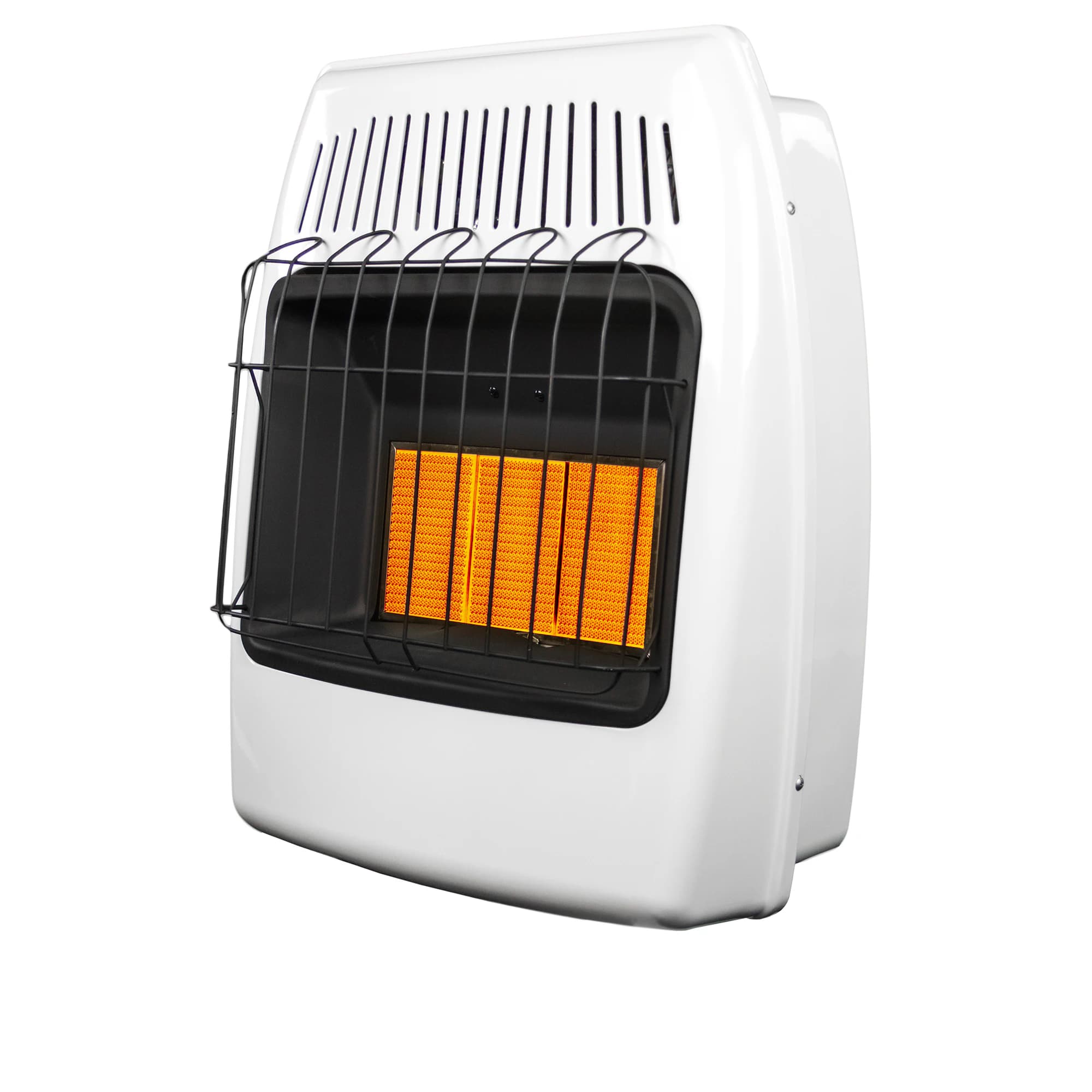
Dyna-Glo IR18PMDG-1
The Dyna-Glo IR18PMDG-1 is a vent-free infrared wall heater. Infrared warms objects and people directly instead of heating the whole air volume, so you feel it faster and it holds up better in a draughty room than a convection heater does. It needs no electricity to produce heat, which makes it useful during an outage. Like every vent-free gas appliance it is a permanent installation subject to CSA B149.1 and provincial gas rules, needs a licensed gas fitter, and vents its combustion products into the room — adequate ventilation and a CO alarm are part of the install, not optional extras.
Estimated$200 – $300
Indoor-Rated vs Outdoor-Only: The Difference That Matters Most
Propane heaters are not interchangeable, and the split that matters is not BTU — it is what the appliance is certified for. Burning propane consumes oxygen in the room and produces carbon monoxide, water vapour and nitrogen dioxide. Certification, ventilation and a CO alarm are what keep that safe, and Canadian rules differ from American ones: the same model number can carry a different rating on either side of the border.
Check the label on your own unit, not the model number. Mr. Heater sells a separate Massachusetts and Canada version of the Big Buddy MH18B that is classified for outdoor use only, while the US-market unit is sold as indoor/outdoor. Same MH18B badge, different rating.
An ODS is not a CO detector. The oxygen depletion sensor cuts the gas when room oxygen falls below roughly 18 percent. It does not sense carbon monoxide, nitrogen dioxide or soot, so a CSA-certified CO alarm is a separate, non-optional purchase.
Unvented heaters need real airflow. CSA B149.1, Canada's natural gas and propane installation code, requires mechanical ventilation for unvented infrared heaters — on the order of 300 cfm of air movement per 100,000 BTU/hr of heater capacity. A closed garage does not supply that.
Vent-free wall heaters are a permanent gas installation. The ProCom and Dyna-Glo wall units here are fixed appliances, not plug-in space heaters. The install falls under CSA B149.1 and your provincial gas authority and should be done by a licensed gas fitter; several jurisdictions restrict unvented room heaters in dwellings.
Size to the space. The manufacturers here rate coverage at roughly 40 BTU/hr per square foot — 9,000 BTU for about 225 sq ft, 18,000 BTU for 450 sq ft. That assumes a reasonably enclosed, insulated space; an uninsulated garage or an open jobsite in a Canadian winter needs more, and buying far more BTU than the room needs just burns more propane and more oxygen.
Frequently Asked Questions
Is it safe to run a propane heater indoors?
Only with a heater rated for it, real ventilation, and a carbon monoxide alarm. Propane combustion consumes oxygen and produces carbon monoxide. An oxygen depletion sensor shuts the heater off when room oxygen drops, but it does not detect CO — that requires a separate CSA-certified CO alarm. Crack a window or door for makeup air, keep the clearances printed on the label, and never run a propane heater while sleeping.
Which of these propane heaters are actually rated for indoor use in Canada?
Among the portables, only the Mr. Heater Portable Buddy MH9BX, which is CSA-certified for gas-fired portable heaters used in ventilated recreational and commercial enclosures. The Big Buddy MH18B is sold in Canada as the Massachusetts and Canada version, which Mr. Heater classifies for outdoor use only, and the Dyna-Glo RMC-LPC80DG is a construction heater for well-ventilated jobsites and outdoor use. The ProCom and Dyna-Glo wall units are vent-free appliances that must be permanently installed under CSA B149.1.
Can I use the Mr. Heater Big Buddy MH18B inside my garage?
Not the version sold in Canada. Mr. Heater lists a distinct Massachusetts and Canada version of the Big Buddy that is classified for outdoor use only, unlike the US-market MH18B which is sold as indoor/outdoor. If you need heat inside a garage, use the Portable Buddy MH9BX instead, keep a door or window cracked for makeup air, and run a CO alarm.
How many BTUs do I need for my space?
The manufacturers here rate coverage at roughly 40 BTU/hr per square foot: 9,000 BTU for about 225 sq ft, 18,000 BTU for 450 sq ft, and 80,000 BTU for around 2,000 sq ft. Those figures assume a reasonably enclosed, insulated space. An uninsulated garage, a pole barn, or an open jobsite in a Canadian winter can need well above that, while buying more BTU than the room needs simply burns more propane and more oxygen.
Conclusion
Five heaters, three different jobs. For heat inside a ventilated enclosure, the Mr. Heater Portable Buddy MH9BX is the one to buy. For outdoor and open-air warmth with more output, the Big Buddy MH18B covers up to 450 sq ft and runs up to 11 hours on two 1 lb cylinders — outdoors only in its Canadian version. For a ventilated workshop or jobsite, the Dyna-Glo RMC-LPC80DG's 50,000–80,000 BTU is the most heat per dollar here. The ProCom MNSD200TBA-BB and Dyna-Glo IR18PMDG-1 are vent-free wall heaters: permanent gas installations for a licensed fitter, not portable units. Buy a CO alarm alongside whichever one you choose.