

Top 7 Biological Filter Media for Aquariums in Canada (2025) — Guide to Faster Cycling, Improved Oxygen Access, and Reliable Biofiltration
Biological filter media are porous materials—such as ceramic rings, bio-balls, and specialized substrates—designed to maximize surface area for beneficial nitrifying bacteria that convert toxic ammonia and nitrite into less harmful nitrate. In 2026 the market in Canada favors innovations that speed bacterial colonization and improve oxygen access: engineered high-surface-area ceramics, 3D-printed lattice media, and composites optimized for flow and durability. Hobbyists and professionals alike choose these media for predictable cycling times, lower maintenance, better water stability in planted and reef systems, and options that fit local shipping and environmental preferences. Canadian buyers often prioritize long-lasting, non-toxic materials and solutions that work well with the region's common tank types—from cold-water setups to densely planted tropical aquariums—making high-efficiency, locally available biological media particularly appealing.
Inception's AI took the time to understand this market in Canada · · How we pickWe may earn a commission on purchases. It never affects our rankings.
Top Picks Summary
AquaClear BioMax Filter Insert integrates ceramic-like bio media into a compact cartridge format built for hang-on-back filters, prioritizing ease of use and predictable flow over maximum media volume. Technically it provides less loose-media surface area than Fluval or Seachem but shines for users who value tidy maintenance and filter compatibility, offering a turnkey option that can be more economical when factoring in time and labor.
Show More Ceramic Rings Biological Filter Media
Aqueon QuietFlow Bio-Balls are engineered to integrate with QuietFlow filter cartridges, offering quiet operation and space-efficient biological filtration for the Bio Balls Biological Filter Media scenario. They strike a middle ground on price and convenience—more refined and quieter than basic bio-balls but with somewhat lower long-term bacterial capacity than Fluval's ceramic rings or Seachem Matrix's engineered media.
Show More Bio Balls Biological Filter Media
Estimated$12 – $24
Eheim Substrat Pro uses sintered porous glass granules engineered for uniform particle size and predictable hydraulic characteristics, which reduces channeling and promotes even bacterial growth in canister and external filters. Against the rest of the list, Substrat Pro trades a modestly higher price for consistent flow behavior and long service life, appealing to users who prioritize stable performance and low-maintenance operation.
Show More Porous Glass Biological Filter Media
We may earn a commission on purchases. It never affects our rankings.
$24.81CAD
CerMedia MarinePure BioFilter Media Spheres
CerMedia's MarinePure spheres are high-porosity ceramic/lattice media engineered to maximize surface area per unit volume, making them a best-in-class choice for three-dimensional printed lattice biological filter media use cases where durable, long-lived colonization is required. Compared with mass-market ring media on this list, MarinePure commands a premium but delivers superior micro- and macro-porosity that accelerates nitrifying biofilm establishment and reduces media turnover costs over time. For systems prioritizing longevity and biological performance, their higher upfront cost is offset by reduced replacement and maintenance frequency versus lower-cost alternatives.
Show More Three Dimensional Printed Lattice Biological Filter Media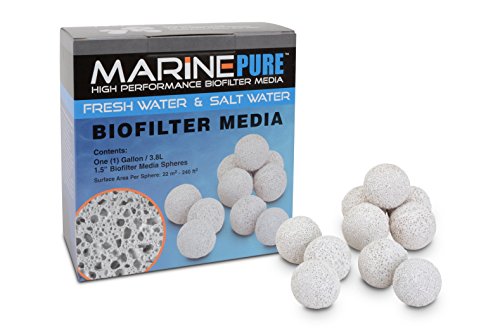
Kaldnes K1 is a moving-bed biofilm carrier made from durable engineered plastic that excels in fluidized-bed (MBBR) and fluidized reactor systems, offering excellent biofilm stability, low clogging risk, and a very favorable cost-per-liter for dynamic filtration systems. Technically distinct from porous ceramic blocks, K1’s advantage is operational flexibility and low maintenance in moving-bed applications; however, its smooth polymer construction lacks the deep internal porosity of ceramic blocks, so it typically supports less internal anoxic habitat for denitrification compared with true porous ceramics.
Show More Porous Ceramic Blocks Biological Filter Media
Marineland Biological Filter Balls are positioned as a cost-effective, easy-to-handle alternative for hobbyists looking to replicate the high surface-area benefits of lava rock without jagged edges or weight. They deliver consistent water flow and good biofilm development for nitrifying bacteria, making them a budget-friendly choice compared with the more engineered Fluval option while being simpler to manage in small- to mid-size systems than bulk SunSun media. For the lava rock use case, they offer comparable biological surface area with lower mess and easier routine cleaning, which can reduce long-term maintenance costs.
Show More Lava Rock Biological Filter Media
Plant!t Clay Pebbles focus on accessibility and user-friendly packaging — pre-washed and ready-to-use options reduce prep time for biological filters and hobbyist systems. While they may not match the ultra-high uniformity of Hydroton or Mother Earth, they outshine some competitors by lowering labor and equipment preparation costs, making them a practical choice for smaller facilities or growers. Compared with Grow!t and General Hydroponics, Plant!t prioritizes convenience and clean presentation over the lowest unit price.
Show More Expanded Clay Pebbles Biological Filter Media
Estimated$12 – $35
What the Research Says About Biological Filter Media
Scientific and applied aquaculture research consistently shows that media performance is driven by available surface area, internal porosity, and flow characteristics that influence oxygen diffusion and biofilm health. Innovations such as engineered ceramics and precision 3D-printed lattices target those same variables to improve nitrification rates and resilience against clogging. Below are beginner-friendly takeaways from the literature and industry testing that explain why certain media outperform others under specific conditions.
Surface area matters: Studies indicate that increasing effective surface area generally raises the capacity for nitrifying bacteria, improving ammonia and nitrite removal per unit volume of media.
Porosity and pore size balance: Media with internal porosity that supports both surface-attached bacteria and sufficient water flow promote stable biofilms; pores that are too small can trap debris and reduce oxygen access.
Oxygen access and flow: Research shows oxygen diffusion to biofilms is a limiting factor for nitrification. Media that maintain open channels and steady flow rates support faster and more reliable nitrification.
Material and chemistry: Ceramic and sintered glass media show stable, inert behavior over long periods; coated or composite media must be validated for leaching and long-term stability.
Engineered innovations: Preliminary studies and lab tests of 3D-printed lattice designs demonstrate improved flow distribution and colonization uniformity compared with some traditional formats, especially in compact filters.
No universal best: Scientific reviews recommend choosing media based on tank size, stocking levels, and maintenance habits—combining coarse media for mechanical pre-filtration with high-surface-area biological media often yields the best results.
Conclusion
If you are shopping for biological filter media in Canada, these top 7 options for 2026 reflect the latest advances in engineered ceramics, 3D-printed lattices, and proven traditional formats that balance surface area, flow, and durability. We hope this guide helped you narrow down the choices; if you did not find exactly what you need, use the search or refine filters to expand by tank type, material, or delivery options within Canada.