

Metal Adsorbing Granules — Canada 2025: Top 5 Tested Options and How to Choose the Right Media for Copper, Iron & Lead Removal
Metal adsorbing granules are granular adsorption media engineered to remove copper, iron, lead and other trace metals quickly from aquarium water. Favored by Canadian aquarists, aquaculture operators and reef hobbyists, these granules offer high surface area, rapid adsorption kinetics and the dosing flexibility to use in media reactors or filter bags. Consumers in Canada choose granular metal adsorbents for precise control over metal levels, predictable contact-time performance, and the ability to tailor treatment to tap water quality, municipal source variations and sensitive livestock. Availability, ease of use, regenerability and minimal impact on beneficial bacteria are primary purchasing considerations in 2025, while concerns about shipping, winter storage and product certification drive preference toward established brands with clear usage guidance.
Inception's AI took the time to understand this market in Canada · · How we pickWe may earn a commission on purchases. It never affects our rankings.
Top Picks Summary
Seachem CupriSorb
Seachem CupriSorb is positioned as a best-in-class metal-adsorbing granule because it is a purpose-built resin with a high affinity for dissolved copper and other heavy metals, making it the go-to choice when targeted metal removal is the primary objective. Compared with broader-spectrum media on this list, CupriSorb delivers more selective, efficient metal removal per gram, which can lower lifecycle cost for users dealing specifically with metal contamination.

We may earn a commission on purchases. It never affects our rankings.
$46.99CAD
Boyd Enterprises Chemi-Pure Elite
Chemi-Pure Elite is a market-leading, multi-function filtration media that combines adsorption and ion-exchange characteristics to address metals along with organics and discoloration, which makes it attractive as a single-media solution for hobbyists and professionals. While pricier than single-purpose metal resins, its breadth means you often replace several products with one cartridge, offering technical and financial advantages for aquarists who need broad water polishing in addition to metal control.

Estimated$25 – $60
Two Little Fishies MetaSorb
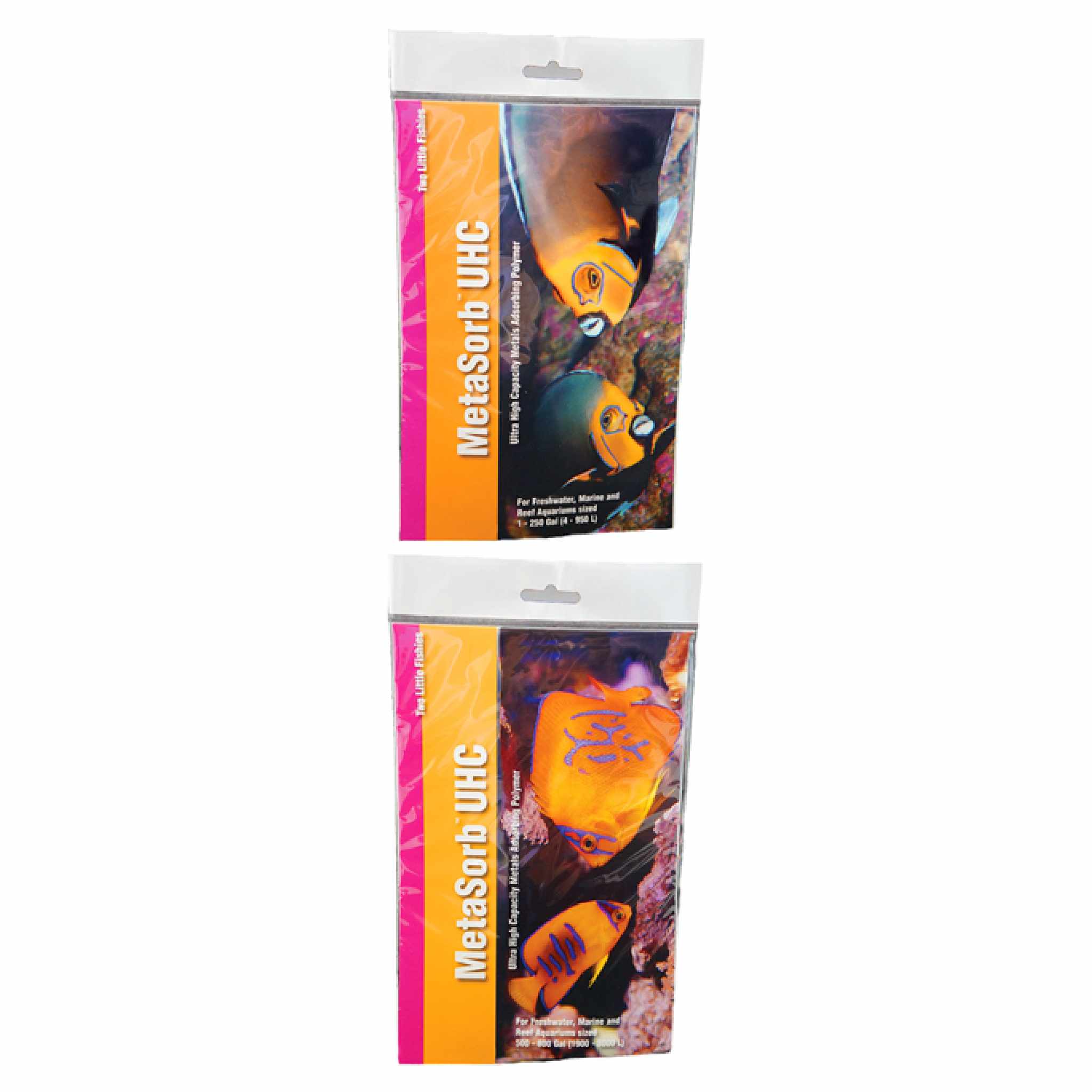
MetaSorb is a focused metal-adsorbing granule designed to remove a range of dissolved heavy metals quickly and affordably, positioning it as a cost-competitive alternative to specialized resins like CupriSorb. It typically appeals to users who want effective metal removal without the premium price of multi-function media, though it does not replace the broader organics- and discoloration-control offered by market leaders like Chemi-Pure Elite.
Seachem Purigen
Seachem Purigen is a synthetic adsorbent best known for removing soluble organic waste and polishing water clarity rather than for direct metal chelation, but it plays an important complementary role in a metal-adsorbing granules strategy by stripping organic ligands that otherwise bind metals. Used alongside dedicated metal resins, Purigen can extend resin life and improve overall performance, delivering indirect financial value by reducing replacement frequency for metal-targeted media.

We may earn a commission on purchases. It never affects our rankings.
$15.99CAD$18.99
20% below its usual priceUsual price $19.99: the median of the daily prices we observed at this store over the last 60 days, 29 days of dataAPI Bio-Chem Zorb
API Bio-Chem Zorb is an economical granular adsorbent geared toward routine maintenance tasks such as removing organics, discoloration and odors; it serves as a budget-friendly option for bulk or regular exchanges. While Zorb is useful for general water quality upkeep, it is less selective for dissolved metals than the dedicated metal-adsorbing granules on this list, so its main advantage is cost-effectiveness for broad, non-specialized treatment.

We may earn a commission on purchases. It never affects our rankings.
$17.09CAD
10% below its usual priceUsual price $18.99: the median of the daily prices we observed at this store over the last 60 days, 28 days of dataWhat the Science and Tests Say About Metal Adsorbing Granules
Research and lab evaluations of granular metal adsorbents focus on adsorption mechanisms, capacity, kinetics and operational factors that matter to hobbyists. At a practical level, studies show that metal-specific granular media remove trace cations through adsorption and ion-exchange or chelation processes, deliver measurable reductions in copper and iron within hours under proper contact conditions, and perform best when particle size, flow rate and pH are matched to the target metal. Evidence from bench-scale tests and manufacturer data sheets highlights differences in capacity (mg of metal per gram of media), regenerability (chemical rinse or salt flush methods) and selectivity when competing ions are present. For new users, the key takeaways are how quickly a chosen granule will reduce metal concentration, whether it can be safely regenerated for multiple cycles, and how to size reactors or bags for predictable results.
Mechanism: Most granules work by adsorption, ion exchange or chelation—removal efficiency depends on surface chemistry rather than bulk porosity alone.
Kinetics: Many metal-specific granules reduce copper and iron concentrations within hours at recommended flow/contact times; finer granules increase speed but may raise pressure drop.
Capacity: Adsorption capacity is reported as mg-metal/g-media; higher capacity reduces replacement frequency but may cost more upfront.
pH and competition: Removal efficiency changes with pH and presence of other cations (calcium, magnesium); test water parameters before selecting media.
Regeneration: Some products can be regenerated using manufacturer-recommended acid or salt rinses; regeneration affects long-term cost and waste handling.
Practical tests: Bench and hobbyist tests commonly use ICP or colorimetric kits to verify reductions; routine testing in the first 24–72 hours confirms expected performance.
Frequently Asked Questions
Which granules should I choose for copper removal only?
Choose Seachem CupriSorb for targeted dissolved copper removal, since it’s a purpose-built chelating resin specifically formulated to selectively remove dissolved copper and other heavy metals; it rates 4.5 and costs $140.18 CAD
Does Two Little Fishies MetaSorb remove lead or zinc?
Yes—Two Little Fishies MetaSorb is engineered to target a spectrum of heavy metals including copper, lead, and zinc; it’s a fast-acting granular resin for reactors and media bags, with a 4.2 average rating.
Is Boyd Chemi-Pure Elite worth CA$64.99 for metals?
Boyd Enterprises Chemi-Pure Elite costs CA$64.99 and is a multi-function media combining adsorption and ion-exchange to remove metals plus organics and discoloration, rated 4.6, making it a single-media option for broad filtration needs.
What fitting options do CupriSorb and MetaSorb support?
Seachem CupriSorb and Two Little Fishies MetaSorb both come in small granular form for use in canisters, reactors, or media bags; CupriSorb lists CA$13.97 with a 4.5 rating, while MetaSorb rates 4.2.
Conclusion
In Canada, metal adsorbing granules are a compact, flexible solution for controlling copper, iron, lead and similar contaminants in both freshwater and marine systems. The five options highlighted here — Seachem CupriSorb, Boyd Enterprises Chemi-Pure Elite, Two Little Fishies MetaSorb, Seachem Purigen, API Bio-Chem Zorb — cover a range of approaches from metal-specific adsorption to broader chemical polishing. For most Canadian hobbyists balancing availability, capacity and clear usage instructions, Seachem CupriSorb is often the best choice overall thanks to its targeted performance and broad distribution; however, Boyd Enterprises Chemi-Pure Elite and Two Little Fishies MetaSorb remain excellent alternatives where multi-purpose removal or reactor compatibility is preferred, and Seachem Purigen or API Bio-Chem Zorb can be useful for complementary polishing tasks. I hope you found what you were looking for — if you want to refine or expand your search by target metal, aquarium size or reactor type, use the site search to narrow results or explore related media options.