

Top 8 Range of Motion Machines in Canada for 2025 — Motorized and Passive Devices for Shoulders, Knees, Wrists, and Ankles
Range of motion machines are motorized or passive rehabilitation devices designed to restore and maintain joint mobility after surgery, injury, or prolonged immobilization. Popular for shoulders, knees, wrists, and ankles, these systems offer programmable speeds, adjustable angles, and controlled cycles to ensure safe, incremental gains in joint excursion. In Canada, demand is driven by an aging population, rising elective surgeries, longer physiotherapy wait times, and growing interest in effective at-home rehabilitation. Consumers and clinicians look for machines that combine clinical efficacy with ease of use, portability, clear programming interfaces, strong safety features, reputable warranties, and evidence-based design. Whether used in hospital outpatient clinics, home care, or rehabilitation centers, modern range of motion machines aim to reduce stiffness, improve circulation, limit scar formation and contractures, and support faster functional recovery while helping patients adhere to consistent therapy plans.
Inception's AI took the time to understand this market in Canada · · How we pickWe may earn a commission on purchases. It never affects our rankings.
Top Picks Summary
Artromot S3 Comfort emphasizes German-engineered precision and patient comfort with very quiet operation, finely graded range-of-motion steps, and safety-focused limit sensing. Technically it outperforms many mid-market devices on control accuracy and ergonomics, though it typically commands a premium compared with simple, value-oriented models like Danniflex. For surgical centers and rehab facilities that prioritize precision dosing of motion and superior patient experience, the S3 Comfort represents a higher-cost but clinically focused option.
Show More Shoulder Continuous Passive Motion (CPM) Devices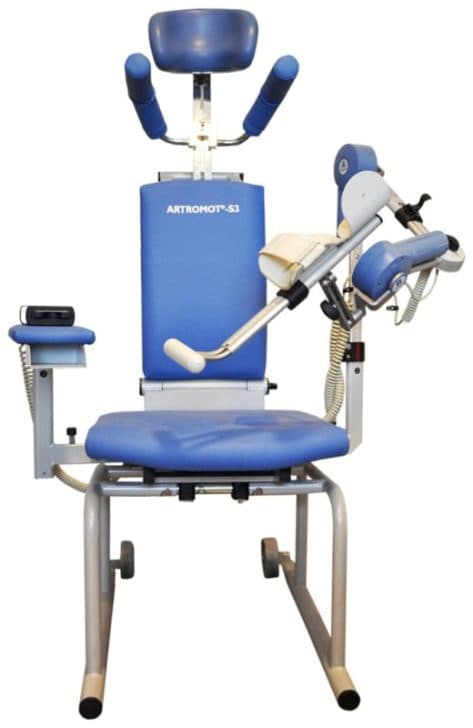
Estimated$7,000 – $11,000
The Kinetec Prima Advance sits between entry-level and high-end Knee Continuous Passive Motion (CPM) Devices as a feature-rich Kinetec model that emphasizes patient comfort and expanded customization without the top-tier price of some competitors. Relative to the Spectra Essential, the Prima Advance adds more programmable options and comfort-oriented adjustments, and it competes with the Chattanooga OptiFlex 3 by offering similar clinical flexibility at a price point that is often perceived as more cost-competitive for medium-sized clinics. Its technical strengths are in enhanced presets and ergonomic design that aim to improve patient tolerance and throughput while containing capital expenditure compared with the most advanced market offerings.
Show More Knee Continuous Passive Motion (CPM) Devices
Estimated$3,000 – $5,000
The CanDo Digi‑Flex Hand Exerciser is a low-cost, clinically popular set of independently adjustable finger resistance pistons designed to build active range of motion and finger strength; its simplicity and per‑digit adjustability make it a versatile choice for progressive rehabilitation. Financially it undercuts motorized systems like the Kinetec while providing more targeted strengthening than general elastic tools such as the FlexBar, and it is often favored for graduated finger ROM therapy in both clinic and home settings. Compared to ergonomic squeezers like the Rolyan, the Digi‑Flex gives therapists precise, incremental resistance for each finger without needing electronics or power.
Show More Wrist and Hand Range of Motion Therapy Devices
We may earn a commission on purchases. It never affects our rankings.
$22.28CAD
ProStretch Plus Adjustable Calf and Foot Stretcher
ProStretch Plus is an adjustable, low-profile calf and foot stretcher designed for progressive dorsiflexion and plantarflexion stretching; its stepwise angle settings make it a cost-effective choice for home users who need more control than a simple rocker. Compared with clinic-grade devices in this list, it strikes a balance between price and functionality, offering greater adjustability than basic rollers while being more affordable than heavy-duty slant boards or specialty hamstring systems.
Show More Ankle and Foot Range of Motion Therapy Devices
The Biodex System 4 Pro is the market-leading multi-joint programmable range-of-motion system, prized for its mature software ecosystem, wide library of validated protocols, and high-precision isokinetic testing capabilities that support both clinical and research workflows. It commands a premium price compared with some competitors but delivers higher throughput, tighter calibration, and a broader test battery than lower-cost alternatives like Kinetec or HUMAC NORM, making it the go-to choice when accuracy and multi-joint automation are mission-critical.
Show More Multi Joint Programmable Range of Motion Systems
Estimated$120,000 – $160,000
The ChiSoft Neck Traction Device is an entry-level, lightweight traction solution aimed at budget-conscious users who need short-term relief and modest improvement in cervical spine range of motion. Its financial advantage is low upfront cost and wide availability, but this comes with compromises in precision, durability and clinical support compared with higher-end options like Saunders and the therapeutic Posture Pump. For patients seeking an inexpensive, portable ROM aid rather than a clinic-grade machine or disc-hydration system, ChiSoft is a practical, economical choice.
Show More Motorized Active Assisted Joint Motion Devices
The ARTROMOT K1 Comfort stands out for its compact, ergonomic design and patient-centered comfort features, which make it one of the most genuinely portable units for in-home rehabilitation. Technically it emphasizes lightweight construction and quiet operation compared with bulkier clinic-focused devices like the OptiFlex 3, and financially it targets mid-range buyers seeking clinical functionality with strong mobility and ease-of-use.
Show More Portable Range of Motion Units
Estimated$2,500 – $4,000
Kinetec Spectra Decisive CPM System
The Kinetec Spectra Decisive CPM System is positioned as a robust clinic-grade continuous passive motion device, valued for its durable build and streamlined operation that make it a cost-effective core option for post‑operative passive ROM protocols. Compared with the JTECH Commander Echo’s active functional testing focus and David Health Solutions EVE’s integrated digital rehab platform, the Spectra Decisive stands out for lower ongoing maintenance costs and simplicity of use in high-volume orthopedic settings where passive mobilization is the primary clinical need.
Show More Clinic Grade Stationary Range of Motion Systems
Estimated$3,000 – $6,000
What Research Says About Range of Motion Machines
Scientific studies and clinical reviews have investigated continuous passive motion and other motorized range of motion protocols across different joints and surgical contexts. Results vary by joint, timing, and patient population, but overall the research supports specific, early, and controlled joint motion as a useful tool for improving short-term range of motion, reducing stiffness, and supporting tissue healing when applied alongside standard rehabilitation. Clinicians typically combine these devices with active physical therapy, pain management, and progressive strengthening.
Total knee arthroplasty: Multiple randomized controlled trials and meta-analyses show that continuous passive motion can improve early knee flexion and reduce the need for manipulation under anesthesia in some patients, although long-term differences in final range of motion may be small when compared with active therapy.
Shoulder and rotator cuff rehabilitation: Early controlled passive motion after certain shoulder procedures can help maintain joint mobility and reduce stiffness in the early postoperative period; outcomes depend on surgical protocol and timing.
Cartilage and tendon healing: Preclinical studies and some clinical reports indicate that controlled motion promotes nutrient diffusion, reduces adhesions, and may support better tissue remodeling compared with prolonged immobilization.
Pain and swelling: Gentle, repeated joint motion can improve circulation and lymphatic drainage, which may reduce postoperative swelling and perceived pain when used with multimodal pain management.
Practical evidence: The best outcomes are seen when range of motion machines are prescribed as part of a structured rehabilitation plan, with appropriate settings, duration, and clinician oversight—rather than as a standalone treatment.
Frequently Asked Questions
Which range of motion machine suits shoulder rehab best?
Artromot S3 Comfort is a strong choice for shoulder work because it combines padded patient supports, high-precision smooth-drive micro-adjustments, and comprehensive safety limit sensing, with an average rating of 4.4.
What exact control capability does Chattanooga OptiFlex 3 offer?
Chattanooga OptiFlex 3 Knee CPM provides advanced programming with multiple therapy modes plus precise speed and ROM control, and it includes Autopilot presets, rated 4.3 on average.
How does Rolyan Ergonomic Hand Exerciser pricing compare?
Rolyan Ergonomic Hand Exerciser lists at CA$19.50 and is designed for comfortable, repeatable grip and pinch strengthening for functional hand range of motion, with an average rating of 4.3.
Is Artromot S3 Comfort better for comfort and safety?
Artromot S3 Comfort emphasizes very quiet operation, cloud-soft padding, ergonomic cradle support, and safety-focused limit sensing, with an average rating of 4.4.
Conclusion
This collection highlights the top range of motion machines available to Canadian buyers in 2026 and explains why these devices remain an important part of post-surgical and injury rehabilitation. We hope you found the overview and research summary helpful. If you want to refine or expand your search by joint, price range, portability, or clinic-grade versus home-use models, use the search or filters to narrow results and find the best machine for your needs.