

Top 5 Collaborative Robotic End of Line Cells in Canada for 2026
Collaborative robotic end of line cells are cobotic solutions that safely work alongside operators for tasks like case packing, palletizing assistance and light depalletizing, offering easy programming and fast redeployment. These cells are ideal for low to medium throughput lines, flexible production and ergonomic risk reduction. In Canada, manufacturers, contract packers and logistics operations choose collaborative cells because they balance automation performance with operator safety, lower integration costs, and fast return on investment. Canadian buyers favor systems with strong local support, compliance with recognized safety standards such as ISO 10218 and ISO/TS 15066, and platforms that integrate with common conveyor, vision and gripping options. Other drivers in the market include labor shortages in many regions, demand for flexible lines that can changeover quickly, and increased focus on workplace ergonomics and injury reduction.
Inception's AI took the time to understand this market in Canada · · How we pickWe may earn a commission on purchases. It never affects our rankings.
Top Picks Summary
Universal Robots UR10e Palletizing Cell
Universal Robots' UR10e Palletizing Cell is best-in-class for flexible, quick-to-deploy collaborative end-of-line palletizing thanks to the UR10e's 10 kg capacity, intuitive Polyscope programming and large UR+ ecosystem of certified peripherals. Compared with heavier industrial brands such as FANUC or ABB it offers lower upfront cost and faster ROI for low-to-mid volume lines, while providing more out-of-the-box integration than tooling-focused vendors like Robotiq.

Estimated$80,000 – $180,000
FANUC CRX-10iA Collaborative Palletizer
FANUC's CRX-10iA Collaborative Palletizer is a market-leading choice where industrial robustness and high-throughput consistency are required, combining FANUC's proven motion control with collaborative safety features for 10 kg-class palletizing. It typically delivers higher uptime and more deterministic cycle times than lightweight cobots (Universal Robots, Doosan) and trades a higher capital cost for lower operational risk compared with retrofit, tooling-only solutions such as Robotiq.

Estimated$100,000 – $220,000
ABB GoFa CRB 15000 Palletizing Solution
ABB's GoFa CRB 15000 Palletizing Solution provides a higher-payload collaborative option well suited to heavier end-of-line packs, offering roughly 15 kg payload capability plus deep PLC and fieldbus integration for industrial lines. Its technical advantage is greater reach and payload compared with UR10e and some other cobots, which supports higher throughput but typically at a premium versus more modular or lower-cost offerings like Robotiq or Doosan.

Estimated$120,000 – $300,000
Robotiq Palletizing Solution
Robotiq's Palletizing Solution packages grippers, conveyors and intuitive palletizing software to convert collaborative arms into turnkey end-of-line cells, excelling as a low-integration-cost retrofit for mixed-brand fleets. Financially it undercuts full-system robot suppliers by focusing on tooling and software rather than selling robots, making it the most cost-effective path to automated palletizing when customers already have cobots from Universal Robots, Doosan or others.

We may earn a commission on purchases. It never affects our rankings.
Estimated$60,000 – $150,000
Doosan M1013 Collaborative Robot Cell
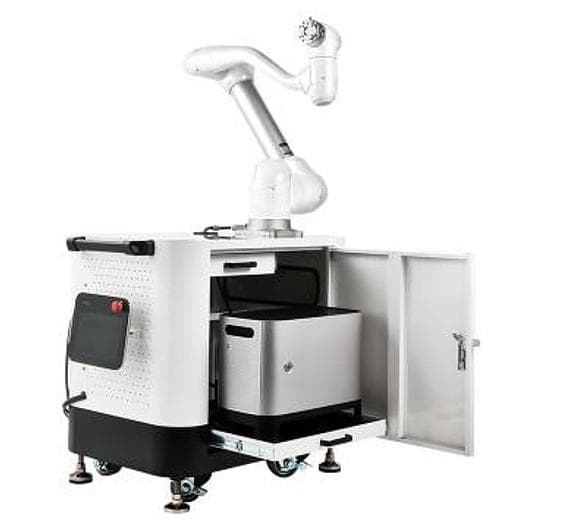
Doosan's M1013 Collaborative Robot Cell delivers a competitively priced 10 kg-class cobot with strong torque sensing and integrated safety, positioning it as a value-focused option for small-to-medium palletizing cells. It competes directly with Universal Robots on affordability and ease of deployment while usually undercutting larger incumbents (ABB, FANUC) on upfront capital, and it offers a more complete cell package than purely tooling vendors like Robotiq.
Estimated$70,000 – $160,000
What Research Says About Cobotic End of Line Cells
Scientific and industry research supports the benefits of collaborative robots for end of line tasks in productivity, safety and ergonomics. Studies from ergonomics research, manufacturing case studies, and industry analyses show that cobots can reduce repetitive strain, shorten payback times on capital, and enable faster redeployment compared with traditional rigid automation. Research also emphasizes that safety is a system-level outcome requiring proper risk assessment, guarding where needed, and validated programming to achieve the full collaborative advantage.
Ergonomics and injury reduction: Occupational health studies report reductions in musculoskeletal disorder risk when repetitive or heavy tasks are automated or shared with robots.
Productivity and ROI: Industry case studies commonly report throughput gains and payback periods from 6 to 24 months for low to medium volume palletizing and case packing when the right cell design and tooling are used.
Flexibility and redeployment: Research on flexible automation shows collaborative cells minimize changeover time and lower the total cost of ownership in plants with frequently changing SKUs.
Safety standards and best practices: Guidance from ISO 10218 and ISO/TS 15066, along with documented safety assessments, underpin safe collaborative deployments when speed and separation monitoring are combined with proper end effector design.
Human and machine collaboration: Studies in human-robot interaction highlight improved operator satisfaction and reduced fatigue when cobots are used to assist rather than replace skilled staff.
Frequently Asked Questions
Which palletizing cell should I buy for flexible lines?
Choose the Universal Robots UR10e Palletizing Cell if you need a flexible, quick-to-deploy end-of-line palletizing setup, with a 12.5 kg payload, ~1300 mm reach, intuitive Polyscope programming, and a 4.4 average rating.
What payload and reach does the UR10e cell offer?
The Universal Robots UR10e Palletizing Cell lists a 12.5 kg payload and ~1300 mm reach, with user-friendly teach pendant support and an average rating of 4.4.
How does ABB GoFa CRB 15000 compare on value?
The provided data doesn’t include a price for the ABB GoFa CRB 15000 Palletizing Solution, but it cites a higher ~15 kg payload capability and mentions PLC and fieldbus integration for heavier end-of-line packs.
Is the FANUC CRX-10iA meant for high-throughput palletizing?
Yes—the FANUC CRX-10iA Collaborative Palletizer is positioned for industrial robustness and high-throughput consistency, with a 10 kg payload, integrated safety systems, and an average rating of 4.3.
Conclusion
If you are evaluating collaborative robotic end of line cells in Canada, this list highlights five strong options for 2026: Universal Robots UR10e Palletizing Cell, FANUC CRX-10iA Collaborative Palletizer, ABB GoFa CRB 15000 Palletizing Solution, Robotiq Palletizing Solution, and Doosan M1013 Collaborative Robot Cell. Each system has strengths for low to medium throughput, flexible production and ergonomic risk reduction; the Universal Robots UR10e Palletizing Cell stands out as the best overall choice for many Canadian buyers because of its mature ecosystem, ease of programming, and broad third-party tooling support. We hope you found what you were looking for. You can refine or expand your search using the site search to compare specifications, local integrators, and case studies relevant to your facility.